Pak’s ‘Renewed Respectability’ A Foreign Policy Failure: Congress
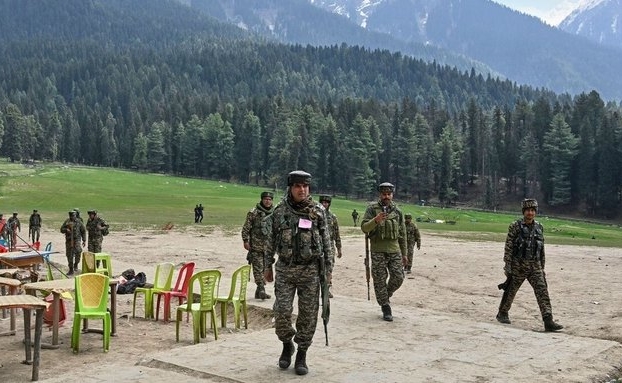
Soldiers patrol Baisaran meadow near Pahalgam after a terror attack on April 22, 2025, left 26 people dead. The Congress has termed Pakistan's 'renewed respectability' since the Pahalgam attack a year ago as a failure of India's foreign policy
On the first anniversary of the deadly Pahalgam terror attack, the Indian National Congress on Wednesday launched a sharp and pointed attack on the Centre, accusing it of allowing Pakistan to regain “respectability” on the global stage despite its continued role in sponsoring terrorism. The opposition party framed this shift as a direct indictment of the foreign policy approach of Prime Minister Narendra Modi, arguing that diplomatic posturing had failed to translate into sustained international pressure on Islamabad.
In a strongly worded post, Congress general secretary (communications) Jairam Ramesh described April 22 as “a day of great pain and intense anguish for every Indian,” recalling the horrific attack in Jammu and Kashmir’s Pahalgam that claimed the lives of 26 people, most of them tourists. “Exactly a year ago, the terror attack orchestrated by Pakistan took place in Pahalgam. Our thoughts are with the bereaved families,” he said, underscoring both the emotional and national significance of the tragedy.
Ramesh also drew attention to individual acts of courage during the attack, noting, “We also recall the bravery of the young local ponywallah who was shot dead while trying to save a tourist.” The reference was meant to highlight not just the brutality of the attackers but also the human cost borne by ordinary citizens caught in acts of terror.
Questions Over Security Lapses and Government Accountability
Beyond remembrance, the Congress used the occasion to raise uncomfortable questions about accountability and preparedness. Ramesh pointed out that the Lieutenant Governor of Jammu and Kashmir had acknowledged an intelligence failure in the lead-up to the attack. “It is not clear what action was taken on this admission,” he said, adding that while “the killers themselves were brought to justice a few months later,” the systemic lapses that enabled the attack remain insufficiently addressed.
This line of criticism reflects a broader opposition argument that the government has been more focused on optics than on institutional reform. By emphasizing the lack of clarity around follow-up action, the Congress sought to portray the response as reactive rather than preventive. The implication is that while swift retaliation may deliver short-term political messaging, it does little to address deeper vulnerabilities in intelligence coordination and counter-terror infrastructure.
The attack itself was carried out by Lashkar-e-Taiba, a Pakistan-based terror group long accused of orchestrating cross-border violence in India. In response, India launched a retaliatory operation, “Operation Sindoor,” targeting what it described as terror and military infrastructure in Pakistan and Pakistan-occupied Kashmir. However, for the Congress, the effectiveness of such actions must be measured not only by immediate outcomes but also by their long-term strategic impact.
“Global Respectability” for Pakistan and a Call for Policy Reset
Perhaps the most stinging criticism from the Congress came in its assessment of India’s foreign policy trajectory over the past decade. Ramesh drew a stark contrast between Pakistan’s global standing after the 2008 Mumbai attacks and its current position. “Pakistan stood isolated after the Mumbai attacks in November 2008,” he said, recalling a period when international pressure on Islamabad was at its peak.
He went on to describe Pakistan’s continuing internal challenges, stating that “its economy remains in shambles, dependent on external support,” and that “its politics is dysfunctional and the Army continues to call the shots.” Yet, despite these structural weaknesses, Ramesh argued that the country has managed to rebuild its international image. “Today, that very same failed state… has now acquired a new global respectability,” he said.
For the Congress, this development is not incidental but symptomatic of a deeper failure in India’s diplomatic strategy. Ramesh was explicit in his criticism: this shift reflects “a complete failure of the substance of the prime minister’s foreign policy and the self-glorifying style of his diplomatic engagement.” The remark underscores a long-standing opposition critique that the government prioritizes high-visibility international engagements and personal diplomacy over consistent, behind-the-scenes coalition-building.
The party also questioned whether the government is willing—or even capable—of recalibrating its approach. “Should he reset? Of course, yes. Will he reset? Most certainly he will not,” Ramesh said, suggesting a lack of political will to acknowledge shortcomings or pursue course correction.
This call for a “reset” in foreign policy is rooted in the belief that India must adopt a more sustained and strategic approach to isolating state sponsors of terrorism, rather than relying on episodic responses. The Congress argues that diplomatic success should be measured by tangible outcomes—such as continued global pressure on Pakistan—rather than symbolic gestures or high-profile summits.
As the anniversary of the Pahalgam attack brings back painful memories, it has also reignited a broader political debate about national security, accountability, and India’s place in the world. While the government has defended its record, pointing to decisive military responses and international engagement, the opposition remains unconvinced, insisting that the re-emergence of Pakistan on the global stage raises serious questions.
In the end, the Congress’s critique goes beyond a single incident or policy decision. It is an attempt to frame the government’s overall approach as reactive, personality-driven, and ultimately ineffective in achieving long-term strategic goals. Whether this argument gains wider traction remains to be seen, but it ensures that the conversation around Pahalgam is not limited to remembrance alone—it is also about reckoning.