Reasons Why India’s Tree-Planting Programmes Are Falling Short
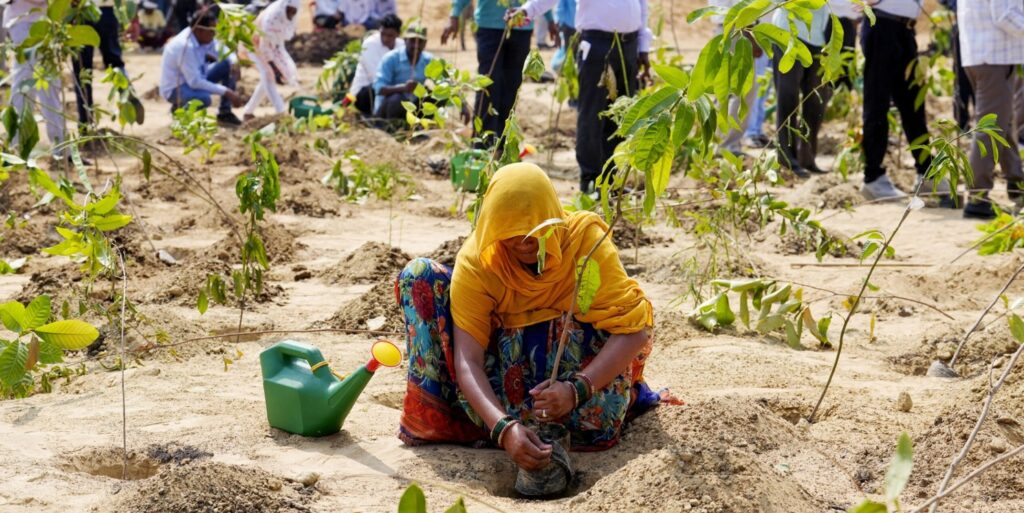
Uttar Pradesh government employees plant saplings as part of an annual tree plantation campaign in Lucknow (Representative image; AP Photo/Rajesh Kumar Singh)
- A new study examined eight major government schemes and programmes aimed at increasing tree cover and their impact.
- Only one programme, which directly targets agroforestry uptake, showed strong positive associations with tree cover.
- The study authors recommend that tree-planting programmes prioritise community livelihoods and their forest rights along with biodiversity protection.
For many countries, including India, increasing tree cover has become a core part of climate mitigation plans to improve biodiversity and ecosystems. From tree planting drives and festivals such as the annual Van Mahotsav, where India pledges to plant millions of tree saplings, to tree plantation programmes such as the Green India Mission (GIM), National Afforestation Programme (NAP), and Sub-Mission on Agroforestry (SMAF), afforestation is high on the priority list of solutions. However, a question that often arises is: how effective are these initiatives?

A new study, published in the journal Environmental Research Communications, attempts to answer this question by examining eight major government policies and programmes and their impact on tree cover, focusing on trees outside forests (ToF).
Many of these programmes operate with state funding, which means citizens’ tax money supports various initiatives. Therefore, it’s important to understand how this funding is actually being used, says Pooja Choksi, researcher and founder of Ficus Research Consulting, and co-author of the study.
Moreover, India has one of the largest land and forestry-based Nationally Determined Contributions (NDCs) — a country’s plans to reduce greenhouse gas emissions. “This creates enormous pressure: achieving these targets requires significant behavioural and land-use changes from citizens, because only limited land is government-owned, and primarily forests,” she explains.
This also leads to a critical question. “How will we realistically meet these NDCs using current (tree planting) programmes, especially when new programmes are introduced every few years?” Choksi asks.
Why agroforestry seems to work
The study authors examined whether the funding for tree plantation programmes (from 2013 to 2019) resulted in tree cover change (from 2017 to 2023) and found that programmes that directly target agroforestry uptake, such as SMAF, show consistent and strong positive associations with tree cover.

A key reason why SMAF seems to be working, at least on land outside of government-owned forests, is that it directly incentivises tree planting on farmland, the authors note. Choksi explains that agroforestry might be heavily promoted because most people plant trees for direct utility value. “This naturally means people choose species that provide certain ecosystem services,” she says.
SMAF offers flexible options: peripheral boundary planting, alley cropping, full plantation, or horticulture, with varying planting densities. Furthermore, the way SMAF works requires states to assess their needs, analyse what will work in their context, and then approach the centre with a funding request based on that analysis, she says. In other words, states aren’t simply being blindly handed funds that must be spent in a certain time period. They are doing the analytical work first, she adds.
Programmes succeed when people have a direct economic stake in the outcome, Pushpendra Rana, a forest officer with the Himachal Pradesh Forest Department, explains. In successful agroforestry regions, farmers can see that if they grow a particular plant for five to 10 years, they will receive concrete benefits, he says. Rana is not associated with this study.
The authors also note that emerging evidence from Southeast Asia also shows that a reduction in deforestation is attributed to agroforestry in the short term. Therefore, policies such as SMAF could help decrease the pressure on existing forests for timber and non-timber products by providing alternatives on private land.
What major tree planting programmes lack
The study showed that many of India’s major and expensive tree planting programmes, such as the Compensatory Afforestation Authority (CAMPA), the NAP, GIM, and the RKVY, show no association or a negative association with tree cover outside forests.
Choksi says that they make no definitive claims that tree-planting programmes outside forests are ineffective. However, the results indicate that many such programmes may not be achieving their intended outcomes in non-forest areas, including degraded and barren lands as well as forests that are already protected.
“The programmes that underperform are primarily those targeting larger land patches, like NAP working through JFM (Joint Forest Management). JFM typically operates on larger community-managed land, and that’s where we saw no significant impact of the expenditures,” she says.
A crucial finding is that GIM, a well-known programme aimed at increasing tree cover and improving biodiversity and with a significant budget, didn’t show a significant impact outside of legally defined forests. The authors find this “especially concerning” since GIM is a part of the country’s international restoration and climate mitigation commitments.
According to the latest India State of Forest Report (ISFR), published by Forest Survey of India (FSI) in 2023, GIM is working in the legally defined forest areas, as the report shows that the tree cover has increased. However, Choksi questions the nature of the tree cover that is increasing. “In such reports, the data is quite coarse at the India-wide scale. We don’t have access to fine-scale data on what species were planted, their density, what shrubs were included, and species diversity. Without this information, we can’t know the true impact of the programme,” she says.
Talking about RKVY, which also has a tree planting component, Choksi says people may not have been going for it, but for other components such as the fertiliser subsidy. In 2023, the Sub-Mission on Agroforestry (SMAF) was restructured as an agroforestry component under Rashtriya Krishi Vikas Yojana (RKVY). “Now with SMAF coming under RKVY, it’ll be interesting to see whether there’s a larger uptake of this tree planting component as opposed to the other more intensive agricultural subsidies component,” she says.
Another challenge in tree planting is how the CAMPA policy is implemented. The policy states that one must replant trees in the same forest range where deforestation occurred. “But that’s often not possible; there simply isn’t enough degraded forest land available for continuous replanting. So what’s happening is you’re cutting down forests in Andaman and Nicobar and then replanting them in Haryana, it’s not going to work because they have different fauna,” Choksi further explains.
A look at the gaps
The effectiveness of tree-planting programmes depends entirely on their design, Rana says and points out that most have a top-down approach in terms of implementation. He explains with the example of setting annual targets, such as planting a certain number of saplings within a specific timeline.
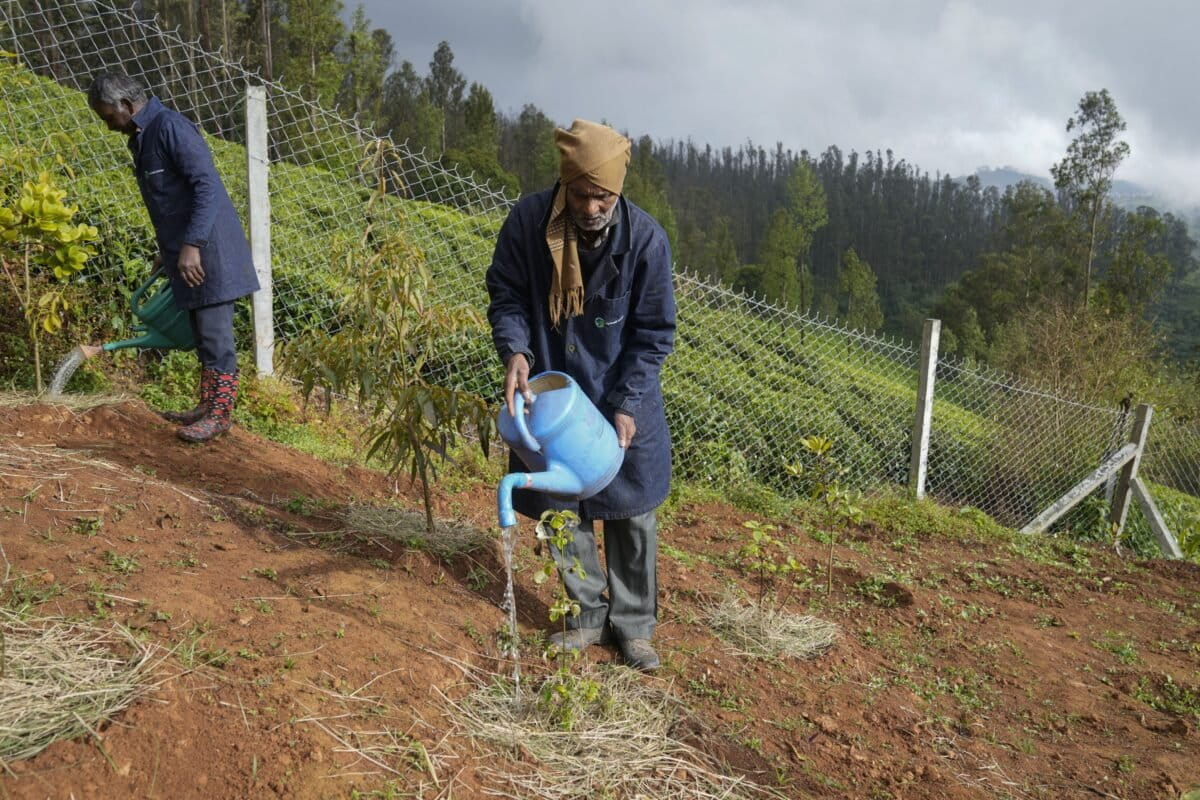
“This often happens without flexibility or consideration of local conditions or prior learning from old planting programmes or effective contributions from local forest resource-dependent communities. This rigid, target-driven approach is flawed, which is a reason for the failure of the programmes,” he says.
Dhanapal G, an environmental researcher who studied forest landscape restoration for his doctorate from the University of Manchester, points out that the (Indian) government measures success solely by tree canopy cover.
“There are very few studies, such as a 2021 study published in Nature Sustainability, evaluating whether tree-planting actually improves biodiversity, helps local communities, or damages grassland ecosystems. Government reports claim success in tree cover, but don’t assess actual environmental or social outcomes. This is a major gap,” shares Dhanapal, who researches forest landscape restoration and climate change adaptation.
Most forest departments plant fast-growing commercial species, specifically teak and eucalyptus, Dhanapal says. These grow quickly and have commercial value. However, local tribal and forest communities depend on native trees such as mahua, tendu, and sal. “When monocultures replace these native species, communities lose their traditional livelihoods. Yet government statistics show tree cover improved,” he explains.
Dhanapal further expresses concern about trees being planted on grasslands and open forest areas, ecosystems that should remain intact. “Researchers have repeatedly warned that grasslands are distinct ecosystems with their own biodiversity value and should be protected. Planting trees on them destroys habitat.”
While tree-planting programmes are well-funded, the success depends on how well these are utilised. Referring to his 2022 study, Rana says that about half the total expenditure on tree-planting programmes in Himachal Pradesh is directed to areas that already have tree cover or where conditions are unsuitable for planting. “Of the remaining 50%, a large proportion may also not survive because we do not account for community needs or understand local context,” he says.
The need for clear data and a redesign
India also lacks fine-scale expenditure data. Choksi explains that data is not publicly available at the district or sub-district level. Dhanapal adds that India does not publish spatial data, and as the country defines forest as any land parcel of more than one hectare in area with more than 10% canopy density as forest, many plantations in private land get included as forest. “And in tabular form, we observe only a gain of forest cover in India,” he adds.
There’s also a lack of data on what species are being planted and which areas, and their impact on the environment, Rana brings up. “In these tree planting programmes, it is sometimes difficult for us to figure out what types of species are planted,” he says. Without these details, Rana says, it’s difficult to “meaningfully evaluate afforestation as a climate strategy.”
The researchers hope that policymakers rethink and redesign some of these programmes, especially those that try to link livelihoods and tree planting efforts. “SMAF proved that thoughtful policy design works. So, rather than abandoning failing programmes, we advocate for trialling alternative approaches and redesigning based on what we learned. However, some programmes require a complete rethink. More and more studies have shown that it is very difficult to compensate for the loss of fragile ecosystems,” Choksi says.
She also calls for unbiased, independent monitoring systems that can verify claims and provide transparent data on actual outcomes.
Rana says the focus needs to be on quality rather than quantity. India has long-term afforestation targets, but the focus largely remains on meeting targets in many cases rather than achieving meaningful outcomes, he emphasises. “We need a system for monitoring and evaluating what we have planted. There is limited accountability and transparency regarding tree-planting programmes, which need to be strengthened,” he adds.
More importantly, there needs to be a scientific approach to identify suitable land parcels for afforestation and methods such as allowing natural regeneration or plantations of native species, Dhanapal says.
To better evaluate the efficacy of tree planting programmes and policies, field-based methods are essential, Choksi says. “If the government gives us information on these plantation sites, we can combine remote sensing data with on-the-ground fieldwork to assess what remote data alone cannot capture,” she explains.
When considering tree-planting as a target to improve biodiversity and cut down emissions, the goals should extend beyond simply achieving climate targets through afforestation, Dhanapal says. “Policies must prioritise community livelihoods, community forest rights and biodiversity protection,” he concludes.
(Published under Creative Commons from Mongabay India)