Biomedical Waste Crosses Borders In The South, Polluting Farmlands
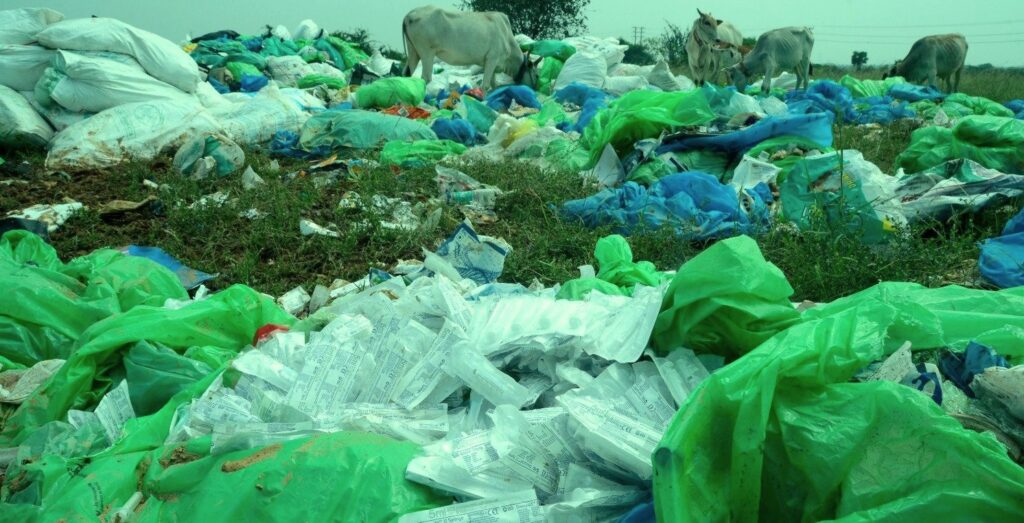
Banner image: Cows feed on biomedical waste dumped near Tirunelveli, Tamil Nadu (Image by Thinakaran Rajamani)
- Unmonitored waste from Kerala is being dumped in Tamil Nadu’s border sharing districts, which affect the soil and water near farmlands.
- This includes biomedical waste from Kerala’s healthcare centres which can impact the health of people and the environment if not managed scientifically.
- However, Kerala’s biomedical waste management facilities are not sufficient for the amount of waste it generates each day and for the future demand.
- While Kerala has introduced GPS tracking for around 300 waste transport vehicles, the problem of unauthorised medical facilities and the waste they generate, still exists.
Reports of Kerala’s biomedical waste being dumped along the Tamil Nadu border, along with incidents of meat waste and plastic waste being buried in pits across Tamil Nadu’s rural landscapes, have, over the years, become a disturbing routine in news reports. What once appeared as isolated violations has evolved into a pattern.
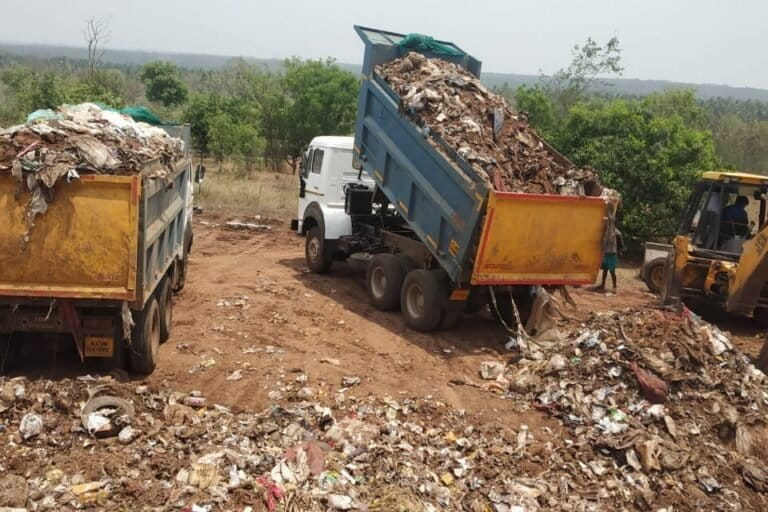
In the last decade, environmentalists estimate that hundreds of mixed waste dumping incidents along the state borders have been recorded, with many more likely unreported. Some of this waste being dumped includes biomedical waste.
In certain instances, the National Green Tribunal (NGT) has taken suo motu cognisance, initiating proceedings against the Kerala government. In one such case, biomedical waste from a cancer centre in Kerala that had been dumped in Tamil Nadu was ordered to be collected and transported back to Kerala.
Yet a critical question remains: why does Kerala’s biomedical waste continue to cross into Tamil Nadu?
In conversations with farmers and residents in affected areas along Tamil Nadu’s border as well as a visit to Kerala’s primary biomedical waste treatment facility, IMAGE, in Palakkad, Mongabay-India found out that the issue is rooted in structural gaps, and not only in isolated violations. High waste-processing costs is one of the main reasons driving illegal dumping and villages near the state border, with poor surveillance and monitoring, become the dumping grounds.
Biomedical waste includes all the waste generated from health care facilities which can have any adverse effect on the health of a person or on the environment in general if not disposed properly. All such waste which can adversely harm the environment or human health is considered as infectious and such waste has to be managed according to India’s Biomedical Waste Management Rules, 2016.
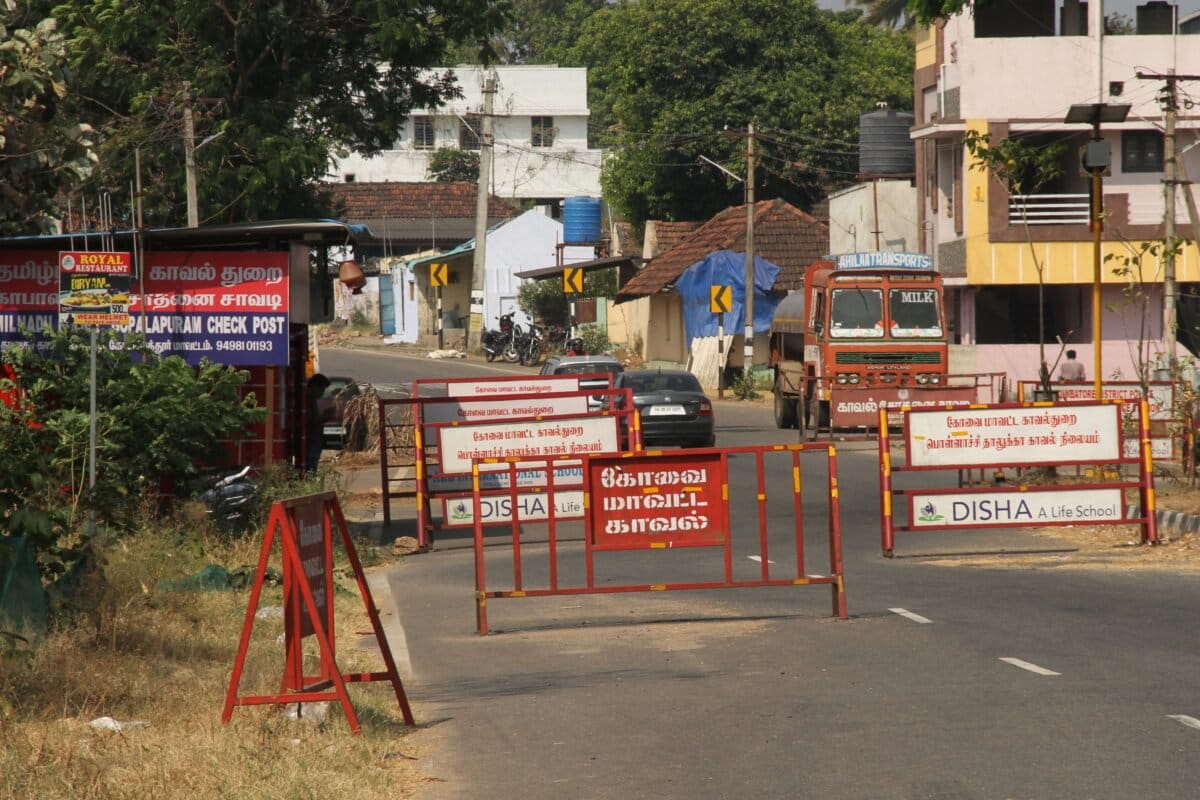
In Tamil Nadu, districts such as Coimbatore, Tiruppur, Theni, Tenkasi, Tirunelveli, Virudhunagar, and Kanniyakumari share long borders with Kerala. While highways and state roads are monitored, vast rural stretches, including farms and interior roads, remain difficult to police.
Residents say mixed waste is transported through these unmonitored routes, often at night, and dumped in agricultural lands or along roadsides. Some of these waste dumping incidents also contain biomedical waste.
The turning point that exposed the pattern
In April 2021, farmers in Semanampathy, a village near Anaimalai of Coimbatore district intercepted trucks carrying waste from Kerala, prompting the NGT to take suo motu cognisance.
State pollution control board inspection observed that waste had been buried in pits, generating leachate and posing risks to soil and groundwater. Farmers reported that a Kerala-based private operator had leased nearly 20 acres of land and was using heavy machinery to dump waste daily.
The case prompted the NGT to look into Kerala’s waste management system and marked a key moment in recognising cross-border dumping as a systemic issue.
Until this case, Kerala relied primarily on IMAGE, which has a capacity of 52.8 tonnes per day across 25 acres. The facility solely handled more than 82% of the biomedical waste generated in the whole state of Kerala.
But, for hospitals in cities like Kochi and Thiruvananthapuram, transporting biomedical waste to this facility (in Palakkad) involves journeys of nearly 200-330 kilometres, significantly increasing operational costs. Sources say this economic burden also has led some operators to resort to illegal disposal practices, including dumping waste across the Tamil Nadu border where the distance to some villages is much lesser.
Following the NGT intervention, Kerala established a second facility, Kerala Enviro Infrastructure Ltd (KEIL) near Ernakulam, with a capacity of 16 tonnes per day. However, cross-border dumping has not significantly declined, sources say.
When Kerala was forced to take its waste back
A striking example came on December 17, 2024, in the Tirunelveli district, where a major dumping incident forced the Kerala government, for the first time, to retrieve biomedical waste that had been illegally dumped in Tamil Nadu and transport it back to its own state.
Kerala Pollution Control Board officers inspected the dumped place after the NGT order, and around 384 tonnes of waste was cleared and transported back to Kerala within days.
The investigation traced the waste back to institutional generators, including the Regional Cancer Centre in Thiruvananthapuram, revealing failures not only in enforcement, but within the authorised waste management chain itself. Compensation notices and recovery proceedings followed.
After this incident, the National Green Tribunal sharply questioned Kerala’s handling of repeated biomedical waste dumping incidents in Tamil Nadu. The tribunal flagged gaps in monitoring, transport oversight, segregation, and accountability. It also criticised delays in action and questioned how illegal cross-border transport continued despite earlier directions and existing regulatory mechanisms.
Dumping continues despite monitoring
In Semanampathy near Anaimalai, the site of the 2021 exposure, Kathiresan, a 40-year-old coconut farmer, played a key role in bringing the waste dumping issue in the region to light.
Kathiresan recalls the night that exposed the issue in Anaimalai. “We saw three lorries carrying foul-smelling waste. When we followed them, we found nearly 30 acres of land had been leased. They were digging pits and burying waste using JCB (earthmoving digger) machines,” he said.
When confronted, the operators admitted they were transporting waste from Kerala, including biomedical waste from unauthorised clinics, plastic waste, and slaughterwaste.
“They told us they were paid to dispose it here. They used interior routes to avoid police checks,” he said. The impact, he says, continues. “They don’t just bury waste. At night, they dump plastic waste along roadsides. Cattle that graze in these areas consume it and fall sick. I own 14 cows. Plastic waste thrown by them entered my field through canal water. One of my cows developed severe digestive problems after eating it, I managed to save it only after a long struggle.”
Gokul Prasanth, a mango farmer who was present during the same incident, says the problem has not ended.
“After the NGT case, dumping was reduced for some time. Tamil Nadu police increased surveillance. But even today, at least once a month, meat waste or plastic waste, and rarely biomedical waste are still dumped in our area.”
He raises concerns about enforcement. “How does this waste continue to cross both Kerala and Tamil Nadu borders? There is suspicion among locals. Are officials being bribed to allow these vehicles through?” According to him, dumping methods have also evolved. “Earlier, they leased farmland and buried waste. Now, they dump it along roadsides at night, especially in areas with little human movement. In some cases, waste is even thrown into open wells near farms, packed in sacks.”
Farmers have begun installing surveillance cameras in some areas. “We cannot depend only on authorities,” he added.
A structural imbalance under pressure
Kerala’s biomedical waste management now relies primarily on two facilities — IMAGE (52.8 tonnes per day) and KEIL (16 tonnes per day). Together, they form the backbone of the state’s common treatment system, while Kerala generates approximately 90-96 tonnes of biomedical waste daily.
This pressure has widened over the past decade. The rapid expansion of healthcare infrastructure, from around 13,800 facilities in 2019 to nearly 29,500 in 2024, has also led to increased waste generation. Compliance has also remained uneven. According to 2019 data, the number of healthcare facilities operating without authorisation was over 7,000. While that number has gone down now, unauthorised facilities have not been eliminated, notes Kerala-based environmentalist Sridhar Radhakrishnan.
Operational constraints add further pressure. In the past there have also been instances of incinerator shutdowns, processing delays, and weak tracking systems, affecting overall efficiency. With a centralised system, waste often travels long distances, sometimes up to 300 km, increasing costs and delays.
In contrast, Tamil Nadu processes around 60 tonnes of biomedical waste daily through a distributed network of 11 treatment facilities, covering 31,082 healthcare units, enabling more stable handling.
Experts say this divergence reflects a structural imbalance, where rising waste generation without matching infrastructure creates systemic pressure, increasing the risk of waste moving outside regulated systems.
Weak enforcement and monitoring gaps
Tamil Nadu-based environmentalist Sultan Ismail, who was previously a member of the Tamil Nadu government’s solid waste management committee, says the issue lies in infrastructure gaps and compliance failures.
“If 11 centres are not enough for Tamil Nadu, how can two centres be enough for Kerala?” he asked. He added that not all waste is properly accounted for.
“In addition to hospital waste, sectors such as poultry generate waste that is not fully monitored. A significant portion of biomedical waste disposed of in the open comes from such sources,” he said. He also pointed to unauthorised facilities in Kerala.
Prabhakaran Veera Arasu, a Tamil Nadu-based environmental engineer and an activist associated with the NGO Poovulagin Nanbargal, said uneven enforcement between the two states contributes to the problem.
“Kerala strictly prevents waste from other states entering. But when its own waste moves out, enforcement appears weaker,” he said.
On the Tamil Nadu side, he added, monitoring gaps allow waste to enter.
Adding that there have been “at least 400 waste dumping incidents along the Tamil Nadu-Kerala border over the past decade”, he said that many more are likely going unreported. “The waste affects soil and groundwater. Chemicals from biomedical waste alter land and water quality, and livestock often consume these materials,” he said.
He also highlighted operational issues within Kerala’s system, including shutdowns, delays, and unauthorised medical centres.
Calls for urgent reform
Radhakrishnan says the situation demands immediate attention. “Biomedical waste is hazardous and must be handled scientifically. Wherever it is dumped, it causes serious environmental damage,” he said.
Noting that Kerala’s infrastructure is insufficient, he said, “Two centres are not enough. The system is struggling to manage increasing waste,” he said.
Radhakrishnan added that public opposition citing pollution risks has slowed the establishment of new facilities but stressed that the government must expand capacity, strengthen monitoring, and take strict action against illegal dumping.
Attempts were made to contact officials of the Indian Medical Association (IMA), which co-manages the IMAGE facility, to know more about the environmental and safety protocols and the waste tracking, transportation and disposal methods. No response was received at the time of publication.
Kerala State Pollution Control Board Chairperson Sreekala S. spoke to Mongabay-India over a phone call and assured that steps are being taken to address the issue. “Currently, biomedical waste is managed through two centres, and they are operating within existing capacity. However, this will not be sufficient for future demand,” she acknowledged. She added that new facilities are being planned and GPS tracking has been introduced for around 300 waste transport vehicles.
“Unauthorised clinics are mainly responsible for dumping across state borders. We are identifying them, imposing heavy fines, and strengthening monitoring. Compared to earlier, now incidents have reduced,” she noted.
At its core, the waste dumping issue reflects a structural imbalance between waste generation, infrastructure capacity, and regulatory enforcement. But for communities living along the border, the crisis is not abstract; it is buried in their soil, flowing through their water, and returning, again and again.