“U’khand Altered 84 Tender Rules For Adani In Rs 1.6 Lakh Crore Deal”
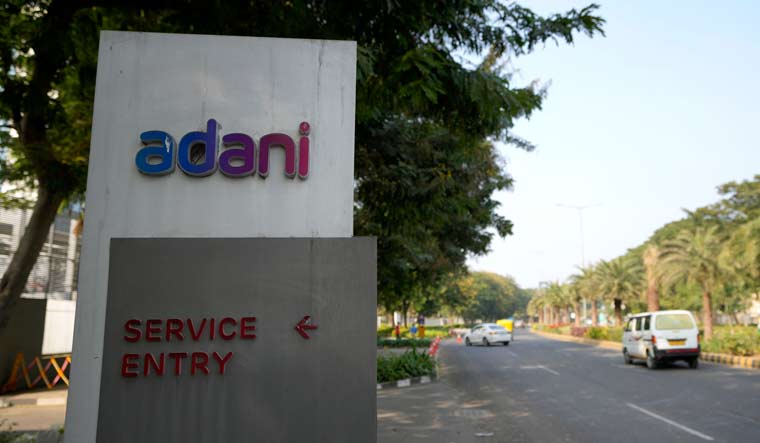
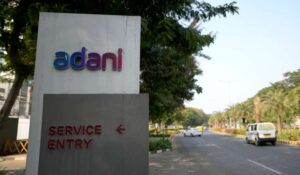
A signage near the entrance of Adani Corporate House in Ahmedabad, Gujarat. Congress MP Pawan Khera has raised questions about why the BJP government scrapped its UJVN-THDC project before creating a 1,320-MW opportunity that aligned with Adani’s Korba plant? (Image: AP)
Rajya Sabha MP Pawan Khera on Thursday alleged that the BJP government in Uttarakhand altered 84 tender rules to favour the Adani Group in a 1,320-MW power procurement deal. He claimed the arrangement could cost the state’s consumers nearly Rs 1.6 lakh crore over 25 years. Addressing a press conference, Khera said the state government first scrapped a public-sector power project and then rewrote the conditions of a fresh tender “until it fitted” Adani Power.
“This is a textbook case of a state government first killing its own public-sector project and then rewriting every single rule of a competitive tender until it fits,” he stated. The original project was to be developed by a joint venture of UJVN Ltd and THDC India Ltd to expand power-generation capacity in Uttarakhand. According to Khera, the venture was abandoned within months of its formation, at a time when Adani Power was acquiring Lanco Amarkantak Power Ltd in Chhattisgarh through insolvency proceedings. That acquisition, he noted, included an under-construction 1,320-MW expansion at Korba.
A fresh tender for 1,320 MW was later floated by Uttarakhand Power Corporation Ltd (UPCL). Khera alleged that successive changes to its conditions ultimately enabled Adani Power to emerge as the successful bidder. “This is crony capitalism dressed up as competitive bidding,” he said. He cited a 2024 decision in which Chief Minister Pushkar Singh Dhami had informed the Union coal and mines minister that the proposed thermal power project in Uttarakhand would be developed through the UJVN-THDC joint venture rather than by a private developer. The proposal received in-principle approval from the Union government in July 2024.
Yet on 16 January 2025, the state government abandoned the project, citing concerns over the timeline. Khera questioned the move, pointing out that the joint venture had been incorporated less than a year earlier and had prepared a roadmap to double Uttarakhand’s power capacity within eight years. Around the same period, Adani Power completed its acquisition of Lanco Amarkantak Power Ltd on 21 August 2024. The deal included the 1,320-MW Korba expansion. UPCL floated its tender on 3 February 2025. Khera alleged that on the same day, Adani Power filed its application for environmental clearance for the Korba plant.
He further claimed that the state government subsequently modified the tender conditions to require the entire 1,320 MW to be supplied by a single bidder and allowed the generating plant to be located “anywhere in India” instead of insisting it be situated in Uttarakhand. On 25 August 2026, the Uttarakhand Cabinet approved the procurement of 1,320 MW of coal-based power from Adani Power for 25 years at Rs 5.746 per unit. The power is to be supplied from the plant in Chhattisgarh.
Officials have stated that Adani Power emerged as the lowest bidder and that the procurement was intended to ensure reliable long-term supply. The Uttarakhand Electricity Regulatory Commission had approved the 1,320-MW purchase in July 2026. Khera questioned why the UJVN-THDC project was dropped only for the state to procure the same quantum of power through a tender that, he alleged, underwent repeated revisions.
“Why did the BJP government kill its own UJVN-THDC project only to create a 1,320-MW opportunity that perfectly fits Adani’s Korba plant?” he asked.“Why were 84 tender conditions rewritten? Was the tender designed for competition, or designed for Adani? And why should the people of Uttarakhand pay nearly Rs 1.6 lakh crore over 25 years for a project whose tender conditions were repeatedly changed to fit one corporate group?” Khera said.
The allegations centre on the sequence of decisions: the abandonment of a publicly promoted joint-venture project, the timing of Adani Power’s acquisition of an equivalent-capacity plant in another state, and the progressive loosening of tender requirements that ultimately allowed power to be sourced from outside Uttarakhand.