BAPS Controversy: When Religious Deference Comes At Women’s Cost
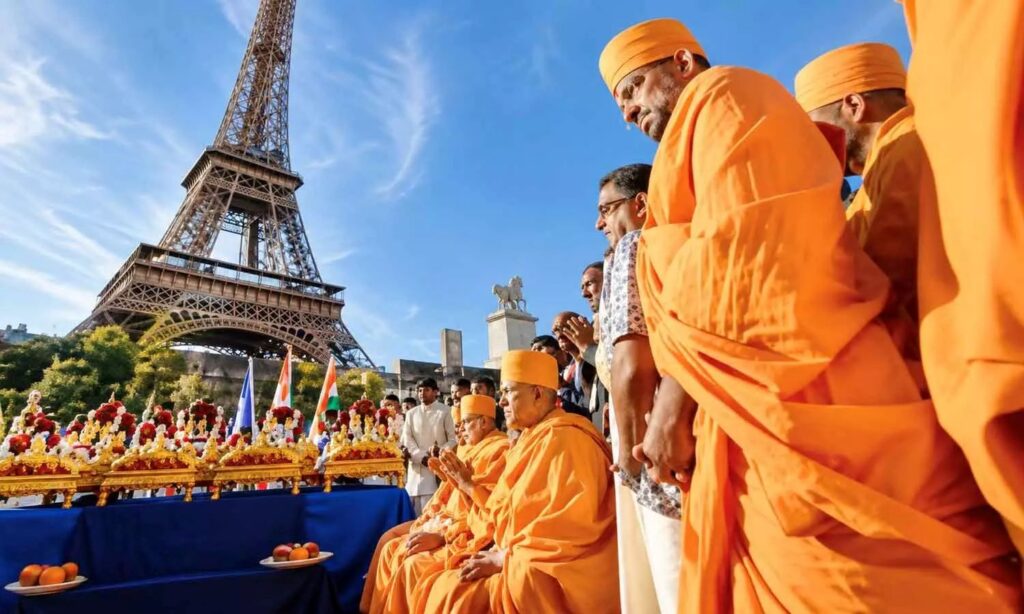
The controversy began when women working at the Eiffel Tower in Paris were asked to leave certain areas or limit their interaction with visiting BAPS monks, whose religious discipline includes strict celibacy and avoidance of physical contact with women
The controversy surrounding a recent BAPS delegation at Paris’s Eiffel Tower is about more than an awkward protocol dispute. It raises a question that liberal democracies cannot afford to evade: where should religious accommodation end and equality begin?
The episode reportedly began when women working at the Eiffel Tower were asked to leave certain areas or limit their interaction with visiting BAPS monks, whose religious discipline includes strict celibacy and avoidance of physical contact with women. The arrangement provoked an outcry among staff and contributed to a temporary closure of the landmark. French authorities have since announced an investigation, while BAPS has expressed regret over the distress caused.
The first principle should be straightforward: religious belief deserves respect. BAPS monks are entitled to observe the disciplines of their faith, including celibacy and restrictions on personal interaction. A secular society does not require religious believers to abandon their convictions at the door.
But religious freedom cannot mean that everyone else must reorganise their professional lives around those convictions.
That is the troubling feature of this episode. There is an obvious difference between a monk choosing not to interact physically with women and an employer instructing female employees to remove themselves so that the monk need not encounter them. The former is an exercise of religious conscience. The latter shifts the burden of religious observance onto workers who do not share the belief.
And that is where the issue becomes unmistakably gendered.
No one needs to claim that the monks consciously intended to demean women to recognise the discriminatory implications of such an arrangement. Misogyny does not always arrive in the form of an explicit declaration that women are inferior. Sometimes it appears as a seemingly polite administrative instruction: move aside, step away, let the men handle this.
The effect can matter as much as the stated intention.
If a woman’s presence is treated as something that must be managed because a male religious visitor cannot comfortably interact with her, she is effectively being made responsible for someone else’s religious restrictions. Her professional role becomes secondary to the visitor’s preferences. That is difficult to reconcile with the principle of equal treatment at work.
Yet the responsibility does not rest solely with BAPS.
The Eiffel Tower’s management also deserves scrutiny. It was the institution in control of the workplace. If special arrangements were requested, management had an opportunity—and arguably an obligation—to establish a clear boundary: religious visitors are welcome, their practices will be respected, but employees will not be segregated by sex to facilitate those practices.
Instead, the reported arrangement appears to have placed the accommodation burden on female staff.
That is a management failure, regardless of the religious identity of the visitors.
Additionally, the suggestion that criticism of this incident amounts to hostility toward Hindu believers is misplaced. A society serious about religious pluralism must be able to respect a religion while questioning how one of its practices is accommodated in a public workplace.
France’s republican tradition makes the question especially sensitive. Its commitment to secularism is often understood not as hostility to religion but as an insistence that the state and public institutions maintain common civic rules. Equality between men and women is one such principle.
Those principles should apply consistently.
The same standard should govern every religious community and they should be entitled to practise their religion. But none should be permitted to impose sex-based restrictions on unrelated employees merely because its members find interaction with the opposite sex religiously uncomfortable.
The proper response, therefore, is neither cultural hostility nor unquestioning deference. It is a simple and demanding principle: accommodate religious belief where reasonably possible, but do not make another person’s equality the price of that accommodation.
The Eiffel Tower is supposed to be a symbol of France open to the world. Its lesson from this controversy should be equally universal. Faith deserves freedom. Workers deserve dignity. Women deserve equality. And none of these principles should have to disappear when the others enter the room.