25 Years After 9/11, What Did The US War On Terror Really Cost?
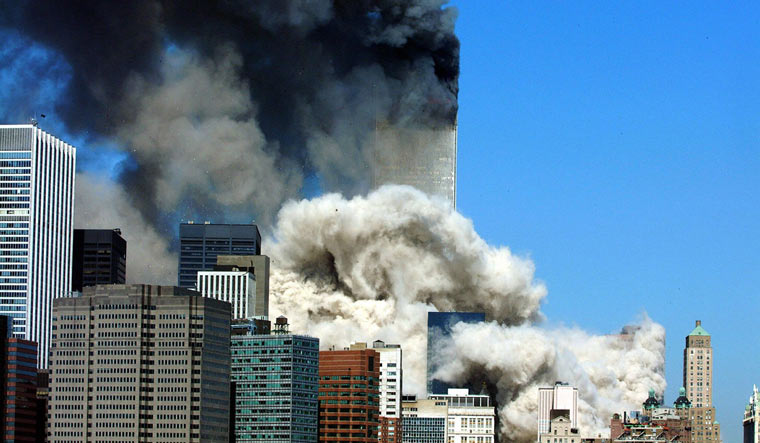
On September 11, 2001, a series of coordinated terrorist strikes were carried out by Al-Qaeda against the United States. Seen above are the Twin Towers in New York, after being hit by two aircraft
Twenty-five years after the September 11, 2001 attacks, the United States is remembering nearly 3,000 people killed in the deadliest terrorist attack on American soil. Across New York, Washington and Shanksville, ceremonies on September 11, 2026, have once again brought grief, remembrance and the heroism of first responders to the forefront. But the 25th anniversary is also an occasion to examine a difficult question: how did the enormous global sympathy generated by 9/11 give way, in many parts of the world, to scepticism about America’s response?
The answer is complicated. The attacks produced an extraordinary moment of international solidarity. NATO invoked Article 5 — its collective-defence provision — for the first time in its history, declaring that an attack on one member was an attack on all. Governments across the world condemned al-Qaeda and expressed support for the American people. Even countries deeply critical of Washington’s foreign policy recognised that the murder of civilians could not be justified.
From Global Solidarity to America’s Wars
The initial American military response in Afghanistan was also viewed differently from what followed. The Taliban regime had provided sanctuary to al-Qaeda, and the campaign to remove it and target those responsible for 9/11 received substantial international backing. In fact, the early phase of the intervention was seen by many as a legitimate response to an extraordinary attack.
The turning point was increasingly the decision to invade Iraq in 2003. Unlike Afghanistan, Iraq was not responsible for the 9/11 attacks, and the connection between Saddam Hussein’s regime and the attacks remained unestablished. The invasion was justified largely through claims about weapons of mass destruction and the broader security threat posed by Saddam’s government. When those weapons were not found, the credibility of the justification suffered a severe blow.
The consequences went far beyond the original military operation. The Iraq war unleashed insurgency, sectarian violence and political instability. Abu Ghraib became a global symbol of abuse, while images of civilian suffering reinforced perceptions that American military power was producing devastation rather than stability. The invasion also altered the balance of power in the Middle East and contributed to conditions that extremist organisations could exploit.
Afghanistan followed a different but ultimately troubling trajectory. The United States spent two decades fighting the Taliban and attempting to build a stable democratic state. Yet the Taliban survived, and the American withdrawal in 2021 ended with the group returning to power. The outcome prompted difficult questions about the limits of military intervention and nation-building. Twenty-five years after 9/11, Afghanistan remains one of the clearest examples of the gap between military victory and sustainable political success.
Security, Civil Liberties and the Price of Legitimacy
America’s loss of goodwill was not caused by the wars alone. The broader “War on Terror” transformed U.S. domestic and foreign policy. The creation of the Department of Homeland Security, expanded intelligence powers, mass surveillance, detention without conventional trial and allegations of torture all generated debates about whether the pursuit of security had come at the expense of civil liberties.
Guantánamo Bay became particularly powerful as a symbol of this controversy. For supporters of aggressive counterterrorism, extraordinary measures were justified by an extraordinary threat. For critics, however, America’s credibility as a defender of human rights was weakened when Washington appeared to apply different standards to itself and others.
Drone warfare produced another dilemma. Targeted strikes allowed the United States to eliminate militant leaders without putting large numbers of American troops on the ground. Yet civilian casualties, secrecy and questions about accountability fuelled resentment in countries where such operations occurred. Counterterrorism may have removed dangerous individuals, but the wider political consequences could sometimes undermine the very legitimacy needed to defeat extremist ideologies.
Still, it would be simplistic to say that America completely squandered the sympathy it received after 9/11. The United States continued to enjoy powerful alliances, and intelligence cooperation between countries expanded substantially. American counterterrorism operations disrupted terrorist networks, and the 2011 killing of Osama bin Laden demonstrated that the United States could eventually reach the architect of the attacks. Terrorism itself also remained a genuine threat, meaning that Washington’s security concerns were not imaginary.
Nor were all the consequences of the post-9/11 wars created by America alone. Local political failures, authoritarian governments, sectarian divisions, regional rivalries and the actions of other powers contributed to the instability in Iraq, Afghanistan and elsewhere. Terrorist organisations also deliberately exploited conflict and anti-American sentiment for recruitment.
The deeper lesson of the past quarter-century is therefore not that America was wrong to respond to 9/11. A state has a responsibility to protect its citizens. The question is how that responsibility is exercised. The experience of the last 25 years suggests that military strength can destroy terrorist networks, but it cannot by itself create legitimacy, political stability or lasting peace.
The extraordinary sympathy that surrounded America in September 2001 was rooted in a shared sense of human vulnerability. What chipped away at it was the perception that Washington had moved from defending itself against terrorism to exercising military power on a much broader scale. The challenge for the United States today is to remember that distinction.
Twenty-five years on, 9/11 remains both a tragedy to mourn and a foreign-policy lesson to study. Its enduring message may be that power can win wars, but legitimacy is harder to build — and much easier to lose.