Delhi PG Building Collapse Exposes Dangerous Student Housing Crisis
The tragedy in Delhi's Satya Niketan has become more than a story about one building. It has raised questions about the safety of student accommodation, unauthorised construction, building inspections, renovation practices and the responsibilities of property owners and civic authorities
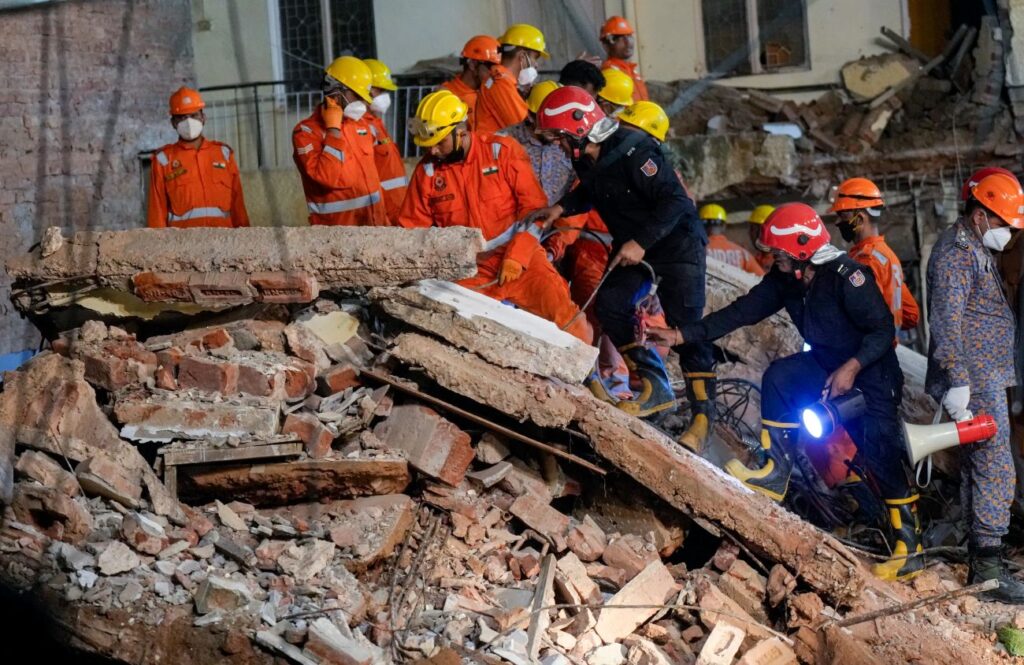
A five-storey building being used as a paying guest (PG) accommodation for students collapsed in Delhi’s Satya Niketan on Sunday, September 6, killing seven people and injuring several others. Rescue operations continued into Monday as teams searched the rubble of the decades-old structure near Delhi University’s South Campus.
The tragedy has quickly become more than a story about one building. It has raised questions about the safety of student accommodation, unauthorised construction, building inspections, renovation practices and the responsibilities of property owners and civic authorities in one of Delhi’s most densely populated student neighbourhoods.
What happened in Satya Niketan?
The building, reportedly around 40 to 50 years old, was being operated as a boys’ PG accommodation. It had a basement and multiple upper floors and housed students attending colleges around Delhi University’s South Campus. The collapse occurred at around 1.30 pm on Sunday, when students were inside the building.
The structure reportedly came down in a “pancake collapse”, with floors falling one on top of another. This made rescue operations particularly difficult because survivors could be trapped beneath heavy concrete slabs. Firefighters, police personnel, the National Disaster Response Force and other emergency teams worked through the night, using smaller equipment where necessary to avoid harming people who might still have been alive beneath the debris.
At one stage, local residents and officials feared that dozens of students could be trapped. The exact number of occupants was difficult to establish immediately, highlighting another problem: there appeared to be no reliable, readily available record of everyone staying in the building.
Renovation work under scrutiny
One of the most important questions is what happened inside the building before it collapsed.
Police and local inquiries indicate that repair or renovation work was underway in the basement and possibly other parts of the structure. Investigators are examining whether this work compromised the building’s structural stability. Water accumulation in the basement and concerns about the foundation have also emerged as possible contributing factors.
Reports have also raised allegations of unauthorised additional floors and inadequate structural reinforcement. Some residents claimed the building had developed cracks and other signs of deterioration. These allegations have not yet been conclusively established, and the magisterial inquiry is expected to determine the precise chain of events.
That distinction matters. The collapse should not be attributed to one factor until the investigation is complete. An ageing structure, renovation work, possible unauthorised alterations, water accumulation and questions over maintenance could have interacted to create a dangerous situation.
Why Satya Niketan matters
Satya Niketan is not an ordinary residential colony. Located beside Delhi University’s South Campus, it has evolved into a major student accommodation hub. Small residential plots have increasingly been converted into PGs and private hostels to meet the enormous demand for affordable housing from students arriving in Delhi.
That transformation has created a difficult regulatory environment. Buildings originally designed for relatively small households may now accommodate far more people. A property can effectively become a commercial hostel without the surrounding infrastructure necessarily changing to match its new use.
The question therefore extends beyond the collapsed building: How many other PGs in Delhi are being operated in structures that were never designed for such occupancy?
A warning from 2022
Satya Niketan has faced a warning before. In April 2022, another building in the same neighbourhood collapsed during renovation work, killing two labourers and injuring four others. That structure had reportedly been declared dangerous by the municipal corporation before the collapse.
The recurrence raises a troubling question about whether lessons from earlier incidents were adequately implemented.
Residents have reportedly described the latest collapse as part of a broader pattern of unsafe construction in the locality. If buildings are repeatedly altered, extended or renovated without effective structural scrutiny, disaster prevention becomes largely reactive.
Who is responsible?
The Delhi government has ordered a magisterial inquiry, while police have registered an FIR against the building owner. The owner has since been arrested, according to reports.
But accountability may not stop with the property owner.
On Monday, the Municipal Corporation of Delhi suspended five South Zone officials, including the deputy commissioner and four engineers, following the collapse.
The Delhi High Court has also taken cognisance of the matter, with notices issued to the Delhi government, MCD, Delhi University, police and other authorities. The court proceedings could broaden the debate over who is responsible for regulating student PGs and ensuring that buildings used to house large numbers of students meet safety requirements.
The larger student housing problem
For students, especially those coming to Delhi from other states, PG accommodation is often a necessity rather than a choice. Proximity to colleges, transport and relatively lower costs make areas such as Satya Niketan attractive.
But affordability can come at the cost of safety when demand is high and regulation is weak.
The tragedy exposes a gap between student housing demand and safe housing supply. Simply sealing dangerous buildings after a disaster will not solve the problem if students have nowhere affordable to go.
Authorities now need to establish how many PGs operate in ageing or structurally altered buildings, whether occupancy limits are being followed, whether fire exits and evacuation routes exist, and whether landlords are undertaking construction without proper approval.
The Delhi government has indicated that buildings with unauthorised fifth floors will face immediate action and that nearby PGs and other buildings will be inspected. It has also moved towards a policy requiring structural audits and safety certification for buildings such as hostels and schools.
The real test, however, will be implementation.
Satya Niketan was a place where students came to study, build careers and live independently. The collapse has turned it into a symbol of a much wider urban safety problem: when an ordinary building becomes a high-density student residence, safety standards cannot remain ordinary. The tragedy will have meaning only if the authorities use it to identify dangerous buildings before they collapse, rather than after lives have already been lost.