The Sundarbans At A Crossroads: Climate Change And Displacement
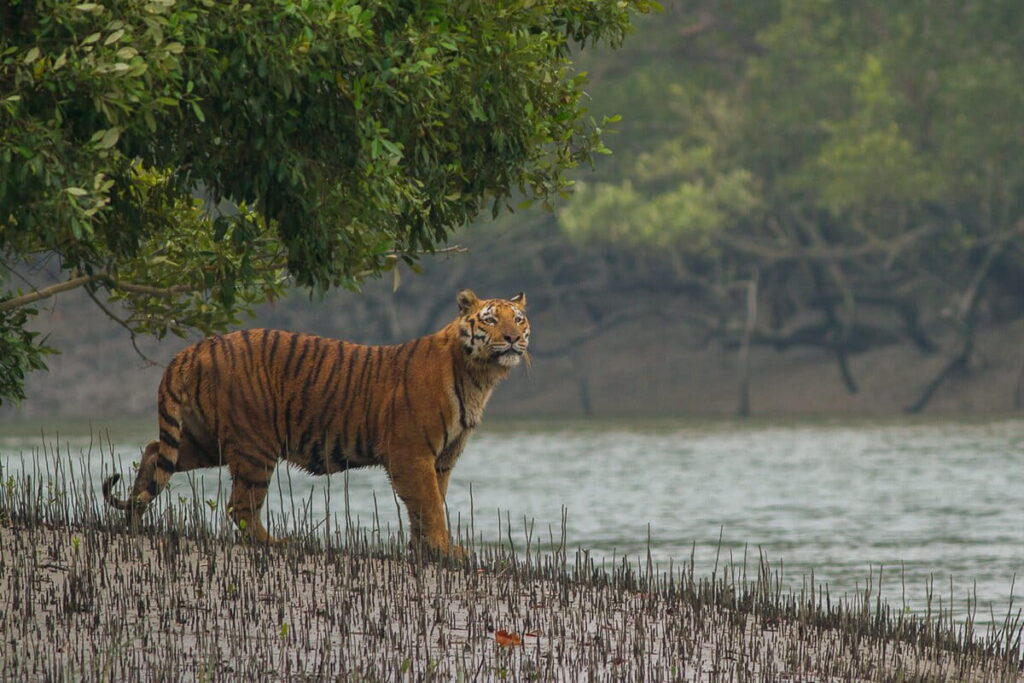
A tiger in the Sundarbans (Image by Soumyajit Nandy via Wikimedia Commons)
Stretching across India and Bangladesh along the Bay of Bengal, the Sundarbans is the world’s largest contiguous mangrove forest and one of the planet’s most remarkable ecological landscapes. Formed by the Ganga, Brahmaputra and Meghna river systems, this vast delta is a constantly changing world of tidal channels, mudflats, marshes and low-lying islands. Its name derives from the Sundari (Heritiera fomes), a distinctive mangrove species that thrives in its brackish waters. The region’s extraordinary biodiversity and ecological significance are reflected in the UNESCO World Heritage recognition accorded to protected areas on both sides of the international border.
The Sundarbans supports a rich variety of aquatic life, including the threatened Ganges river dolphin and Irrawaddy dolphin, while its mangrove forests provide habitat for the endangered Royal Bengal tiger. The interaction between freshwater flowing from the great rivers and the saline waters of the Bay of Bengal creates diverse ecological niches that sustain this abundance of life.
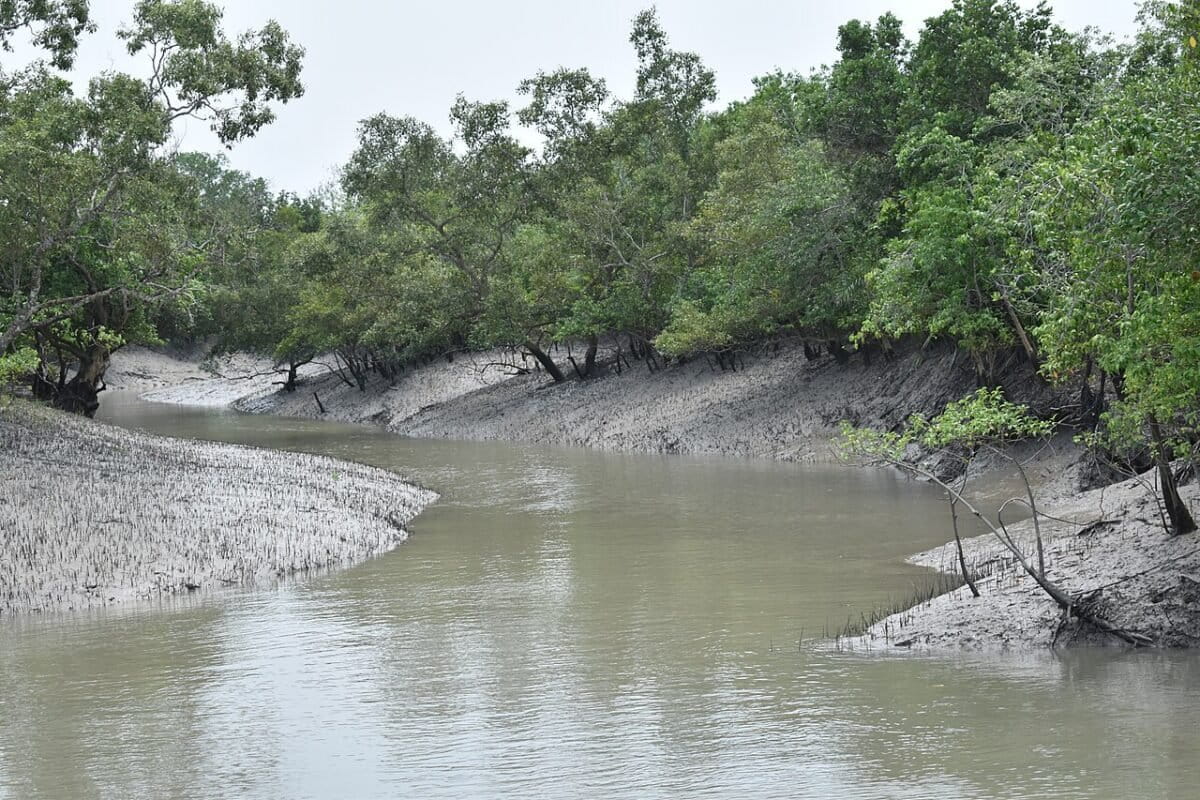
In his 2004 novel The Hungry Tide, Amitav Ghosh captures this intricate relationship between water, geography and biodiversity. He describes how river and seawater “interpenetrated each other, creating hundreds of different ecological niches.” These micro-environments, he suggests, function like “floating biodome[s] filled with endemic fauna and flora,” sustaining an extraordinary range of aquatic species. His evocative account reflects the scientific complexity of an ecosystem in which even small variations in salinity and water movement can determine which organisms survive.
The Sundarbans’ present-day geography is the product of millions of years of geological and climatic change. The uplift of the Himalayas helped shape the monsoon system and the rivers that transport sediment into the Bengal Basin. During the Early Holocene, rising sea levels pushed seawater far inland, preventing rivers from building stable land quickly enough. Later, as sea-level rise slowed, sediment deposition began to outpace the advance of the sea, allowing the delta to expand towards the Bay of Bengal.
Between approximately 5,000 and 2,500 years ago, the stabilisation and relative retreat of the sea created extensive mudflats and shallow estuaries. These conditions enabled mangroves to establish themselves in the tidal environment. Tectonic changes subsequently altered freshwater flows, leaving parts of the western delta increasingly dependent on tidal processes.
Yet the landscape is not simply a geological achievement. It is also a human story of migration, survival and contested relationships with nature. Labour migration during British colonial rule, followed by movements across the border around Partition and in later decades, brought people seeking land, security and belonging. Communities built lives on fragile islands, negotiating an uncertain existence alongside wildlife, shifting waterways and regional political tensions. As Ghosh’s novel explores, conservation and human survival can come into conflict when people depend on forest resources for food, fishing and income.
Climate change and the search for an amphibious future
Today, the ecological balance that sustains the Sundarbans is under mounting pressure. Rising sea levels, increasingly destructive cyclones, coastal erosion and soil salinisation threaten both biodiversity and human settlements. NASA Landsat satellite imagery, as cited in the source material, indicates that sea levels in the region have risen by approximately three centimetres annually over the past two decades. The region has also reportedly lost nearly 12 per cent of its shoreline to erosion over four decades.
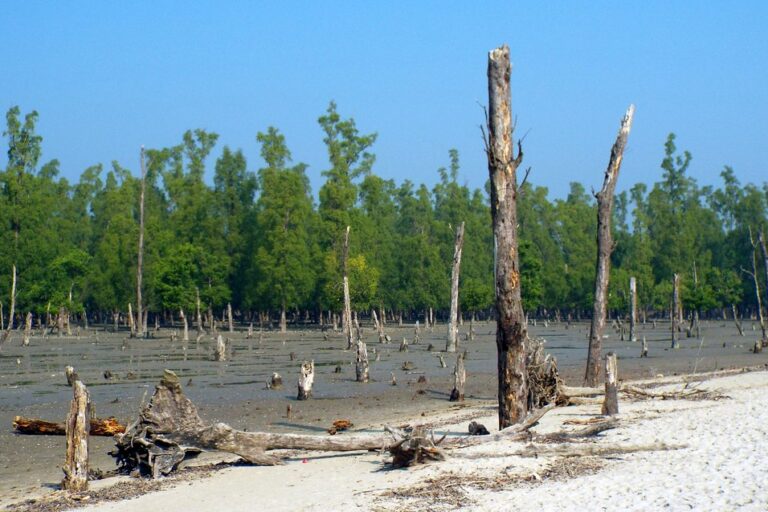
These changes are intensified by several interconnected factors: global warming and the thermal expansion of seawater, the gradual subsidence of deltaic land, reduced sediment deposition resulting from upstream dams and river interventions, and declining freshwater flows associated with structures such as the Farakka Barrage. Together, these pressures weaken the delta’s natural capacity to replenish land and resist the encroaching sea.
For residents, the consequences are immediate. Cyclones breach embankments and inundate villages, while saltwater intrusion contaminates agricultural fields and freshwater sources. Monsoons bring flooding and waterlogging; summers bring freshwater shortages and sharply rising salinity. Farming becomes less productive, fishing livelihoods become increasingly uncertain, and households face growing economic insecurity.
The Sundarbans is home to an estimated seven to 7.5 million people across India and Bangladesh. As islands erode or disappear, thousands have been displaced, contributing to climate-related migration. Yet environmental displacement remains inadequately addressed by existing legal and policy frameworks. Disaster-response systems may provide relief after extreme weather events, but longer-term displacement caused by gradual environmental degradation presents a different challenge. Poverty, ill health and social insecurity further compound the crisis. A post-cyclone household survey cited in the source material found that 510 out of every 1,000 residents experienced malnutrition or illnesses, including waterborne and communicable diseases.
One proposed response is the Amphibious Living Opportunities (ALO) framework, which seeks to help communities adapt rather than simply abandon their homes. Its approach combines resilient housing, climate-adapted farming, sustainable fisheries, diversified livelihoods and community-led cooperation, supported by investment, technology and institutional partnerships.
The challenge is to protect the Sundarbans without overlooking the people whose lives depend on it. Conservation must recognise local livelihood needs, while adaptation policies must give vulnerable communities a meaningful role in shaping their future. The ALO framework offers a possible pathway, but its success will require sustained funding, effective institutions and genuine community participation.
The Sundarbans stands at a critical juncture. Its future depends on whether ecological protection and human security can be pursued together. The question raised by Ghosh’s The Hungry Tide remains urgent: can people and nature coexist in a landscape where the same forces that sustain life can also threaten it?