BJP Backs Puri Amid Epstein Row, Raising Questions Of Accountability
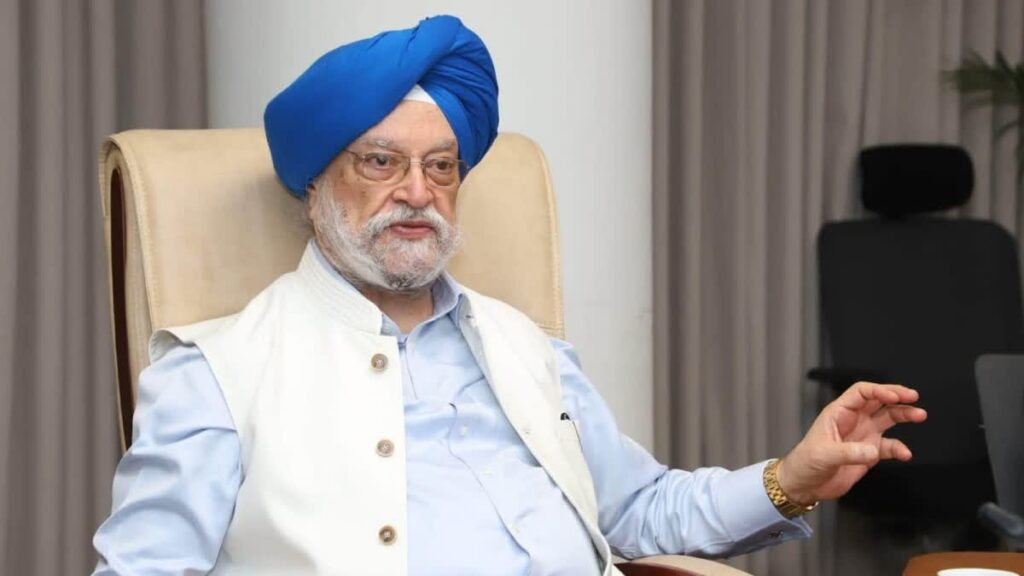
The BJP’s decision to nominate Union Petroleum Minister Hardeep Singh Puri for the Rajya Sabha by-election in Madhya Pradesh risks conveying that political loyalty and institutional convenience matter more than the appearance of accountability (Image: ETV Bharat)
The Bharatiya Janata Party’s decision to nominate Union Petroleum Minister Hardeep Singh Puri for the Rajya Sabha by-election in Madhya Pradesh is more than a routine political appointment. Coming amid renewed scrutiny of his documented interactions with Jeffrey Epstein, the convicted sex offender, the move raises uncomfortable questions about political accountability, public trust and the standards the Narendra Modi government expects its ministers to uphold.
The BJP announced Puri’s candidature on October 28, with polling scheduled for November 12. The decision follows the circulation of photographs released by the United States Department of Justice showing Puri seated across a table from Epstein. Emails and other records released earlier this year have also documented contact between the two men over several years. These records have intensified questions about the nature of their interactions.
To be clear, appearing in photographs or correspondence with Epstein does not, by itself, establish criminal wrongdoing. Puri has denied wrongdoing and maintained that his meetings took place in a professional context. His office has also said that he cannot recall the specific meeting depicted in the recently circulated photograph. Those explanations must be considered fairly. But fairness cannot mean that questions arising from documented associations should simply be brushed aside, particularly when the individual concerned holds high public office.
The issue, therefore, is not whether a photograph constitutes proof of a crime. The issue is whether a government that repeatedly invokes integrity, national interest and public morality is prepared to demand convincing answers from one of its own senior ministers.
Political patronage over public accountability
Puri has acknowledged meeting Epstein on a few occasions during his association with the International Peace Institute in New York. He has described the interactions as professional, including efforts connected with bringing LinkedIn co-founder Reid Hoffman to India. In February, he rejected allegations of wrongdoing. Reports in February also said that a government-level internal review had found no evidence of objectionable or criminal involvement, although that account was attributed to sources and did not amount to a judicial finding.
These explanations deserve scrutiny on their merits, not automatic dismissal. Yet the public is entitled to ask what the meetings involved, why the communications occurred and whether the minister’s account adequately addresses the questions raised by the released material. A transparent, evidence-based explanation would serve both public confidence and Puri’s own interests.
Instead, the BJP’s latest decision risks conveying that political loyalty and institutional convenience matter more than the appearance of accountability. A nomination is not a conviction or an acquittal; nor is it a substitute for answers. But it is a public endorsement, and the party leadership cannot reasonably expect citizens to regard it as politically neutral.
The government may argue that no wrongdoing has been established and that Puri remains entitled to contest an election. Legally, that distinction matters. Democratic politics, however, involves more than determining whether a criminal charge can be sustained. Ministers exercise public power and should be held to standards of openness and judgment commensurate with their responsibilities.
The BJP has often presented itself as a party of discipline and probity. That claim becomes difficult to defend if serious public questions surrounding a minister are treated merely as an opposition talking point. The responsible course would be to explain what scrutiny was undertaken, what evidence was considered and why the party believes the controversy does not undermine confidence in its nominee.
A test of the Modi government’s credibility
Puri’s nomination also carries a political calculation. The Madhya Pradesh by-election is expected to favour the BJP, which governs the state and has a majority in its Legislative Assembly. The party may therefore see little electoral risk in choosing him.
But an easy electoral contest does not eliminate the obligation to answer difficult questions. Indeed, when a party can nominate a candidate with a strong prospect of victory, its choices reveal the standards it is willing to defend without the pressure of a closely fought campaign.
The Modi government should recognise that public confidence is not protected by repeating that allegations have not been proved. Nor is it strengthened by treating scrutiny as politically motivated whenever it concerns someone within the ruling establishment. The correct response is to distinguish carefully between evidence, allegation and speculation, while ensuring that reasonable questions receive substantive answers.
Puri, for his part, should offer a clear and comprehensive account of his interactions with Epstein, grounded in the available records. It is a basic expectation of a minister whose public responsibilities require trust.
Ultimately, the BJP is entitled to choose its candidates, and Puri is entitled to the presumption of innocence. But neither entitlement places public figures beyond scrutiny. By nominating him amid an unresolved controversy, the party has chosen to assume the political responsibility that comes with that decision.
The test now is whether the government will meet legitimate questions with transparency or rely on its political strength to ride out the storm. A Rajya Sabha nomination may secure a minister’s place in Parliament. It cannot, on its own, secure public confidence. That must be earned through candour, accountability and a willingness to answer questions, however inconvenient they may be.