Epstein Photo Shock Puts Puri And Modi Government On The Defensive
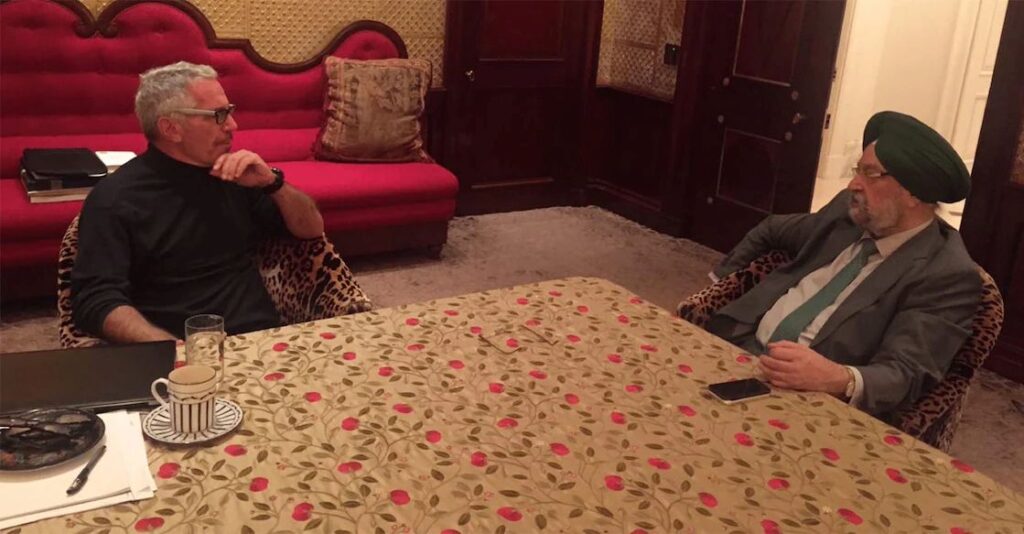
In February 2026, Hardeep Singh Puri had described his encounters with convicted sex offender Jeffrey Epstein as taking place as part of a delegation and said he had no independent meetings with the latter. But the newly circulated photograph, which shows the two men seated opposite each other without anyone else visible in the frame, has prompted questions about whether that description was sufficiently complete and accurate (Photo: X/Swamy39)
The photograph of Union Petroleum Minister Hardeep Singh Puri sitting across a table from Jeffrey Epstein, the convicted sex offender whose connections with the global elite continue to haunt public life, has raised uncomfortable questions for the Narendra Modi government. At a time when the ruling Bharatiya Janata Party (BJP) routinely invokes nationalism, integrity and public morality to attack its political opponents, the image presents a test of its own standards of accountability. The controversy has intensified amid US Secretary of State Marco Rubio’s visit to India, turning an already embarrassing episode into a major political confrontation.
The photographs, drawn from records released by the US Department of Justice, began circulating widely in October 2026. Reports indicate that multiple images show Puri and Epstein seated across a table, with no other person visible in the frames. The images have renewed scrutiny of Puri’s earlier explanations about his association with Epstein and raised questions that cannot simply be dismissed as partisan attacks. The photograph makes a detailed, credible explanation from a senior minister necessary.
An explanation that raises more questions than it answers
Puri had acknowledged in February 2026 that he met Epstein three or four times while associated with the International Peace Institute in New York, before joining the Union Cabinet in 2017. He maintained that the meetings were professional and connected to efforts to promote investment and technology opportunities in India, including discussions involving LinkedIn co-founder Reid Hoffman. He denied any connection with Epstein’s criminal activities.
The difficulty for Puri is that his earlier public account has now come under renewed scrutiny. In February, he described his encounters as taking place as part of a delegation and said he had no independent meetings with Epstein. The newly circulated photograph, which shows the two men seated opposite each other without anyone else visible in the frame, has prompted questions about whether that description was sufficiently complete and/or accurate.
Puri’s office has responded that the minister cannot recall which meeting the photograph depicts or whether others were present before or after the moment captured. It has also insisted that the interaction was professional, pointing to the papers on the table and the formal setting.
But this response leaves important questions unanswered. What exactly was discussed? Who arranged the meeting? Were other participants present outside the frame? What correspondence exists between the two men, and does it support the minister’s account? These are reasonable questions concerning a senior public official, not proof of guilt.
Epstein’s crimes were grave, and his ability to maintain relationships with influential people across politics, finance and business has made transparency surrounding his associates a matter of international public interest. Anyone whose interactions with him are documented should be prepared to explain those interactions fully. A minister cannot expect the public to accept a vague recollection as the final word when photographic and documentary evidence invites further examination.
The government’s response is equally troubling. The BJP has built much of its political messaging around decisive leadership and the promise of clean governance. Yet when a senior minister faces questions about his association with a notorious convicted sex offender, the public deserves more than political counterattacks or silence from the leadership. Prime Minister Narendra Modi should make clear what standards of disclosure and accountability apply to members of his Cabinet.
The opposition, led by Congress leader Rahul Gandhi, has demanded answers and questioned the timing of the photographs’ circulation alongside Rubio’s visit. Gandhi has suggested that the episode raises questions about possible political pressure on Indian officials. However, the available evidence does not establish that the US government is blackmailing anyone or that Rubio’s visit was connected to the photographs. The images were part of a Justice Department dataset released earlier in the year, although they attracted widespread attention in October.
That distinction matters. The opposition is entitled to demand transparency, but allegations of blackmail require evidence. The government, meanwhile, cannot use the absence of proof of criminal conduct as an excuse to avoid legitimate questions about a minister’s past associations.
The timing has added diplomatic sensitivity to the affair. India and the United States have substantial interests in defence, trade, energy and technology. Rubio’s visit should have provided an opportunity to advance these priorities, rather than becoming entangled in speculation about an Indian minister’s past. There is no established evidence that the controversy has altered bilateral negotiations, but it has created an unwelcome political distraction.
Ultimately, this episode is a test of public accountability. Puri must provide a clear chronology of his meetings and communications with Epstein, while the government must explain whether it considers his existing disclosures adequate. If the minister’s account is accurate, transparent documentation should help establish that. If important details have been omitted, the public deserves to know why.
The BJP cannot demand uncompromising scrutiny of its opponents while treating questions about its own senior figures as politically motivated. For a government that frequently presents itself as the guardian of national prestige, the most effective way to protect that prestige is not to evade uncomfortable questions. It is to answer them. In public life, credibility depends not merely on what leaders deny, but on how convincingly they account for the facts.