Chalo Delhi March Signals Growing Opposition Challenge to BJP
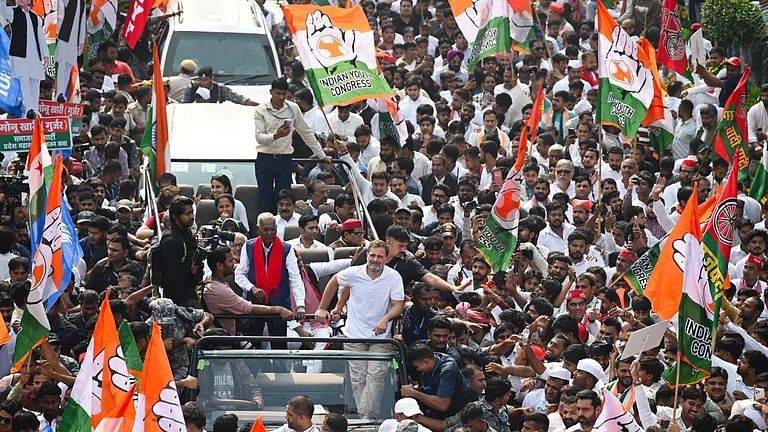
The Chalo Delhi march on Nov 1 saw significant turnout in the national capital. Among other leaders, Rahul Gandhi of the Congress participated in the march
The INDIA bloc’s Chalo Delhi march on November 1, culminating in a rally at Delhi’s Ramlila Maidan, was more than a show of opposition strength. It brought a wide spectrum of political parties onto a common platform to challenge the Election Commission’s Special Intensive Revision (SIR) of electoral rolls and demand the resignation of Chief Election Commissioner Gyanesh Kumar. More importantly, it demonstrated that concerns over voter rights, institutional accountability and the credibility of democratic processes have become a rallying point for parties otherwise divided by regional interests and competing political ambitions.
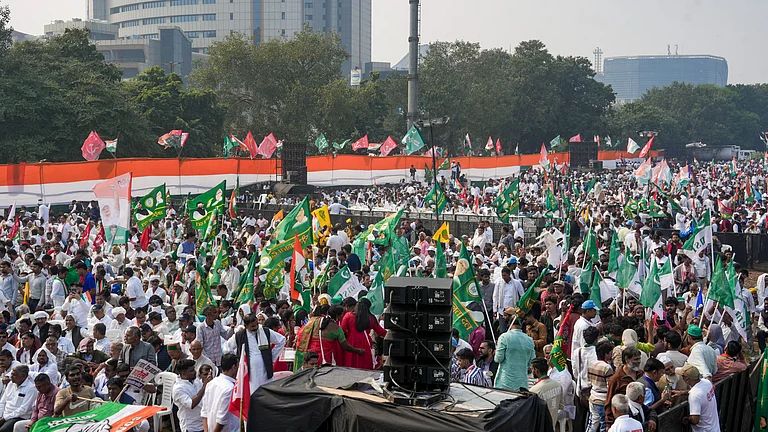
The turnout was significant. Thousands of supporters gathered at Ramlila Maidan, with several reports describing the crowd as running into tens of thousands. The INDIA bloc had projected a turnout of up to 10 lakh, while the Delhi Police had anticipated around 50,000. The precise attendance remains disputed: the BJP sought to dismiss the gathering as a failure, claiming that substantial portions of the venue remained empty. Nevertheless, the scale of the mobilisation and the presence of prominent opposition leaders made it difficult to portray the event as an insignificant political exercise.
The BJP’s response suggested that the march had unsettled the ruling party. Its leaders attempted to ridicule the gathering and question its size, while the party had earlier objected to the choice of November 1, which marks the anniversary of the 1984 anti-Sikh violence. Such criticism is part of the political contest, but the intensity of the response also indicates that the BJP recognises the potential consequences of an opposition campaign capable of bringing multiple parties and their supporters together. A ruling party confident in its political position should be prepared to answer questions about electoral processes rather than rely primarily on dismissing those raising them.
The opposition’s central charge concerns alleged irregularities in the SIR exercise, including the deletion of voters’ names and the absence of adequate transparency in the process. The Election Commission maintains that the revision is intended to remove duplicate, deceased and otherwise ineligible entries, and that eligible voters who have been wrongly excluded can seek re-enrolment. The opposition, however, argues that the scale of deletions and the manner in which the exercise has been conducted threaten the voting rights of legitimate electors. These allegations require scrutiny and cannot be treated as established fact merely because they were repeated at a large rally. Equally, the Commission cannot expect public confidence to rest solely on its assurances.
An Opposition finding its voice, and a Government facing questions
One of the most consequential aspects of the march was the appearance of opposition leaders who do not always see eye to eye on political strategy or electoral priorities. Rahul Gandhi, Sonia Gandhi, Mallikarjun Kharge and Priyanka Gandhi Vadra were joined by Samajwadi Party chief Akhilesh Yadav, Trinamool Congress leaders Mamata Banerjee and Abhishek Banerjee, RJD leader Tejashwi Yadav, National Conference president Farooq Abdullah, PDP leader Mehbooba Mufti, and representatives of the Left and other parties. Their participation gave the protest a national character and helped counter the perception that the campaign against SIR was merely a Congress-led initiative.
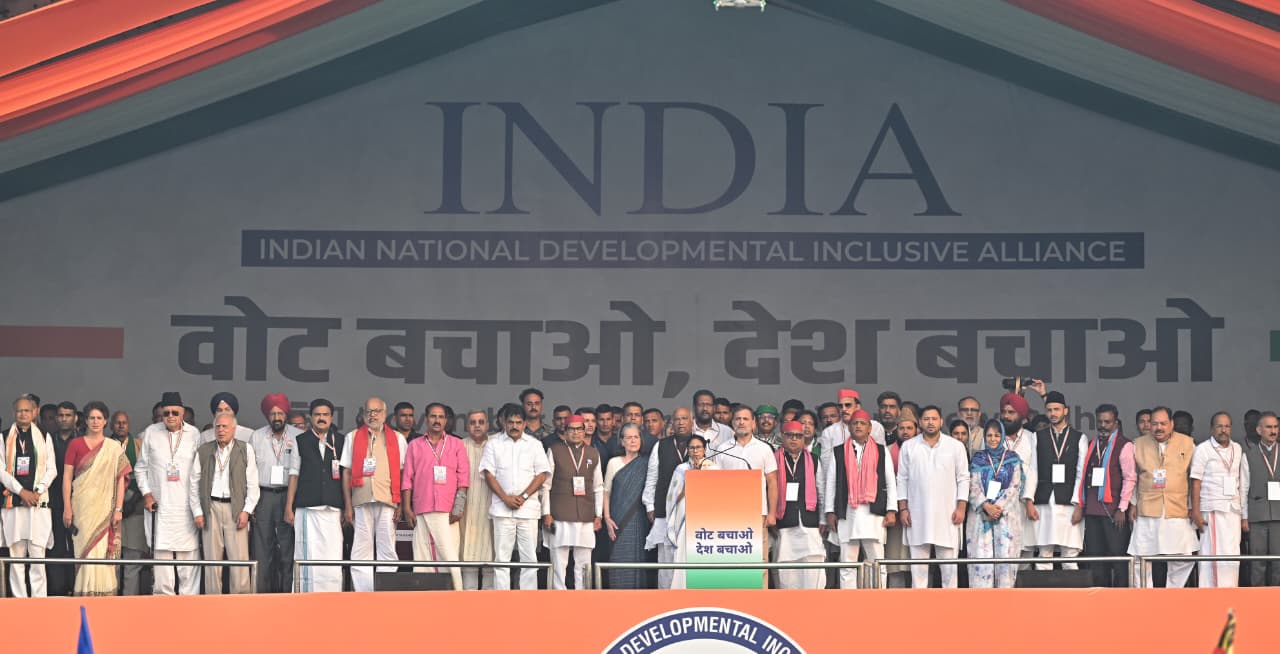
The unity on display should not be mistaken for the resolution of longstanding differences within the INDIA bloc. The parties remain competitors in several states, and sustaining cooperation beyond a single demonstration will require political accommodation and a shared programme. Yet, at a time when the BJP’s electoral dominance has often left opposition parties struggling to establish a common narrative, the ability to assemble on one platform is itself politically significant. It suggests that the perceived threat to electoral fairness may offer the opposition a broader point of convergence than individual state-level political calculations.
Rahul Gandhi’s growing prominence was another defining feature of the event. As Leader of the Opposition in the Lok Sabha, he has increasingly positioned himself as the principal political face of the campaign against alleged voter deletions. His appeal to students, farmers, workers, women and young people to join the march sought to take the issue beyond party cadres and frame it as a question of citizens’ rights. His leadership of the march, alongside leaders from across the opposition, reinforced his emerging role as a national figure capable of bringing disparate political forces together.
This does not automatically translate into electoral gains for the Congress or the INDIA bloc. Rahul Gandhi’s rising profile will ultimately be tested by the opposition’s ability to sustain its campaign, offer credible alternatives and convert public mobilisation into political support. But the BJP would be mistaken to dismiss his growing visibility as merely rhetorical. A leader who can make institutional accountability and constitutional rights central to a national political conversation poses a challenge that cannot be answered by personal attacks alone.
The larger significance of the march lies in the questions it has raised about public confidence in institutions and, by extension, the government that appoints and oversees them. The Election Commission is constitutionally independent, and allegations of partisan conduct must be examined on evidence rather than political assertion. However, when opposition parties and sections of the public repeatedly question the transparency of electoral processes, the responsibility to restore confidence rests heavily on the institution itself. Clear explanations, accessible records, consistent procedures and credible grievance-redress mechanisms are essential.
There are also wider signs of public dissatisfaction with the ruling dispensation that the BJP cannot afford to overlook. The opposition’s mobilisation reflects a belief among its supporters that democratic institutions are not being held sufficiently accountable. It would be premature to interpret one rally as proof of a nationwide collapse in public faith in the government. But neither should the turnout and the breadth of political participation be dismissed as inconsequential. The erosion of trust, once it takes hold, is difficult to reverse through political messaging alone.
The government may still command a formidable electoral and organisational machine. Yet, its democratic legitimacy depends not simply on winning elections but also on ensuring that citizens believe those elections are conducted fairly. The Election Commission must address concerns with evidence and transparency, while the government must resist the temptation to treat scrutiny as hostility.
The Chalo Delhi march may not resolve the opposition’s internal contradictions or settle the dispute over SIR. Its importance lies in having brought the issue back into public view and demonstrated that the opposition can, at least on certain questions, act collectively. For the BJP, the message is clear: electoral dominance does not make questions of accountability disappear.
For the opposition, the challenge is equally clear: a crowded Ramlila Maidan is a beginning, not a political victory. What matters now is whether the unity displayed on November 1 can be sustained, and whether the demand for transparency can be translated into verifiable answers and lasting public confidence.