Citizens Push Back Projects That Threaten Bengaluru’s Green Cover
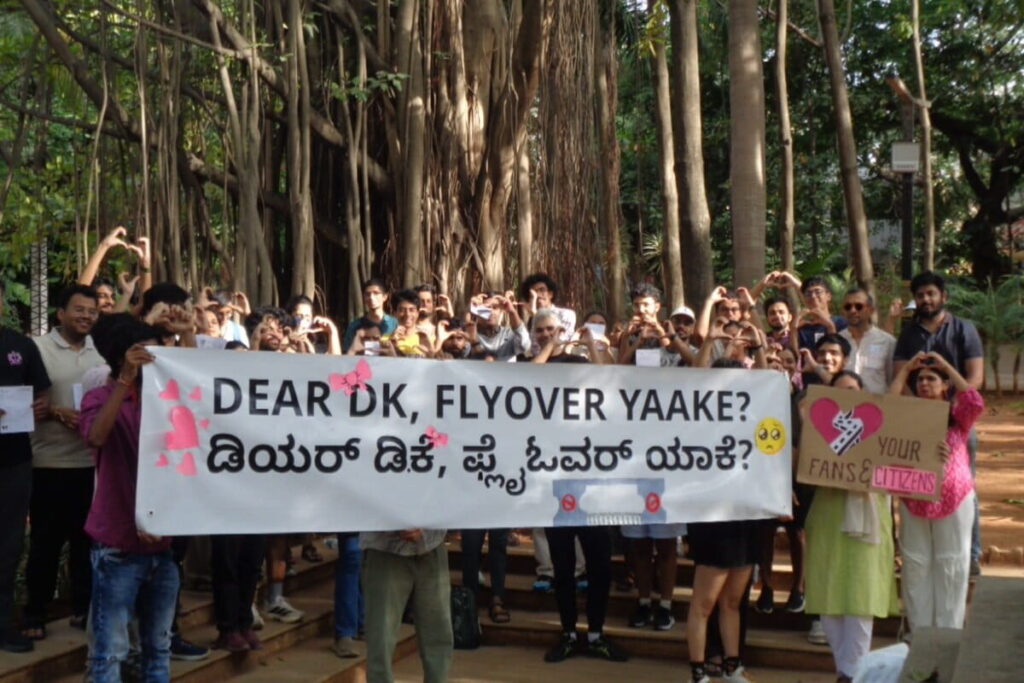
Bengaluru residents gather for the Dear DK city-wide campaign, which urges authorities to redirect funds from a flyover project towards public transport (Image by Asadullah M.A. Ansari)
- Bengaluru residents are protesting the loss of trees to elevated corridors and tunnel roads, with some of them counting trees at risk and questioning official estimates of tree loss.
- While mature trees and connected green spaces are vital safeguards against urban heat, studies show Bengaluru has lost 88% of its vegetation cover in five decades.
- Ecologists warn that compensatory planting and tree transplantation projected as remedies cannot fully offset tree loss.
Bengaluru, a city rapidly losing its green cover to infrastructure projects, had an important job to do: count its trees. In August 2019, the Karnataka High Court mandated the exercise under the Karnataka Preservation of Trees Act, 1976, setting a three-year deadline which wasn’t completed even seven years later.
Residents in some neighbourhoods decided to then take the task into their own hands, driven by the apprehension of losing trees to several large-scale infrastructure projects announced for the city, including flyovers and tunnel roads. What they found has prompted them to push back against some of these impending projects.
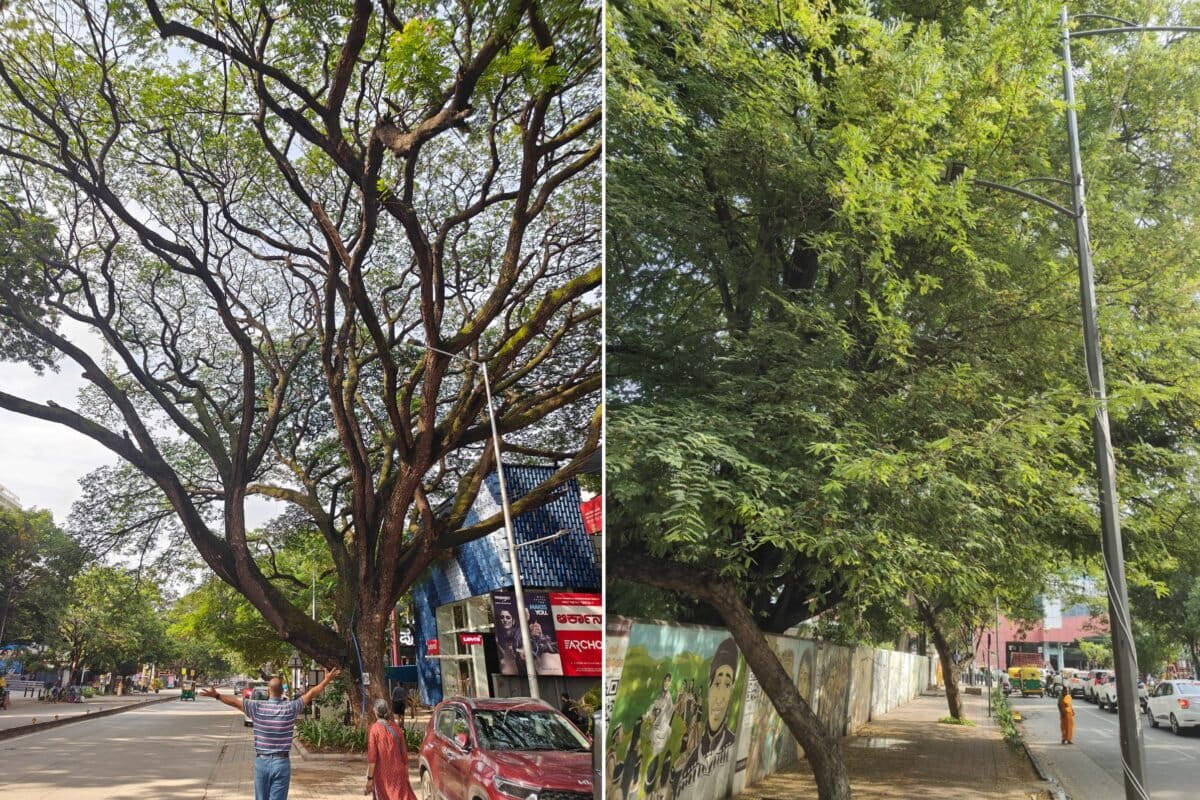
In east Bengaluru’s Indiranagar, a group of residents mapped the trees along the alignment of a proposed 13-km flyover from Swami Vivekananda Metro Station in the east to Silk Board Junction in the south, via Indiranagar. The flyover’s detailed project report (DPR) estimates that 89 trees will be felled for the proposed elevated corridor, while 235 trees fall within its construction width. The latter figure indicates the number of trees within the designated construction area, not necessarily the number that will be cut.
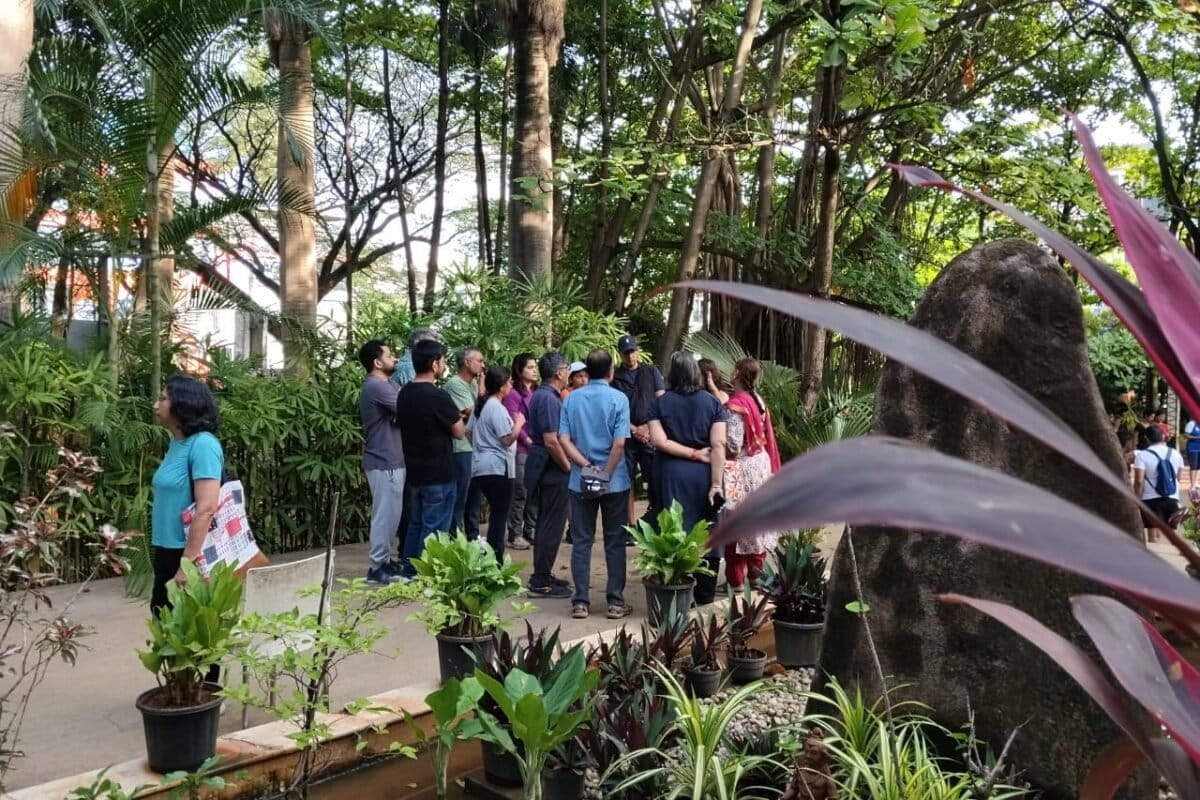
Unconvinced that these figures reflected the trees on the ground, I Change Indiranagar, a network of resident welfare associations in the area, decided to conduct an independent survey, starting with a roughly 3.5-km stretch of the route. The group counted 1,001 trees.
There is, however, a caveat. The DPR’s count of 235 trees covers the entire 13-km flyover alignment, while the residents surveyed only one section of it. Also, since they could not determine which trees would be directly affected by construction, they counted every tree along that stretch. “Our survey didn’t include the trees that will be cut inside the Swami Vivekananda Metro Station where the ramp will begin or a nearby church and temple whose premises will be taken. The count would be more than 1,001 if we included those,” says Sneha Nandihal, co-founder of I Change Indiranagar.
Four residents’ associations, including one Nandihal represents, filed a petition over the discrepancy, which is currently being heard in the Karnataka High Court. As a result, Bengaluru Smart Infrastructure Limited (B-SMILE), the agency implementing the project, has dropped one stretch of the flyover while the rest of the project continues. “There was a writ petition, so we did not want to hurry. We will abide by the court decision,” informs Balaji M.T., an official with B-SMILE.
Multiple campaigns to save trees
Harini Nagendra, Director of the School of Climate Change and Sustainability at Azim Premji University, has conducted several independent environment impact assessments in Bengaluru since 2007. She says discrepancies of this kind are common because DPRs tend to count trees selectively, often resulting in lower estimates.
Smaller trees are left out, undervaluing them, while “overmature” trees are excluded on the assumption that they are likely to die soon. “They are the very trees that deserve more attention,” she says, considering the carbon sequestration potential of mature trees.
The Indiranagar flyover is one of the 11 elevated corridors proposed across 75.6 km of the city, at an estimated cost of ₹13,000 crore. A separate citywide citizen’s campaign, Dear Dr DK, Flyover Yaake? is urging the authorities to rethink this approach and redirect the funds towards public transport. “Flyovers shift the choke point from one place to another,” says Asadullah M.A. Ansari, one of the campaign organisers. He points to the recently opened double-decker flyover between Silk Board and Ragigudda, which, instead of easing congestion at the junction, has been accused of shifting it to the next one.
Mongabay-India had earlier reported on a tunnel project in north Bengaluru’s Hebbal, where residents are opposing the proposed removal of 1,128 trees for a 2.2-km tunnel. GBA officials confirmed that they had received around 1,600 objections from residents after issuing a public notice on the proposed tree removal on September 19.
On October 16, the National Green Tribunal, hearing a petition challenging the felling, ordered that no trees be cut for the project until the case is decided. The next hearing is scheduled for December 15. The order does not halt other work on the tunnel, which is ongoing. A separate petition challenging the project is also before the Karnataka High Court.
Why green covers matter
These protests come against the backdrop of a city whose once-vaunted green cover has been thinning due to urbanisation, with far-reaching consequences. A 2014 study by the Indian Institute of Science (IISc) estimated that Bengaluru had 1.47 million trees for a population of 9.5 million, or roughly one tree for every seven residents. This was not enough to sequester even the carbon dioxide residents produce simply by breathing, estimated at 540-980g per person per day, says T.V. Ramachandra, author of the report and head of the Centre for Ecological Sciences at IISc.
A 2025 IISc study found that Bengaluru’s built-up area increased by 1,078% between 1973 and 2025. During the same period, vegetation cover shrank by 88% and water bodies by 79%. According to the study, this transformation contributes to the urban heat island effect, in which built-up areas become hotter than surrounding non-urban areas because surfaces such as concrete and asphalt absorb and radiate heat.
Vegetation and water bodies help counter this effect by acting as natural heat sinks. The IISc study found that land surface temperatures reached 40°C in built-up areas, falling as green cover increased to as low as 31°C in areas with dense vegetation or water cover.
Mature trees provide greater cooling than young plantings because of their larger canopies. “We have this wicked cluster of urbanisation, pollution, and climate change, which is trapping so much heat into our cities. The oldest trees are our best safeguard, especially in heat waves,” says Nagendra.
The other safeguard is unfragmented green cover, such as parks and tree-lined avenues. While comparable India-based research is lacking, studies elsewhere have shown that microclimate is not just affected by the number of trees, but the spatial pattern and connectivity of trees, says Nagendra. “When trees are more interconnected, you have better amelioration of urban heat islands and increased protection with shade because there are spillover effects to neighbourhood areas.” Street trees are also among the best weapons to reduce air pollution, she adds.
The IISc study recommends at least 30% vegetation cover in any given area to sustain a comfortable microclimate, but Ramachandra estimates that less than 4% of the city is currently under green cover.
Offsets are not enough
Mobility infrastructure projects often come with a stated offset. The DPR of the Indiranagar flyover sets aside ₹4.26 crore to plant 2,350 saplings “wherever possible in and around Bengaluru city area”.
Compensatory plantings are often carried out on the city outskirts or on secluded government land, Nagendra says, doing little for affected neighbourhoods. “If you compensate in some other place, you’re not going to get the social, environmental or ecological benefits for that region. That region is still going to suffer heat waves, pollution and the mental stress that comes from complete lack of greenery.” Replacing mature trees with saplings is no immediate solution either, as they take at least 30-40 years to provide some of the same benefits, she adds.
Some project reports propose tree transplantation, which involves relocating a tree with much of its root system intact. Bengaluru’s guidelines require trees to be assessed for species, age, size and health before transplantation. However, the Indiranagar flyover’s DPR, which proposes relocating 37 trees, provides no such details. At Hebbal, 1,050 of 1,128 trees marked for removal are slated for transplantation. The tree survey lists species, girth, height and condition, but not age or which trees will be moved.
Mature trees are difficult to transplant, with poor survival rates, Nagendra points out. “When they survive, they’re shocked so badly it takes them a really long time to recover.” Transplantation is largely limited to trees younger than 25 years, says Vijay Nishanth of Vruksha Foundation.
DPRs forget urban wildlife
By focusing narrowly on tree counts, project reports also fail to account for the broader impacts on urban biodiversity. I Change Indiranagar’s survey mapped ancient rain trees alongside saplings just five- or six-years-old, belonging to diverse species. “There are really old trees in the Swami Vivekananda Metro parking. In CMH park, there’s a huge banyan tree,” says Nandihal, pointing to birds such as parakeets and barbets that use these trees. Such details find no mention in the flyover’s DPR.
Similarly, the Hebbal tunnel tree survey does not assess the impact on Hebbal Lake, which is home to about 183 bird species. The tunnel will also pass through the Veterinary College campus, which hosts at least 95 bird species.
Project reports and many urban environmental impact assessments typically overlook habitat fragmentation, says Nagendra, with consequences for urban wildlife. Research shows that insects and butterflies respond to green spaces within a three-kilometre radius, while birds respond within five kilometres. “So they need unfragmented habitats to move,” she says.