‘Hellhole’ Remark: India’s Global Image Still Battles Western Bias
Shalini Apr 24, 2026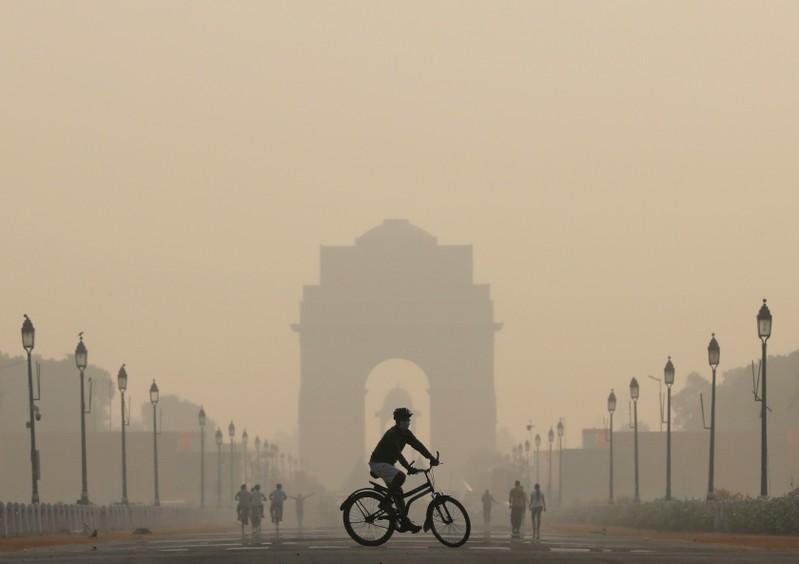
FILE PHOTO: A man rides a bicycle on a smoggy morning near India Gate in New Delhi
“A baby here becomes an instant citizen, and then they bring the entire family in from China or India or some other hellhole on the planet,”read a post made by Donald Trump on his Truth Social account on April 23.
The remark was part of a four-page transcript of comments made by podcaster Michael Savage shared by Trump. In his transcript, Savage accused people from India and China of abusing the privilege of America’s birthright citizenship.
When Donald Trump endorsed the description of India as a “hellhole,” it did more than spark outrage—it revived a long-standing debate about how India is perceived in parts of the so-called developed world. The use of such a stark, dismissive term is not just diplomatically abrasive; it reflects and reinforces a deeply embedded narrative that reduces India to a set of negative tropes, often ignoring its remarkable transformation over recent decades.
Usage of words like “hellhole” is not neutral. It carries historical baggage and taps into a reservoir of imagery that has been cultivated over centuries—of India as dirty, chaotic, overcrowded, and unhygienic. These perceptions, while sometimes rooted in visible challenges, are frequently exaggerated and stripped of context. When a global political figure uses such terminology, it validates these biases for wider audiences, particularly those with limited or second-hand exposure to India.
What makes this especially problematic is the disconnect between rhetoric and reality. India is not a monolith defined by its problems; it is a complex, rapidly evolving nation that has made significant advances in technology, infrastructure, and global influence. Yet, such progress often struggles to compete with the persistence of outdated stereotypes in international discourse.
Progress Ignored: India Beyond the Stereotype
Over the past three decades, India has undergone a transformation that is difficult to overstate. It is now one of the world’s largest economies, a major player in global supply chains, and a hub for innovation. Organizations like the Indian Space Research Organisation have achieved milestones that rival those of far wealthier nations, including cost-effective space missions that have drawn global admiration.
In the technology sector, India’s contributions are immense. Its IT industry powers businesses worldwide, while Indian engineers and scientists hold leadership roles in some of the biggest global firms. The country’s digital infrastructure—from biometric identification systems to real-time payment platforms—has been hailed as a model for scalability and efficiency.
Despite this, Western portrayals often remain stuck in a time warp. Images of slums, open drains, and pollution continue to dominate coverage, creating a skewed perception. These issues do exist, but they coexist with modern cities, cutting-edge research facilities, and a growing middle class. The problem is not that challenges are highlighted, but that they are disproportionately emphasized at the expense of progress.
Trump’s “hellhole” comment fits squarely into this pattern. It collapses a vast, diverse nation into a single derogatory image, ignoring both scale and nuance. In doing so, it mirrors a broader tendency within certain Western narratives to view developing countries through a deficit lens—focusing on what they lack rather than what they have achieved.
The Roots of Bias: Colonial Hangovers and Cultural Superiority
To understand why such perceptions persist, one must look beyond contemporary politics to historical context. During the colonial era, European powers frequently portrayed colonized societies as backward and inferior. These depictions were not accidental; they served to justify domination and exploitation. India, under British rule, was often described in precisely the kinds of terms that still echo today—unsanitary, disorganized, and in need of “civilizing.”
Although formal colonialism has ended, its narratives have proven remarkably durable. They have seeped into education, media, and cultural attitudes in subtle ways. The idea of the “developed” West versus the “underdeveloped” rest of the world is not just an economic classification; it often carries implicit assumptions about cleanliness, order, and superiority.
When a figure like Trump approves the uses of the word “hellhole,” it taps into this legacy, whether consciously or unconsciously. It signals not just criticism, but dismissal—a refusal to engage with complexity. This is where accusations of bias and even racism gain traction. The issue is not merely that India is criticized, but that it is often judged by harsher, less nuanced standards than Western nations facing their own serious challenges.
Selective Vision and Double Standards
One of the most striking aspects of this discourse is the presence of double standards. Many Western countries grapple with issues such as homelessness, drug crises, urban decay, and systemic inequality. Yet, these problems are rarely used to define the entire nation in the same sweeping, derogatory terms.
In contrast, challenges in India—be it sanitation, pollution, or infrastructure gaps—are often generalized to represent the whole country. This selective framing reinforces a hierarchy of perception, where flaws in developing nations are seen as inherent, while those in developed countries are treated as exceptions.
Media plays a significant role in perpetuating this imbalance. Sensational imagery and narratives tend to attract more attention, and stories that confirm existing stereotypes are more likely to be amplified. As a result, the global audience receives an incomplete picture—one that aligns neatly with preconceived notions.
Challenging the Narrative Without Ignoring Reality
None of this is to suggest that India is without problems. Issues like urban sanitation, environmental degradation, and inequality are real and require sustained effort. However, acknowledging these challenges does not justify reducing the country to a derogatory label.
The more productive approach lies in balanced engagement—recognizing both shortcomings and achievements. India’s efforts in improving sanitation, expanding infrastructure, and driving digital inclusion demonstrate a trajectory of progress. These developments deserve as much visibility as the problems.
At the same time, it is important not to fall into the trap of painting the entire “developed world” as uniformly biased or racist. Attitudes vary widely, and many individuals and institutions in Western countries engage with India in informed, respectful ways. The issue is less about a monolithic prejudice and more about persistent narratives that have yet to catch up with reality.
Words Matter, Perceptions Matter More
The use of the word “hellhole” is more than a passing insult—it is a reflection of how powerful language can reinforce outdated and unfair perceptions. For India, the challenge is twofold: continuing to address genuine domestic issues while also reshaping its global image.
Breaking free from entrenched stereotypes requires more than rebuttal; it demands consistent storytelling, visibility of achievements, and deeper cross-cultural understanding. Until then, remarks like these will continue to find resonance—not because they are accurate, but because the narratives they draw upon remain stubbornly alive.