Whose Water Is AI Drinking In India?
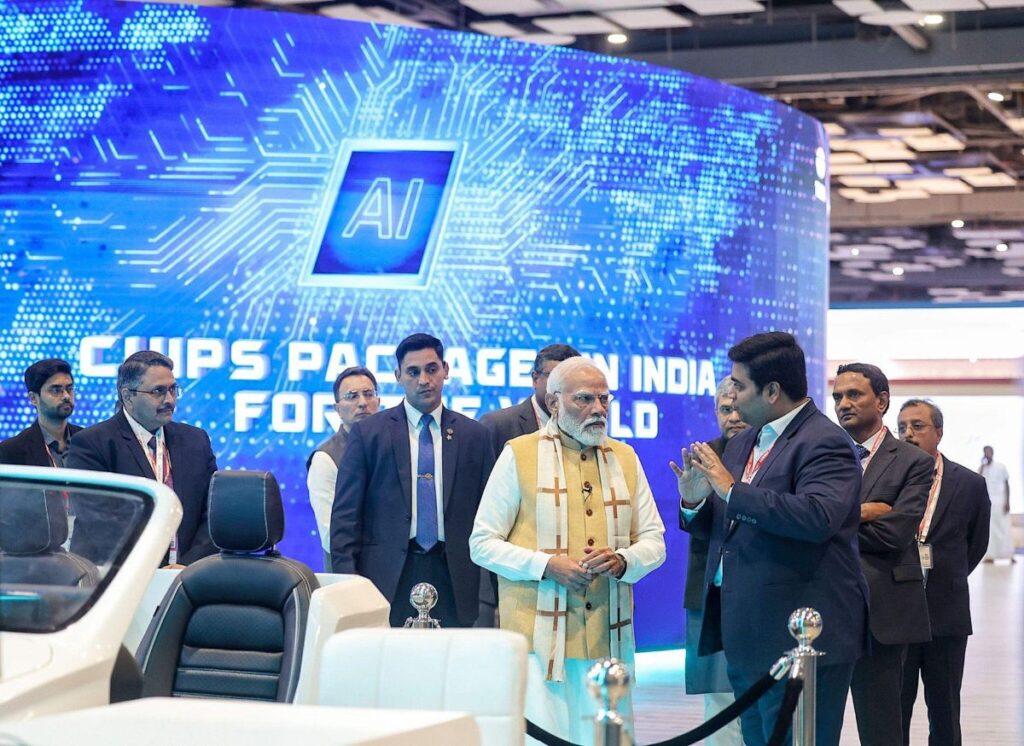
Prime Minister Narendra Modi at the February 2026 India AI Impact Summit in New Delhi (Image: Seshadri SUKUMAR / Alamy)
Every tech giant in the world is interested in building AI data centres in India. Late last year, Microsoft, Amazon and Google committed tens of billions of dollars to doing so. This year, the Adani Group pledged USD 100 billion, bringing the combined first wave to USD 167.5 billion.
India is now confronted with a question societies need to field time and again as technologies evolve. It is not whether the country should embrace AI, but on whose terms and at what cost.
Technologies do not arrive as neutral instruments. They come as forces – creative or destructive, liberating or dispossessing – shaped by the interests and ideologies of those who deploy them. The steam engine inaugurated industrial capitalism and facilitated colonial extraction. The Green Revolution fed millions and indebted millions more. Artificial intelligence carries similar epoch-making potential, but India is welcoming it at a peculiarly fraught moment.
The country is simultaneously one of the world’s most ambitious technology adopters and one of its most unequal societies, beset by deepening environmental stress, caste-based discrimination and resource scarcity. In early 2026, it hosted a high-profile international summit on AI governance, signalling its aspiration to be a rule-setter rather than merely a rule-taker in the global AI order. However, the current trajectory of AI infrastructure investment in India is a deeply political allocation of a scarce common resource. How water is being shared is systematically disadvantaging society’s most vulnerable.
A government press release indicates that India’s data centre IT capacity has quadrupled, from 0.4 gigawatts (GW) in 2020 to 1.5 GW by 2025, with consultancy firm Deloitte projecting 8-10 GW more to be built by 2030.
Every large data centre requires enormous quantities of water to cool its servers. A single 100-megawatt facility can consume roughly two million litres of water per day. India’s data centres collectively consumed about 150 billion litres in 2025. That is projected to more than double, to approximately 358 billion, by 2030.
Where in India are these facilities being built? Mumbai, Bengaluru, Chennai, Hyderabad, Delhi-NCR – major hubs already confronting acute water shortages or inequities.
Bengaluru’s data centres alone consume over 26 million litres each year, even as the city recently experienced what was described as its “worst water crisis” in nearly five centuries. Hyderabad faces a projected water deficit of 870 million litres per day by 2027, yet Amazon continues to expand its facilities there. Chennai, which experienced its own “Day Zero” in 2019 when the city’s main reservoirs ran completely dry, remains among the most sought-after destinations for server farms. Much of the investment is, in other words, heading into water-stressed places.
The social geography of water
Access to water in India has always been saturated with relations of power – caste, gender and class structures – which dictate who receives it, who is denied it and who is punished for claiming it.
Caste remains the most pervasive determinant. Dalits have been systematically excluded from accessing water sources for centuries. In the Mahad Satyagraha of 1927, B. R. Ambedkar led Dalits to drink from a public tank that caste custom forbade them to touch. It was a watershed moment in modern Indian history precisely because it named water access as a fundamental question of human dignity and political equality. That battle is not over. Dalits continue to be denied access to wells, taps and water distribution systems in villages across the country; in some regions, when they fetch water from areas frequented by the dominant caste, they are subjected to violence, social boycott or both.
Class also mediates access in urban India in particularly sharp ways. In cities like Bengaluru, water has become a commodity distributed through informal tanker networks whose prices spike dramatically during shortages. During the 2024 Bengaluru water crisis, residents in peripheral areas reported steep increases in private tanker prices. Older core urban districts with piped supply were comparatively better protected, whereas rapidly growing peripheral neighbourhoods and many commercial developments – including in the city’s tech corridors – depended on borewells and tankers and experienced the sharpest price shocks. The urban poor, lacking the capital to stockpile or to purchase from private suppliers, absorb the most severe impacts of water scarcity; in this sense, the informal economy of water operates as a regressive tax on poverty.
Ambedkar’s argument at Mahad was simple and devastating: “We are not going to the Chavadar Lake merely to drink its water. We are going to the lake to assert that we too are human beings like others. It must be clear that this meeting has been called to set up the norm of equality.”
Applied to the age of AI, this assertion on the norm of equality requires little modification. When 342 million Indians still lack access to safe drinking water, the decision to prioritise the cooling of AI servers, operated by some of the most profitable corporations in human history, is not a technical policy choice. It is a political one. It is a choice about whose consumption matters and whose deprivation is acceptable collateral damage.
The latest UN water report’s warning is stark: diverting water from agricultural and household use can mean unemployment, social unrest and cascading humanitarian consequences. In the Indian context, this is already happening at the margins, and the current scale of data centre investment will push it to the centre. The communities most likely to bear the cost are those already most water-insecure: Dalits, Adivasis, women in water-scarce districts, the urban poor living outside the formal supply grid.
Hierarchies of sacrifice
The standard corporate response to these concerns is a set of technocratic pledges: recycled wastewater, air cooling technologies, “water-positive” commitments, and efficiency star ratings. These deserve scrutiny. Only about half of data centre operators globally tracked their water usage in 2020; just 10% did so across all their facilities. Google’s global water consumption increased by 17% in 2023 alone. Microsoft, the New York Times found, has internally projected “that water use at its data centres will more than double by 2030 from 2020, including in places that face shortages”. Globally, roughly two-thirds of all new data centres built since 2022 have been in water-stressed regions, and only five of 15 Indian state data centre policies contain any sustainability parameters.
The so-called solutions on offer are, in this light, technocratic adjustments to a fundamentally flawed premise: that this scale of expansion is inevitable and desirable. They tinker at the margins of the problem while accepting its structural cause. The efficiency metric improves, the water still disappears, and the communities downstream still go without. This is not sustainable development; it is the optimisation of extraction.
The defenders of this model will argue that AI is critical national infrastructure, that data centres create employment and tax revenue, and that India cannot afford to be left behind in the global AI race. These arguments deserve engagement, but they cannot be engaged with honestly without acknowledging what they elide: that critical infrastructure, historically in India as elsewhere, has often been built on the dispossession of those with the least political voice.
The AI revolution need not be a resource-injustice revolution. But averting that outcome needs more than corporate sustainability pledges and efficiency metrics. It requires a binding national framework aligning data centre siting and water consumption with hydrological realities. It requires mandatory disclosure of water usage, enforceable targets and genuine penalties for non-compliance. It requires environmental clearance for large-scale digital infrastructure to incorporate water-equity assessments that centre the rights of Dalits, Adivasis, women and the poor – not merely the interests of investors. India’s aspiration to be an AI power is legitimate. But it will be hollow, and ultimately unstable, if it is built on the thirst of those who already have the least.
Technologies are, in the end, social choices. The choice before India today is whether its AI infrastructure will deepen existing inequalities or help to dismantle them. That choice must be made not only in the server rooms of Bengaluru or Hyderabad, but equally importantly in the laws, regulations and political priorities that govern whose water, and whose future, is considered worth protecting.