‘(The Real) Issue Was Not Women’s Reservation But Modi Preservation’
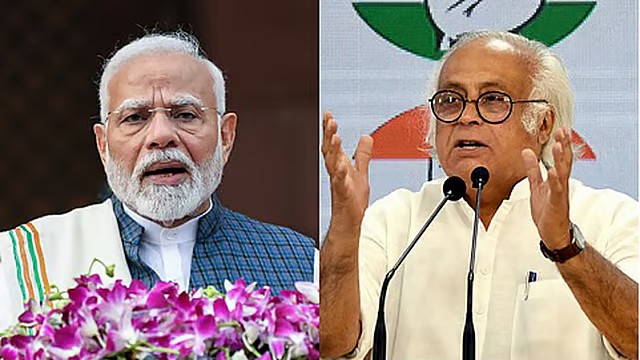
PM Narendra Modi and Congress leader Jairam Ramesh, who called the defeat of the Women's Reservation Bill a blow to ‘bulldozer politics’ (Image: MetroVarthaa)
The Congress on Monday sharpened its attack on the Centre following the defeat of the Constitution (131st Amendment) Bill in the Lok Sabha, framing the outcome as a decisive rejection of what it described as a politically motivated attempt to push delimitation under the guise of women’s reservation. Senior party leader Jairam Ramesh argued that the episode exposed the government’s “real agenda,” asserting bluntly: “The issue was not women’s reservation but Modi preservation.”
The Bill, which proposed 33 per cent reservation for women in the Lok Sabha while simultaneously increasing the total number of seats from 543 to 816, failed to secure the constitutionally mandated two-thirds majority. It garnered 298 votes in favour and 230 against—well short of the 352 required for passage. For the Congress, this shortfall was not merely a legislative defeat for the government, but a symbolic repudiation of what it calls a “deceptive” policy design.
“Bulldozer Politics” and the Delimitation Push
Ramesh did not mince words in characterising the government’s approach. “It was the defeat of the politics of bulldozer and a rushed delimitation,” he said, accusing the Centre of attempting to “push delimitation through deceit.” According to him, the linkage between women’s reservation and delimitation based on the 2011 Census was neither incidental nor benign, but a calculated move with deeper political implications.
By tying the implementation of reservation to a future delimitation exercise, the government effectively postponed the actual delivery of quotas, critics argue. “The Bill was not about women’s reservation but one of pushing delimitation through deceit,” Ramesh reiterated, suggesting that the framing of the legislation masked its true intent.
The Congress has consistently expressed concern that delimitation—especially one based on outdated census data—could disrupt the federal balance by altering representation among states. These fears were compounded by the absence of explicit safeguards in the Bill itself. Ramesh questioned assurances made by Union Home Minister Amit Shah that no state would lose representation, asking pointedly: “How can we trust someone who says something, but the Bill doesn’t mention it in black and white?”
For the opposition, this gap between verbal assurances and legislative text is emblematic of a broader pattern. The criticism goes beyond procedural objections to touch on issues of transparency and intent. The Congress maintains that if the government were genuinely committed to women’s empowerment, it would have ensured that the reservation provisions were immediate and unconditional, rather than contingent on a complex and potentially contentious delimitation process.
Questions on Intent and Delayed Implementation
Another major line of attack from the Congress concerns the timing and implementation of the Nari Shakti Vandan Adhiniyam, which had been passed unanimously in September 2023 but remained dormant for over two years. Ramesh highlighted what he sees as a glaring inconsistency: “Suddenly, the Act was notified on the night of April 16. This reflects the seriousness of the BJP about women’s reservation… They kept sleeping for 30 months.”
This delay, according to the Congress, undermines the government’s claims of commitment to gender justice. The party argues that the sudden notification of the Act, followed by the introduction of a contentious amendment, suggests a politically expedient rather than principled approach.
Ramesh also pushed for immediate implementation of women’s reservation without linking it to delimitation. “We demand immediate implementation of women’s reservation in the legislatures on the current strength of the Lok Sabha,” he said, urging the government to bring a fresh amendment either in the upcoming Monsoon Session or sooner. The Congress has further called for the inclusion of Other Backward Classes (OBC) women within the quota framework, expanding the scope of representation.
The party has also demanded greater transparency and consultation, renewing its call for an all-party meeting after April 29, once polling in West Bengal concludes. It has asked the government to place its proposals in writing before engaging with political stakeholders, a move aimed at ensuring clarity and accountability.
Beyond the immediate legislative battle, the Congress has accused the government of attempting to sideline broader social justice issues, including the demand for a caste census. This, it argues, reflects a selective approach to reform that prioritises political optics over substantive change.
Responding to remarks by Prime Minister Narendra Modi that women would respond to opposition criticism, Ramesh countered that women voters are “fully aware” of the Congress’ historical role in advancing reservations in local bodies. He dismissed the government’s narrative as “propaganda,” asserting that it would not mislead an informed electorate.
As the political fallout continues, the debate over women’s reservation and delimitation remains a flashpoint. With both sides trading claims and counter-claims, the episode has not only stalled a key piece of legislation but also intensified scrutiny of the government’s legislative priorities and political strategies.