From Kashmir To Delhi? Internet, Metro Curbs Raise Questions Over Govt Response
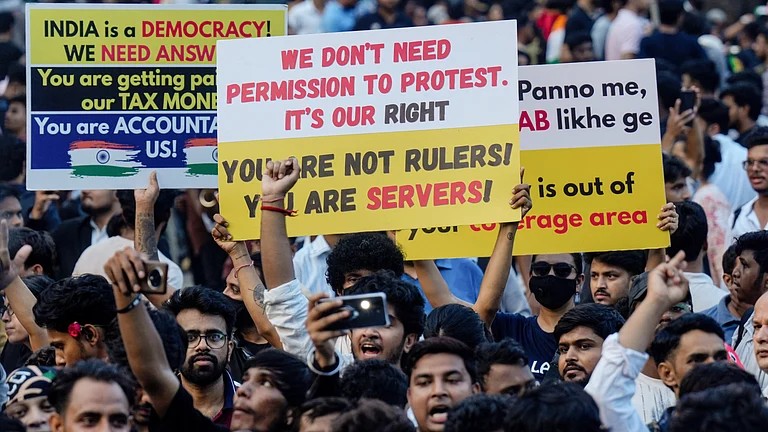
Students continue their protest at Delhi's Jantar Mantar. The shutdown of internet and Metro services in Delhi, even if limited to certain areas, has become one of the most contentious tools in India's recent security playbook. Over the past decade, internet suspensions have frequently been imposed in Jammu and Kashmir, particularly after major political developments or unrest
The images emerging from parts of Delhi over the past several days have been striking. Internet disruptions, barricaded roads, closed Metro stations, heavy police deployment and restrictions around key government areas have transformed sections of the national capital into zones of heightened security. For many observers, the measures evoke uncomfortable comparisons with a place where such restrictions have become all too familiar: Kashmir.
Authorities have cited law and order concerns to justify internet suspensions and mobility restrictions in parts of Delhi amid escalating student protests over alleged examination irregularities. While governments often argue that temporary curbs are necessary to prevent misinformation, violence or disruption, critics contend that such measures come at a significant democratic cost.
The shutdown of internet services, even if limited to certain areas, has become one of the most contentious tools in India’s security playbook. Over the past decade, internet suspensions have frequently been imposed in Jammu and Kashmir, particularly after major political developments or periods of unrest. For many Indians, Kashmir became synonymous with prolonged communication blackouts, where residents found themselves cut off from information, family members and even essential services.
Seeing similar methods deployed in the nation’s capital inevitably raises difficult questions. Is the state increasingly relying on extraordinary restrictions to deal with political dissent? Or are authorities responding to what they perceive as genuine security risks?
The answer is unlikely to be straightforward. Yet the symbolism is impossible to ignore.
Delhi occupies a unique place in India’s democratic imagination. It is where Parliament sits, where national policies are debated, and where citizens traditionally gather to make their voices heard. Protest sites such as Jantar Mantar and Ramlila Maidan have long served as venues for public expression. When restrictions associated with conflict-prone regions begin appearing in the capital, the comparison naturally attracts attention.
The latest protests have centred on allegations of examination irregularities and demands for greater accountability in the country’s competitive examination system. Students have been joined by activists, political parties and civil society groups, turning what began as a sectoral issue into a broader public debate about governance, transparency and the future of young Indians seeking educational and employment opportunities.
One of the most visible consequences of the government’s response has been the closure of Metro stations in central Delhi. While authorities often suspend Metro services as a precautionary measure during large demonstrations, the impact extends far beyond protesters.
Thousands of office workers, students, tourists and daily commuters depend on the Delhi Metro as the city’s primary mode of transport. When stations in the heart of the capital are shut, the ripple effects spread quickly across the network. Longer travel times, overcrowded alternative routes, missed appointments and additional transport costs become part of everyday life for people who have no connection to the protests.
For a city that prides itself on one of the world’s largest and most efficient Metro systems, repeated closures highlight the difficult balance between maintaining public order and ensuring uninterrupted public services.
Internet blackouts — what is the compulsion?
Internet disruptions create another layer of inconvenience. In a digital economy, connectivity is no longer a luxury. It is essential for navigation, banking, education, emergency communication, food delivery, ride-hailing services and countless other daily activities. Even localized shutdowns affect businesses, freelancers, delivery workers and residents who rely on uninterrupted internet access for their livelihoods.
Critics argue that these restrictions can have a chilling effect beyond their immediate purpose. Limiting communication makes it harder for people to document events, verify information and coordinate peaceful gatherings. At the same time, authorities maintain that restrictions are intended to prevent rumours and maintain public safety during sensitive situations.
The scale of the security response has also fuelled political debate. Opposition parties have argued that the government’s actions reflect discomfort with the size and persistence of the student movement. The government, however, has maintained that law enforcement measures are aimed at preserving public order and preventing disruptions in high-security areas.
Whether the administration is politically rattled by the growing protests is ultimately a matter of interpretation rather than an established fact. The unusually extensive deployment of security personnel, preventive detentions, transport restrictions and communication curbs has nevertheless prompted questions from critics about whether the response has been proportionate to the situation.
Student movements have historically occupied a significant place in India’s political history. From the JP Movement of the 1970s to anti-corruption protests and more recent demonstrations on education and employment, young people have repeatedly emerged as powerful voices capable of influencing public discourse.
Unlike many protests driven by party politics, student movements often resonate across ideological lines because they revolve around aspirations shared by millions of families—education, fairness and employment opportunities.
That is why the present moment carries significance beyond the immediate controversy surrounding examination irregularities. It has become a test of how democratic institutions respond when large numbers of young citizens seek accountability.
The comparison with Kashmir should therefore not be understood as suggesting that the situations are identical. The historical, political and security contexts are fundamentally different. However, similarities in the methods employed—temporary internet restrictions, movement controls and heightened policing—have inevitably prompted public discussion about the normalization of such measures in situations involving civic protest.
Every government has a responsibility to maintain law and order. Equally, every democracy has an obligation to safeguard peaceful dissent and minimize restrictions on ordinary citizens. Finding that balance is never easy.
As Delhi returns to normalcy, the debate is unlikely to end with the reopening of roads or restoration of internet services. Instead, it may leave behind a broader question: when extraordinary measures increasingly become part of the response to public protest, where should a democracy draw the line between security and civil liberty?