Wangchuk Ends His 26-Day Hunger Strike, CJP Says Protest Will Go On
Sonam Wangchuk, activist and education reform advocate, ended his 26-day indefinite hunger strike on Thursday night after the Centre promised to address several key concerns emerging from the nationwide student movement against alleged examination irregularities
Activist and education reform advocate Sonam Wangchuk on Thursday night ended his 26-day indefinite hunger strike after the Centre assured him that several key concerns raised during the nationwide student agitation over alleged examination irregularities would be addressed.
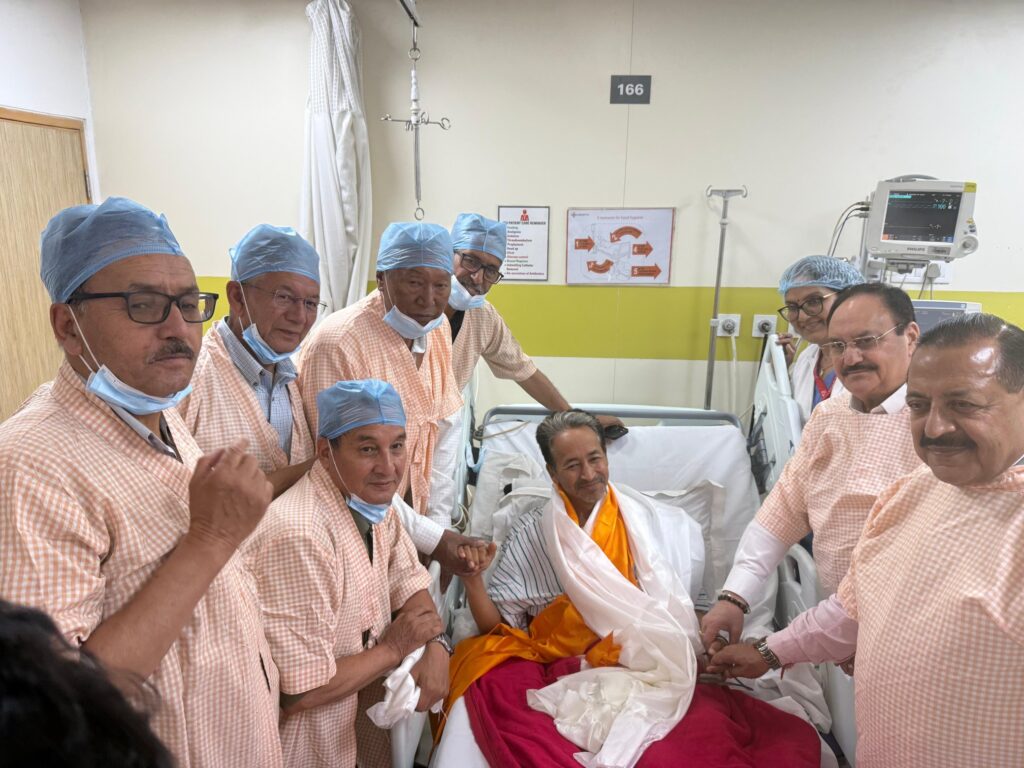
The breakthrough came shortly before midnight at Medanta Hospital in Gurugram, where Wangchuk had been undergoing treatment while continuing his fast under medical supervision. Union Ministers J.P. Nadda and Jitendra Singh met the activist in the presence of senior leaders of the Apex Body of Leh Ladakh and conveyed the Centre’s assurances, prompting Wangchuk to finally call off his fast.
Announcing his decision in a post on X, Wangchuk said, “Just now, in the presence of Union Ministers J.P. Nadda, Dr Jitendra Singh and the senior leaders of Apex Body of Leh Ladakh, I finally broke my fast after 26 days.”
Soon after the announcement, Prime Minister Narendra Modi wished Wangchuk a speedy recovery and urged him to focus on regaining his health.
“I urge Sonam ji to follow his daily routine as advised by the doctors and regain his weight as soon as possible. I pray to the Almighty that Sonam ji remains healthy,” Modi wrote on X.
Reading out the government’s assurances at the hospital, Union Health Minister J.P. Nadda said the Centre had taken a positive view on several issues raised during the agitation.
“The government is positive on not registering cases against those protesting peacefully at Jantar Mantar in Delhi and those who participated in the march to Parliament on July 20, 2026,” Nadda said.
He also reiterated the government’s commitment to discussing examination paper leaks and broader reforms in Parliament.
“The government has already assured discussions in Parliament on the issue of paper leaks and broader reforms in the examination system. Besides, the government is also positively considering suitable compensation for the suicide victims of recent NEET paper leaks,” he added.
The assurances marked the first major breakthrough after nearly four weeks of protests centred on allegations of examination irregularities, demands for education reforms and calls for greater accountability in the country’s competitive examination system.
Reflecting on the movement, Wangchuk said the support he received had gone beyond political affiliations.
“Sixty-five Members of Parliament, cutting across political lines, either met me personally or signed letters urging me to end my fast,” he said.
He added that his decision followed prolonged negotiations and was taken to prevent further unrest.
“This was done after long negotiations on various conditions and in view of possible violence in the country. I will explain the conditions in detail in a separate video very soon. Meanwhile, I urge you all to stay very vigilant about not allowing violence of any kind anywhere,” Wangchuk said.
While Wangchuk has ended his fast, the Cockroach Janta Party (CJP), which spearheaded the agitation at Jantar Mantar, made it clear that its protest would continue until its broader demands are met.
In a statement issued on Friday, CJP founder Abhijeet Dipke thanked Wangchuk for what he described as an extraordinary sacrifice while reaffirming that the movement was far from over.
“We are relieved and grateful that Sonam sir has ended his hunger strike after 26 days. Thank you, sir, for your extraordinary courage and sacrifice. By putting your own life on the line, you awakened the conscience of an entire nation. Your life is far too precious to this country,” Dipke said.
He added that the organisation would continue its peaceful protest until Union Education Minister Dharmendra Pradhan stepped down.
“The Cockroach Janta Party’s peaceful protest at Jantar Mantar will continue until Dharmendra Pradhan resigns,” he said.
Apart from demanding Pradhan’s resignation, the organisation has sought accountability for alleged examination irregularities, comprehensive reforms in the education system, compensation of Rs 1 crore for the families of students who allegedly died by suicide following the NEET paper leak controversy, and the withdrawal of all FIRs and legal proceedings against peaceful protesters.
Wangchuk joined the CJP-led protest at Jantar Mantar on June 28, launching an indefinite hunger strike in solidarity with students demanding accountability over alleged examination irregularities, education reforms and the resignation of the Union Education Minister.
Over the course of his 26-day fast, the activist reportedly lost nearly 11 kilograms. Even as his health deteriorated, he repeatedly appealed to supporters to remain peaceful despite the police action during the ‘Sansad Chalo’ march on July 20.
On July 18, Delhi Police shifted Wangchuk from the protest site to Safdarjung Hospital, citing concerns over his deteriorating condition. His wife, Gitanjali Angmo, challenged the move before the Delhi High Court, arguing that he was being kept at the government hospital against his wishes.
The High Court later facilitated his transfer to Medanta Hospital in Gurugram, where he continued his fast under specialist medical care.
Even while hospitalised, Wangchuk maintained that he wished to return to his students and resume his work as an educator but could not end the fast until meaningful safeguards were offered for the young protesters whose demands had inspired the movement.
With the Centre now assuring discussions on examination reforms, expressing a positive stance on refraining from prosecuting peaceful protesters and considering compensation for families affected by the NEET controversy, Wangchuk has ended his fast. However, with the CJP and student groups continuing their agitation, the wider debate over examination integrity, accountability and education reforms is expected to remain at the centre of the national conversation.