Purging Millions From W Bengal’s Voters’ List Risks Their Disenfranchisement
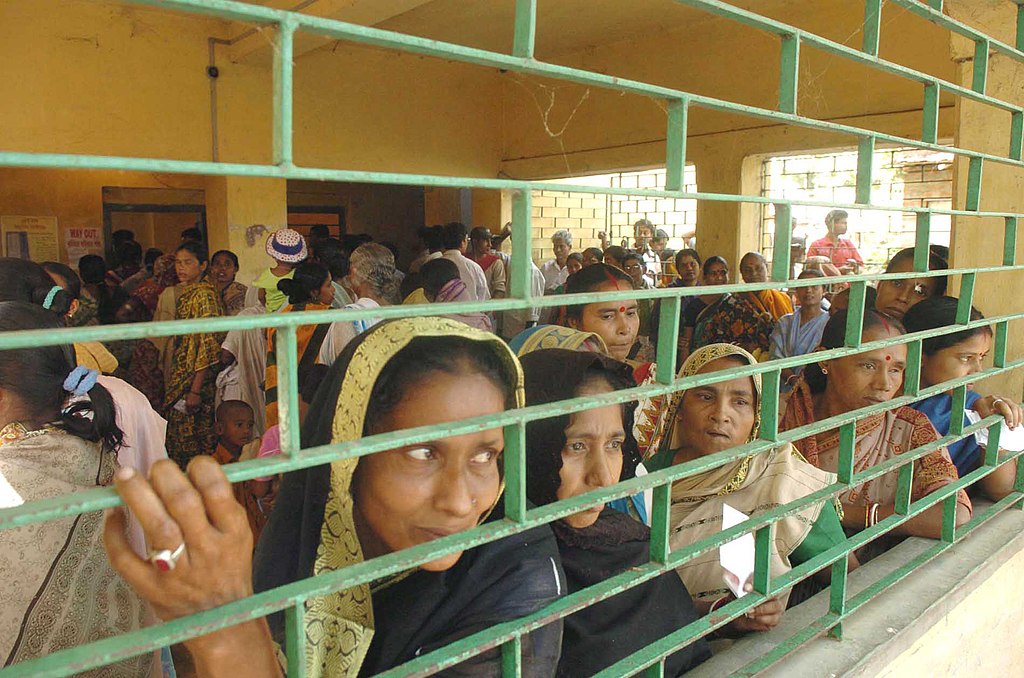
Voters at a polling station in Hooghly, West Bengal. A disproportionate number of Muslims were called for SIR-related hearings in West Bengal (Image: Government Open Data License – India, Wikimedia Commons)
A resident of Malda district, Shweta Das found to her consternation that her name had been struck off the West Bengal electoral roll published on February 28.
But Shweta’s parents’ names were on the list even as she appeared for an in-person hearing which is part of the contentious and controversial Special Intensive Revision of the voters list.
The case of Kolkata-based researcher Sabir Ahmed’s octogenarian father, an Indian passport holder, is under “adjudication”, leaving his citizenship in question.
The new roll does not contain 540,000 names – effectively struck off – and has placed an additional 60,06,675 names, in a total electorate of 7,08,16,630 people, under adjudication. While the draft list was published in December 2025, the number of people placed in the adjudication category is a little more than 8 percent of the total voters.
The rationale followed in the process and the ways to resolve such adjudications are not known. What is, however, known is that the final voters list has shrunk by 16 percent.
Since the SIR exercise in Bihar concluded just before the scheduled Assembly elections last year, researchers and citizens’ groups alike have pointed out that the task both disproportionately affects marginalised groups and, in Bihar, had targeted Muslims (through Form 7 or reporting of ‘doubtful’ voters). In one instance, the BJP, which secured the largest vote share in the election, had attempted to mark and delete 80,000 voters in a single constituency as doubtful.
In Bengal, the tragedy unfolded swiftly. Between November 2025 and January 2026, nearly a hundred people died of suicide or ailments attributed to SIR- related stress. They include overworked Booth Level Officers (BLOs) – ranging from school teachers to anganwadi (courtyard shelter) workers, and voters who were worried over seemingly trivial issues such as spelling errors in the 2002 list which framed the basis of the mapping exercise which then led to the new electoral roll.
Dreaded notices
As thousands of BLOs worked under the ECI’s supervision to prepare lists of existing voters, as well as to enumerate the dead and to take stock of people who had permanently moved out of their localities, the draft list soon gave way to endless hearing notices and fear over what would be one’s fate if one missed a hearing.
Reports of an anguished father appearing for hearing after leaving his wife and child’s dead bodies in the morgue, of grooms appearing for hearing instead of the wedding and of the elderly and the sick travelling to hearing centres in ambulances were routine.
The hearing notices were not sent merely to the unmapped, but also to those clubbed under a newly created “Logical Discrepancy” category. The LD is created algorithmically, through intervention of artificial intelligence not trained in everyday abbreviations such as Sk. for Sheikh and Mukherjee for Mukhopadhyay. This happened also through mismatch in data, such as in Nobel Laureate Amartya Sen’s case, which showed that the difference between 92-year-old Sen’s mother and his age was less than 15 years, and is therefore illogical.
Analysing publicly available data, Kolkata-based Sabar Institute has shown that a disproportionate number of Muslims were called for SIR-related hearings, even after they could be easily mapped onto the 2002 electoral roll. For example, only 20 percent of electors in Kolkata’s Jorasanko Assembly constituency are Muslims, but 56 percent of those in the LD list in the constituency belong to that faith.
Bangla Gobeshona Kendra and Sabar Institute have shown that the percentage of people under adjudication in districts such as North Dinajpur increased proportionately with the margin with which the BJP lost the 2021 Assembly elections. The number of adjudications in the two constituencies the BJP won are the lowest.
Malda and Murshidabad, districts with significant Muslim population, and North 24 Parganas, which has a strong presence of the Matua community, make up for more than 40 percent of the ‘under adjudication’ list, an opaque category that puts citizens on trial.
Many of the Matuas had been promised citizenship under the recently notified Citizenship Amendment Act (CAA), which introduced, for the first time in India’s history, a religious component in citizenship.
Disenfranchising move
Almost as if in response to the indeterminate status that ‘under adjudication’ places the Matuas in, the central government set up two more fast track CAA courts only three days after the publication of the SIR list, lending credence to the accusation that the SIR was an exercise intended to create a large, disenfranchised, stateless Bengali-speaking Muslim population.
The SIR has created a perfect maelstrom but its conditions were prepared well in advance. The bogey of the infiltrator, the alleged undocumented Bangladeshi migrant, has been looming large over the political imagination, in every speech made by BJP leaders in West Bengal.
It is a continuation of an old ‘detect, delete, deport’ policy, aimed at identifying and thereby removing alleged ‘illegal’ immigrants. Bengali-speaking Muslim migrant workers have been persecuted under the aegis of this bogeyman – abducted, unlawfully detained, beaten up, pushed across the border and stranded in Bangladesh.
Other, more insidious preparations, using institutional mechanisms, have also been implemented. Last year, when this author’s 70-year-old mother applied for passport renewal a second time, she was told to furnish her parents’ death certificates, and her academic credentials starting from the secondary level. Another professor was taken to task for not having a voter identity card, while a regular passport renewal took her three months.
The CAA faced opposition from civil society and political parties alike, before the Covid-19 pandemic forced people indoors. But CAA is one in a long list of legislations in South Asia that have disenfranchised specific groups. Ranging from the Citizenship Act of 1982 in Myanmar that created the stateless Rohingya population, to the Pakistan Citizenship Act of 1951 which denied citizenship to foreigners (Afghan refugees) married to Pakistani women, and the Bhutanese census that aimed to identify citizens and issue them cards—denying the same to Nepalese-speaking Lhotasampas—South Asia has historically seen legal and institutional mechanisms aimed at disenfranchising vulnerable groups.
The SIR exercise, with its stress on documentation, heavy reliance on micro-observers and non-native judiciary, and opaque computational technology, takes such exclusion one step further. The latest West Bengal voters list has justifiably acted as an impetus for a renewed call for action by civil society and political parties alike, especially when the forcibly disenfranchised take on the very institutions that should have been empowering.