The World’s Smallest Wild Cat Faces Growing Roadkill Threat In UP
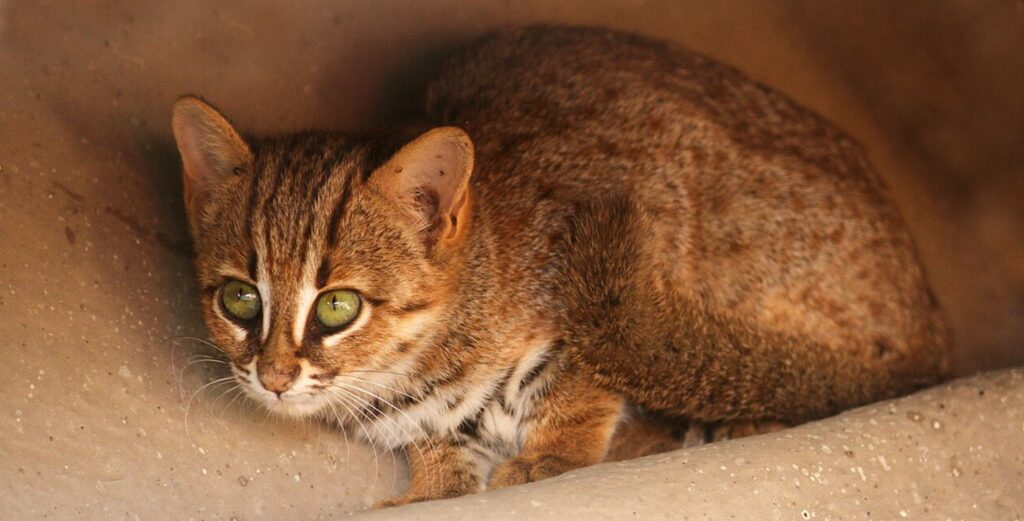
A rusty-spotted cat (Prionailurus rubiginosus). Image by Davidvraju via Wikimedia Commons
- Two roadkill incidents of the near-threatened rusty-spotted cat were recorded at the National Chambal Sanctuary in Uttar Pradesh in May.
- Such roadkill data for small carnivores remains heavily underreported, say conservation scientists, while highlighting the lack of studies on the effects of roads on small carnivores.
- Besides flyovers and drainage culverts, scientists recommend spreading awareness about speeding and implementing proper road signage indicating the presence of wildlife, as mitigation measures.
Scientists at the Wildlife Institute of India (WII) have reported two roadkill incidents of the rusty-spotted cat (Prionailurus rubiginosus) at the National Chambal Sanctuary in Etawah, Uttar Pradesh. The two records are the first documented occurrence of the small carnivore in southern Uttar Pradesh, according to the research paper published in the Journal of Threatened Taxa in May.
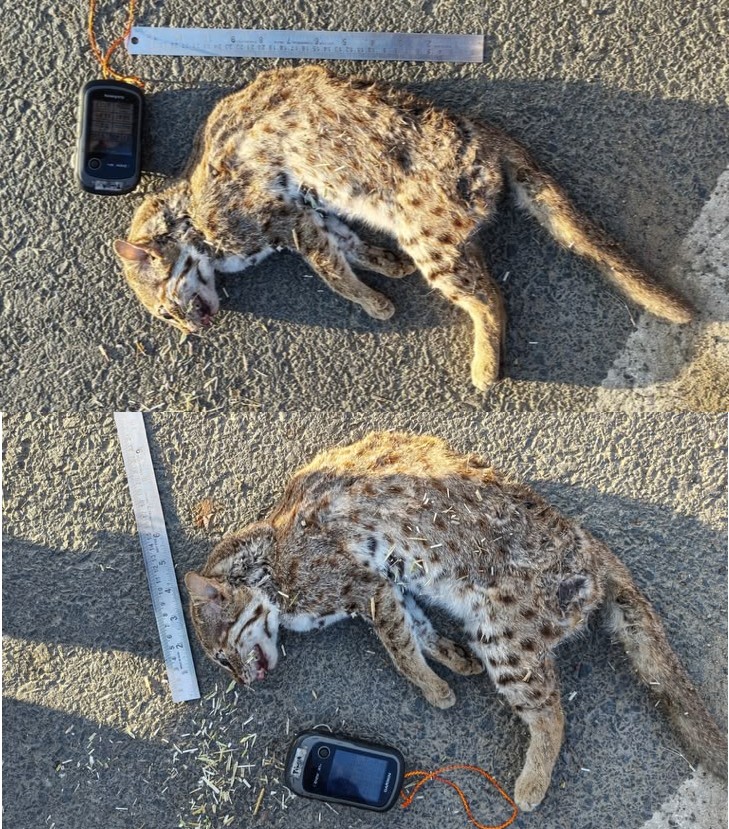
Roadkill data for small carnivores is heavily underreported, and these records were “a matter of chance”, according to Vishnupriya Kolipakam, a WII scientist and one of the paper’s authors.
While they add a new locality to the small cat’s known range, the wildlife sanctuary falls within its distribution range, Kolipakam said. “The wild cat has been reported from areas all around Chambal, including Kuno, Rangarh-Vishdhar, Ranthambhore, and Dholpur,” she said.
However, this follows a pattern, as seen in recent papers that have curated sighting reports of the strictly nocturnal cat.
There were nine records of roadkill from the Saurashtra Peninsula in Gujarat between 2016 and 2024, and four records from Rajasthan between 2000 and 2020. In Nepal, too, where the cat was discovered as recently as 2016, there has been a record of a roadkill.
For an elusive small cat that has been rarely observed in the wild, these roadkill records add up to a significant number.
There are also not enough studies looking at the effects of roads on small carnivores, noted Shomita Mukherjee, a senior principal scientist at the Sálim Ali Centre for Ornithology and Natural History (SACON). “Whatever is known of roadkills is largely through opportunistic records,” Mukherjee said.
“The actual number will be much higher,” she added.
Death traps for small cats
Native to India, Nepal, and Sri Lanka, the rusty-spotted cat is widely recognised as the world’s smallest wild cat species. It is roughly half the size of a domestic cat, measuring just 38-45 cm in body length and weighing between 1 and 2 kg.
One misconception about the rusty-spotted cat is that it is rare, said Aly Rashid, a tourism professional and naturalist. “It is not rare, but it is rarely observed, due to its strictly nocturnal habits and small size,” he said.
The recent expansion of camera trapping in India has shown that the rusty-spotted cat has a wider distribution than previously understood.
However, Rashid cannot recall encountering a rusty-spotted cat roadkill in the Satpura Tiger Reserve, where his family runs an eco-lodge. “In dry habitats like Chambal, Gujarat and Rajasthan, where they are quite common, perhaps the occurrence of roadkills is higher,” he said.
But why are roads such a significant threat to small carnivores like the rusty-spotted cat? Roads are a threat to all wildlife, especially felids and canids, Kolipakam said. “Small cats suffer due to their size and nocturnal habits, which makes detection by drivers difficult,” she said. “Their response to moving vehicles, freezing or changing course, also adds to the problem.”
Cats use roads for various reasons, according to Mukherjee. “Cats are primarily visual animals and for nocturnal species [like the rusty-spotted cat], roads often provide good opportunities to hunt,” she said.
Roads fragment natural habitats, creating edge environments with abundant resources that attract rodents and other small animals, Mukherjee said. “If the roads are lit, insects also get drawn to lights, which could attract small cats,” she added.
Roads also serve as good demarcation and territory-marking structures for cats, Mukherjee noted.
Building better mitigation measures
The International Union for Conservation of Nature (IUCN) recognises habitat loss and fragmentation as the primary threats to the rusty-spotted cat. While road networks are highlighted as a threat in other small cat assessments, they are not for the rusty-spotted cat. Mukherjee, a member of the IUCN Cat Specialist Group, believes road networks should similarly be recognised as a significant threat to the rusty-spotted cat.
Even though road networks are considered economically vital for the country, there are still measures that can be taken, Mukherjee said, such as creating awareness about speeding, particularly at night. “Large, visible signposts for drivers that indicate the presence of wildlife should be mandatory,” she added.
While it is impossible to make the nation’s vast road network completely accident-proof, WII scientist Kolipakam recommended focusing mitigation measures along forested and other wildlife-dense areas. Enabling wildlife crossing via flyovers and drainage culverts is crucial for mitigating habitat fragmentation and preventing wildlife-vehicle collisions, she said.
There should be more focused monitoring efforts, too, according to Mukherjee. “Roads that are especially risk-prone for small carnivores should be identified through studies and regularly monitored for roadkills,” she said. Similar to accident-prone sections on roads for humans, hotspots should be identified for wildlife, too, Mukherjee added.