Tree Plantation Sparks Debate Over Urban Greening & Miyawaki Method
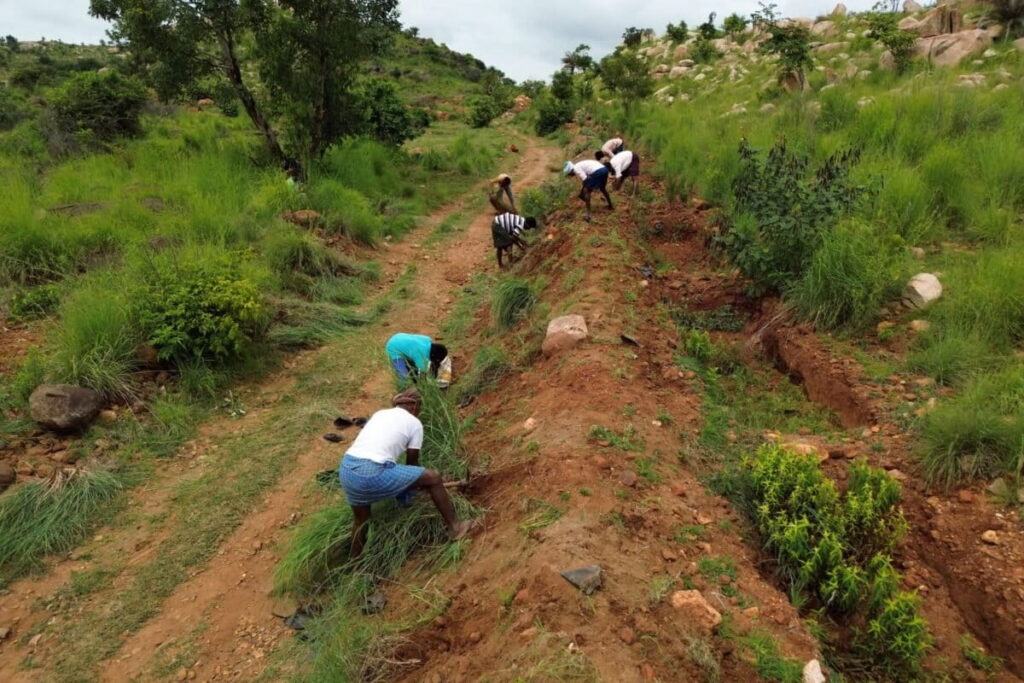
Restoration work in progress at Bagepalli near Bangalore. Experts advise against equating rapid tree growth with ecological restoration, as it ignores the importance of herbs, grasses and understorey vegetation (Image courtesy of ATREE Bagepalli)
- Bengaluru’s record-breaking plantation drive has renewed debate over whether mass tree planting is the most effective way to restore urban ecosystems.
- The Miyawaki method can rapidly create dense green cover, but scientific evidence for many of its claimed benefits remains limited.
- Ecologists say greening cities such as Bengaluru requires restoration tailored to their native ecosystems, long-term planning and accountability, not just planting millions of saplings.
Bengaluru’s ambitious attempt to create a Guinness World Record by planting nearly 1.5 million saplings in a single day has reignited debate among ecologists over whether mass tree-planting campaigns are the best way to restore urban ecosystems.
The plantation drive, organised by the Bangalore Development Authority (BDA) across nearly 240 acres, was carried out using the Japanese Miyawaki method of dense native tree planting. Supported by multiple corporate social responsibility (CSR) initiatives and environmental organisations, the project aims to increase the city’s green cover, reduce the urban heat island effect and improve climate resilience.
BDA Chairman N.A. Haris said the initiative was intended to address the city’s growing environmental challenges.
“The idea is to make Bengaluru greener. There is global warming, so we want to start this movement with the city,” Haris said before the event.
According to the BDA, plantations have been created around lakes, nala buffer zones and public spaces, with every sapling being geo-tagged to monitor its survival over time. Haris also said the Miyawaki technique would enable the trees to grow rapidly.
“We are using the Miyawaki method for tree plantation. The trees will grow fast in three years’ time,” he said.
However, while the scale of the initiative has been widely praised, ecologists argue that planting millions of saplings alone cannot compensate for the continued loss of wetlands, mature trees and natural ecosystems caused by rapid urbanisation.
Ecologists question one-day plantation drives
Scientists say the focus of urban restoration should extend beyond setting records or increasing plantation numbers.
“What exactly are we trying to achieve? Is it setting a record or greening the city? If it’s ecology, then what environmental problem are we trying to solve?” asked Rajkamal Goswami, a scientist at the Ashoka Trust for Research in Ecology and the Environment (ATREE), who studies forests and biodiversity dynamics.
Goswami believes that many urban greening projects prioritise logistics over ecological planning.
“They’re calling these ‘urban forests’, but they are not being planned as part of a long-term urban development plan. We are already destroying existing green spaces as the city expands, while simultaneously trying to green the city without a proper plan,” he said.
The Bengaluru drive comes at a time when several Indian cities have launched similar large-scale plantation campaigns. Ahmedabad recently planted over 361,000 saplings in a single day as part of its own Guinness World Record attempt.
Questions have also been raised about accountability and long-term maintenance. According to media reports, the BDA allocated around ₹880 million for the project, although the final expenditure has not yet been disclosed. Reports of saplings dying within days of planting have also revived concerns over survival rates and the effectiveness of one-day plantation drives.
Researchers say that while increasing tree cover is generally beneficial, cities require restoration strategies suited to their own ecological conditions rather than relying on uniform solutions.
Recent scientific studies suggest that dense tree cover can reduce temperatures by providing shade, but in tropical savanna cities such as Bengaluru, certain tree species may also increase humidity through evapotranspiration, raising the “feels-like” temperature in poorly ventilated areas. Experts argue that species selection, canopy structure and landscape design are therefore as important as the number of trees planted.
Miyawaki method faces scientific scrutiny
Developed by Japanese botanist Akira Miyawaki, the Miyawaki method promotes dense planting of native species to rapidly create self-sustaining forests on degraded land. The technique has gained widespread popularity among governments, corporations and citizen groups across India.
However, restoration scientists say many of its claimed ecological benefits remain insufficiently supported by scientific evidence.
“For most of those claims, the evidence is either weak or non-existent. Many of these claims are made primarily in grey literature and promotional reports rather than in peer-reviewed scientific publications,” said ecologist Pooja Choksi, who specialises in restoration science.
Choksi pointed to a 2025 systematic review that found strong evidence only for rapid early tree growth and canopy development. However, the researchers concluded that this could largely be attributed to intensive soil preparation, irrigation and maintenance rather than the Miyawaki method itself.
The review also found no empirical evidence supporting the widely promoted claim that Miyawaki forests become self-sustaining within three years. Similarly, evidence that these plantations significantly improve biodiversity or store substantially more carbon than other restoration approaches remains limited because of the lack of long-term comparative studies.
The method is also resource-intensive, requiring dense planting, extensive soil preparation, irrigation, organic amendments and labour-intensive maintenance during the initial years.
Socio-ecologist Anirban Roy, whose research examined Miyawaki forests in Bengaluru and Palakkad, found that carbon storage increased as plantations matured, with five-year-old forests storing nearly four times more carbon than two-year-old sites.
Even so, Roy cautioned against treating rapid tree growth as equivalent to ecological restoration.
“One of the biggest drawbacks of the method is its overemphasis on trees. It ignores the importance of herbs and grasses in tropical forest ecosystems,” he said.
Roy explained that dense planting intensifies competition for water and nutrients while reducing sunlight reaching the forest floor, suppressing shrubs, herbs and other understorey vegetation.
“Miyawaki is not fully inappropriate if we can adapt it to the ecological needs of the region by introducing a variety of plants such as herbs and shrubs, apart from just trees,” he said.
Ecologists also note that Bengaluru’s natural landscape consists largely of dry tropical forests, thorn scrub and semi-arid savannas rather than dense rainforests. In a city already facing groundwater depletion, densely planted, water-intensive forests may place additional pressure on scarce water resources.
“We need to plant trees that conserve water. In Bengaluru’s climate, what is required are savanna plants,” Goswami said.
Choksi believes urban restoration should move beyond tree-counting exercises and instead focus on restoring native ecosystems that balance biodiversity with the needs of city residents.
“Urban restoration needs to be approached differently because cities are already heavily modified landscapes often with space and water constraints,” she said.
Rather than attempting to recreate dense forests everywhere, she argued that cities should combine low-density tree planting with native grasses, shrubs and other vegetation suited to local ecosystems.
“The challenge is to find a balance between biodiversity and people’s needs for recreational spaces,” Choksi said. “We need trees, but we need other kinds of vegetation too.”