Steel’s Green Challenge: Can India’s Small Mills Afford To Decarbonise?
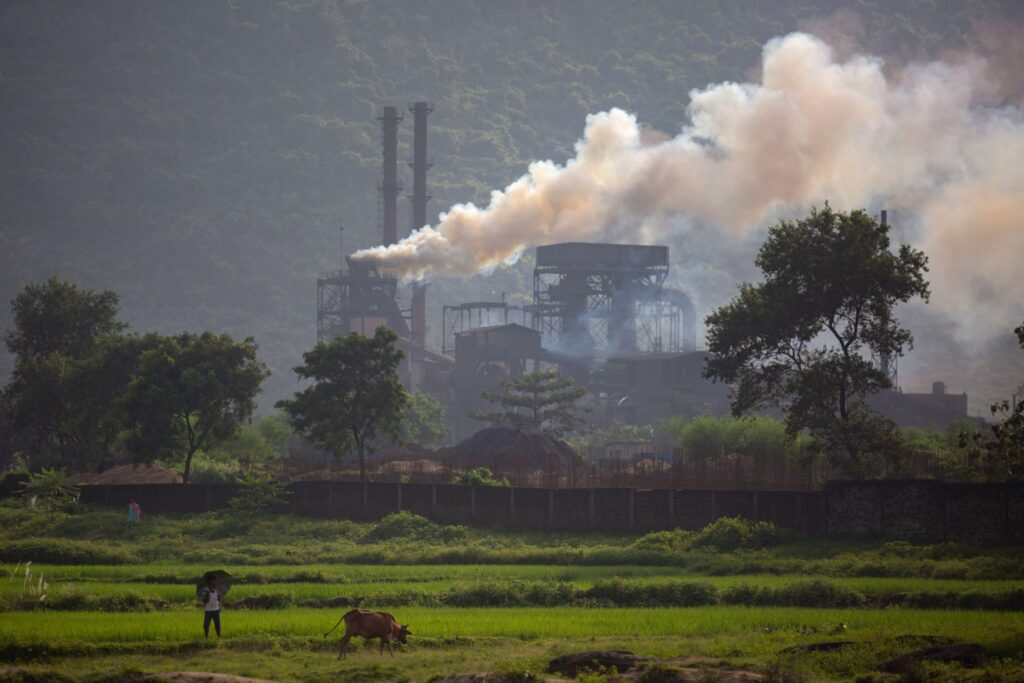
Smoke rises from a coal-powered steel plant at Hehal village near Ranchi, Jharkhand (Image: Altaf Qadri / Associated Press / Alamy)
The steel industry announces itself soon after you land at Raipur airport. Hoardings for Goel TMT, GK TMT, Concrete TMT and other local brands line the road into the city, reflecting an industry deeply woven into Chhattisgarh’s economy but little known beyond the state.
Beyond Raipur, in the industrial clusters of Urla and Siltara, the advertisements give way to steel plants, rolling mills, ironmaking units and trucks carrying coal and iron ore. Smoke and dust underline the environmental cost of steelmaking, even as the factories support tens of thousands of workers and a vast network of transporters, contractors, traders and suppliers.
The challenge facing these businesses is increasingly clear: how can India’s small and medium-sized steelmakers cut emissions without undermining their ability to survive?
A high-emission sector under pressure
Micro, small and medium-sized enterprises (MSMEs) account for about 40% of India’s crude steel production. Many rely on coal-based direct reduced iron (DRI), or sponge iron, as a key input before producing steel in electric or induction furnaces.
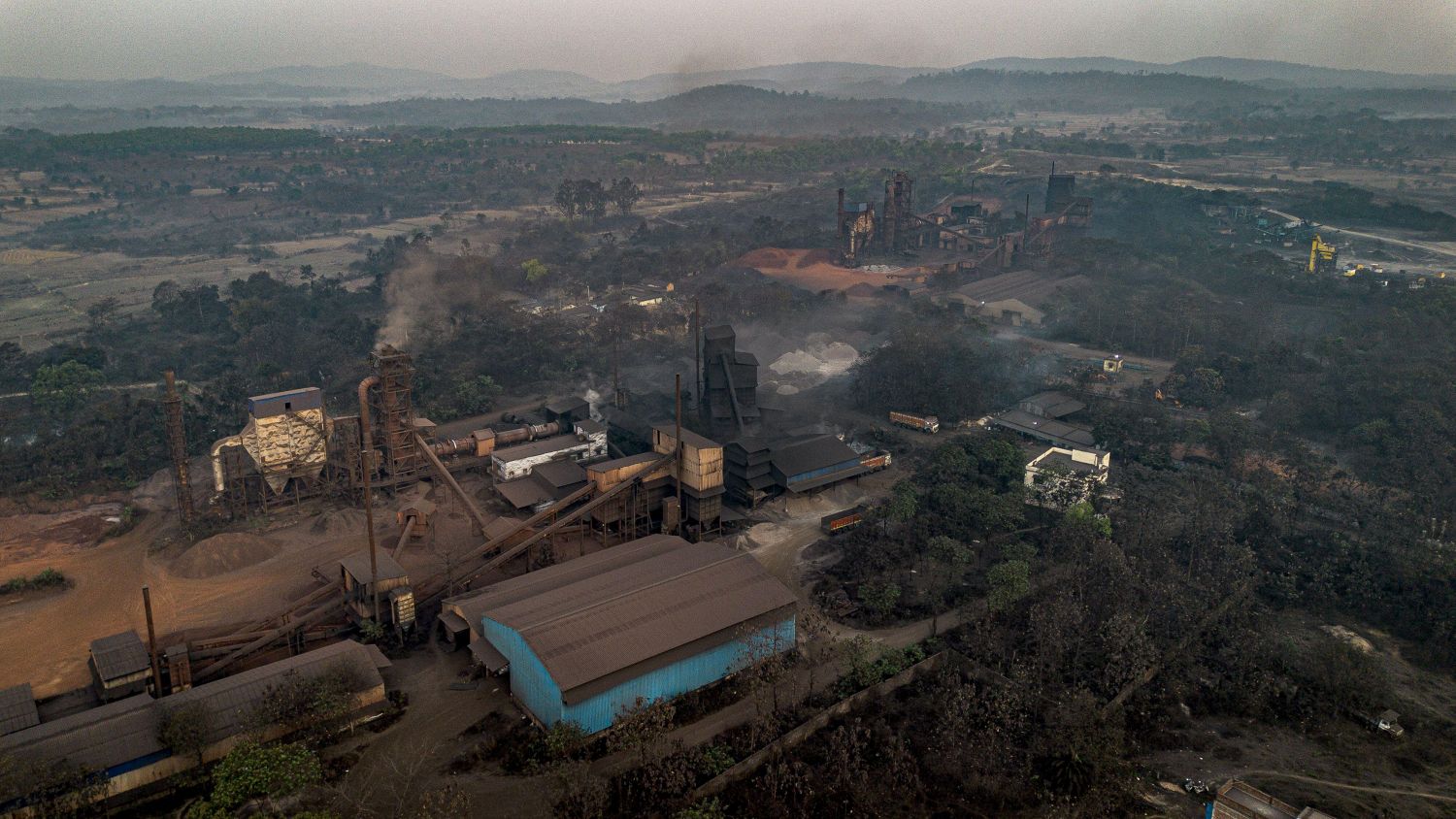
According to the Council on Energy, Environment and Water (CEEW), coal-based DRI producers alone account for nearly 30% of India’s crude steel output. The route is also among the country’s most carbon-intensive, generating around 2.7–3.1 tonnes of CO2 per tonne of crude steel, compared with a global average of about 1.92 tonnes.
Government pressure to reduce emissions is growing, including through India’s carbon credit trading scheme. But for smaller producers already operating on thin margins, decarbonisation can look like an additional financial burden.
“The point is that the government is pushing us to be energy efficient and that is the need of the hour. But the way forward is a bit confusing,” said Saurabh Agrawal, president of Raipur-based Real Ispat & Power.
Survival comes before decarbonisation
Raipur is home to an estimated 316 MSME secondary steel enterprises. Unlike large integrated producers such as Tata Steel and JSW Steel, many smaller companies lack the capital and technical capacity to make major technology investments.
“Most secondary steel companies don’t have the financial bandwidth,” said Saurabh Trivedi of the Institute for Energy Economics and Financial Analysis. He argued that concessional finance, viability-gap funding and credit guarantees are needed to make decarbonisation financially viable.
The timing is difficult. Steelmakers are facing weak demand, regional overcapacity and higher electricity tariffs. Infrastructure spending also slowed around the 2024 general election, while a subsequent tariff increase added to pressure on margins.
“People [in steel MSMEs] are literally not interested in doing anything in decarbonisation because they are struggling for survival,” said Vivek Agrawal, an independent industrial consultant and former executive at Godawari Power & Ispat.
Efficiency offers a practical starting point
For many producers, the most realistic path is not an immediate switch to radically different technology but improvements that also reduce operating costs.
Waste-heat recovery is one example. Almost all sponge-iron producers in Raipur, including larger local companies, use captive power plants equipped with waste-heat recovery boilers. The technology captures heat that would otherwise be lost and converts it into useful energy.
Continuous casting and hot charging can also reduce emissions by avoiding energy-intensive reheating. But these technologies require space and capital that smaller companies often lack.
“I don’t do hot charging because I don’t have land,” said Sanjay Tripathi, president of the Chhattisgarh Steel Re-rollers Association. Although hot charging can save around INR 1,000 per tonne of steel in coal costs, he said the capital investment makes it difficult for smaller companies to justify.
Solar power shows what can work
Solar energy is another area where the business case is helping drive adoption. Captive solar power is increasingly attractive as installation costs fall and grid electricity becomes more expensive.
Steelmakers in Raipur said that captive solar can cost roughly INR 3–3.5 per kilowatt-hour, compared with INR 6.5–7 for grid electricity. Mahamaya Steel plans a 150 MW captive solar plant near Bilaspur, while Real Ispat expects similar solar capacity to become operational this year.
But access remains unequal. High land costs, upfront capital requirements and transmission charges make solar difficult for micro-scale rolling mills.
Technology upgrades can nevertheless produce immediate savings. Mahamaya Steel, for example, replaced five old induction furnaces and installed a new one.
“By replacing these old furnaces, we were able to save 35 units per tonne in power costs,” said managing director Rajesh Agrawal. The company estimates annual savings of INR 3.5 crore.
Bigger support is needed
Some alternatives, such as natural gas, remain economically difficult. Steelmakers in Raipur say gas can cost at least twice as much as coal and is vulnerable to supply disruptions and currency fluctuations.
“No one is using piped natural gas in Raipur,” Tripathi said. “Coal is available everywhere [in coal-rich Chhattisgarh].”
Government support schemes have also struggled to gain traction because of complex procedures, limited awareness and insufficiently attractive financial incentives.
Industry experts argue that public policy must therefore help create the conditions for investment. IEEFA’s Trivedi said industrial decarbonisation “is not going to happen through market forces alone”.
CEEW has called for measures including green-steel procurement, capital support for secondary producers and trade corridors for low-carbon “green iron”.
For now, the transition is likely to be gradual. As S&P Global Market Intelligence’s Ashima Tyagi puts it, India’s secondary steel sector faces “one of the most complex decarbonisation challenges anywhere in the global steel industry”.
The immediate priority may be energy efficiency and technologies that pay for themselves. But deeper emissions cuts will eventually require much larger investments—and a policy framework that smaller steelmakers can realistically afford.