Yadav On ECI: A Grievous Charge Against A Constitutional Institution
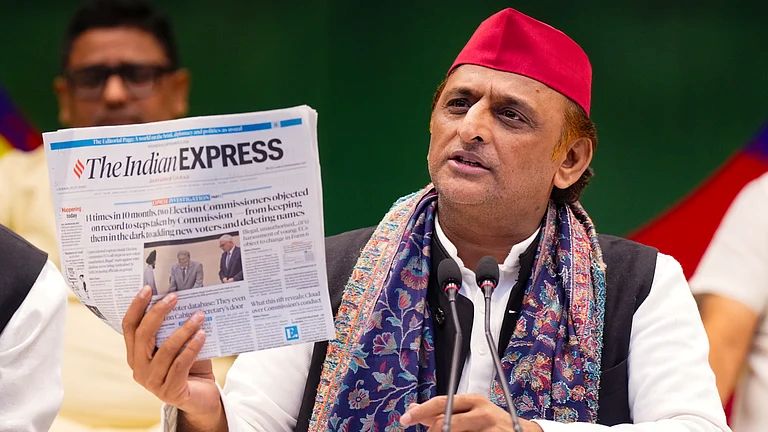
Akhilesh Yadav has questioned the ECI’s impartiality over reported dissent, linking it to SIR, voter deletions and election postings in Uttar Pradesh and calling for scrutiny of governments formed during the alleged lapses
Samajwadi Party president Akhilesh Yadav’s latest salvo on the Election Commission of India (ECI) has brought an old but fundamental question back to the centre of India’s democratic debate: what happens when political parties lose confidence in the institution responsible for conducting elections?
Speaking on September 23, 2026, Yadav alleged that the Election Commission had not been functioning impartially and went further, arguing that governments formed during a period of alleged electoral irregularities were “unconstitutional”. His remarks followed reports that Election Commissioners Sukhbir Singh Sandhu and Vivek Joshi had raised objections on multiple occasions over decisions connected with the Special Intensive Revision (SIR) of electoral rolls.
The allegation is politically consequential, but it is important to distinguish between a political assertion and an established constitutional finding. Whether an election was lawfully conducted, or whether a government lacks constitutional legitimacy, is ultimately a matter for the constitutional and judicial processes prescribed by law—not something that follows automatically from disagreement within the Election Commission.
What the internal dissent means
Reports that two Election Commissioners recorded objections 14 times over a 10-month period have intensified scrutiny of the poll panel. Opposition parties have interpreted the reported disagreements as evidence of institutional dysfunction and have demanded greater accountability from Chief Election Commissioner Gyanesh Kumar.
But dissent within a multi-member institution does not, by itself, establish that its final decisions were unlawful or partisan. The ECI has maintained that individual observations, technical suggestions and internal disagreements are normal features of deliberation and that its final decisions, including those concerning the SIR process, were taken unanimously and according to statutory procedures. That distinction matters. Institutional disagreement can be a sign of healthy internal scrutiny, but persistent disagreements can also raise legitimate questions about transparency, decision-making and whether dissenting views are adequately addressed. The credibility of the institution therefore depends not merely on claiming unanimity at the end of a process, but on demonstrating how important objections were considered and resolved.
Why impartiality matters
The Election Commission occupies an unusual position in India’s constitutional structure. Under Article 324, it has responsibility for the superintendence, direction and control of elections to Parliament, state legislatures, and the offices of the President and Vice-President. The ECI itself describes its role as that of an autonomous constitutional authority responsible for administering the electoral process.
That responsibility makes public confidence particularly important. Elections are not credible merely because voting takes place; voters and political parties must also have reasonable confidence that electoral rolls, polling procedures, counting and dispute-resolution mechanisms are administered fairly.
Yadav’s allegations therefore deserve scrutiny rather than either automatic acceptance or dismissal. Claims of voter deletions, procedural irregularities or selective enforcement need to be tested against documentary evidence, electoral records and the Commission’s explanations. Political rhetoric cannot substitute for such verification.
The Constitutional claim needs caution
Yadav’s assertion that governments formed under an allegedly impartiality-deficient Election Commission are “unconstitutional” is considerably broader than the underlying allegation. An accusation concerning the conduct of an election does not automatically invalidate every subsequent government.
India’s constitutional framework provides mechanisms for challenging election outcomes and addressing electoral disputes. A government’s legitimacy cannot simply be declared void by a political party because it believes the election process was compromised. At the same time, allegations concerning the integrity of elections should not be dismissed merely because they originate from the Opposition.
The appropriate test is evidence: Were electoral laws followed? Were eligible voters improperly excluded? Were complaints investigated? Were decisions reasoned and transparent? And, where irregularities are established, were effective remedies available?
Beyond political sparring
The larger issue is institutional trust. The ECI cannot depend solely on its constitutional status to command confidence; it must continually demonstrate independence through transparent procedures, reasoned decisions and credible mechanisms for addressing complaints.
Equally, political parties have a responsibility to distinguish demonstrable electoral irregularities from broader claims that may undermine public faith without sufficient evidence.
A robust democracy requires both an independent election authority and a political opposition capable of scrutinising it. Akhilesh Yadav’s allegations have consequently raised questions that extend beyond one political confrontation: how should internal dissent within the ECI be disclosed, how should electoral-roll disputes be independently examined, and what remedies should exist when confidence in the electoral process is challenged?
Those questions deserve answers grounded in evidence and constitutional procedure. The credibility of India’s electoral system ultimately depends not on the assertions of either the ruling establishment or the Opposition, but on whether citizens can see that their votes are registered, counted and protected through institutions that are demonstrably accountable.