‘Village for Sale’: Maha Hamlet Protests Decades-Long Water Crisis
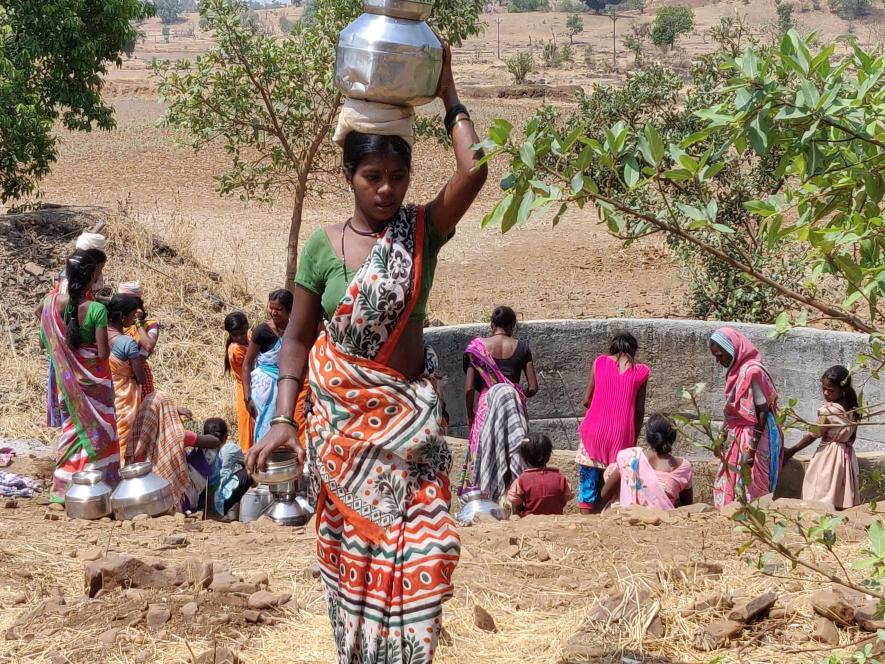
Women fetch water from the village's communal well. For residents of Tulshi village in Maharashtra's Solapur district, the banner saying 'Village for Sale' is more than a provocative slogan. It represents years of frustration over living beside an irrigation network while continuing to rely on tankers for basic water needs (Representative Image)
Around 7,000 residents of Tulshi village in Maharashtra’s Solapur district have put up a striking banner declaring “Village for Sale, Price: Water”, drawing attention to a water crisis they say has persisted for more than two decades.
Located in Madha tehsil, Tulshi has been struggling with water shortages despite its proximity to canals under the Sina-Madha Lift Irrigation Scheme. Villagers say an approximately 800-metre stretch of excavation linked to the scheme has remained incomplete for 26 years, preventing the village from receiving the water it was promised.
With farms and wells drying up, residents have increasingly been forced to depend on water tankers.
“The village faces water scarcity every year. Though the canals of the Sina-Madha scheme pass close to the village, we don’t benefit from it. By putting up the board saying ‘Village for Sale, Price: Water’, we are trying to draw the government’s attention to our plight,” Tulshi sarpanch Sharad More said.
Protests intensify
Frustration over the lack of a permanent solution has led villagers to intensify their protests. Residents began a hunger strike on September 14, demanding immediate action to address the shortage. They later staged a ‘thali-naad’ protest, beating utensils outside the Madha tehsil office.
Villagers have warned that their agitation will escalate if authorities fail to provide a lasting solution.
According to More, completing around 800 metres of excavation near the seventh and eighth outlets of the Sina-Madha scheme could resolve Tulshi’s water crisis. Residents say the work has remained incomplete despite repeated assurances and government plans.
The shortage has been aggravated by inadequate rainfall during this year’s monsoon. Although work has been undertaken under the Jal Jeevan Mission, villagers say it has not provided relief because the local water sources on which the scheme depends have dried up.
Farms, livelihoods and families affected
The crisis has affected not only drinking water supplies but also Tulshi’s agricultural economy. The village’s population largely depends on farming and animal husbandry, both of which require a reliable supply of water.
Residents say the shortage has also begun affecting social life. More claimed that around 350 young men in the village remain unmarried, as families are reluctant to marry their daughters into a village where water remains scarce.
Tulshi has 14 ponds and wells, all of which villagers say have dried up. Residents believe that replenishing these water bodies could substantially improve water availability for both households and agriculture.
A proposal and estimate for filling the ponds and wells have reportedly already been prepared.
Funds sanctioned, work yet to begin
The government has taken several steps over the years, but villagers say implementation remains the major problem.
In 2024, the Krishna Valley Development Corporation reportedly approved the provision of water from the Sina-Madha Lift Irrigation Scheme to Tulshi and several other drought-prone villages, including Bavi, Paritewadi, Kurdu, Pimpalkhunte, Ambad and Anjangaon.
In January this year, the government announced that Rs 90 lakh had been sanctioned for 2025-26 for supplying water through a closed pipeline from the Sina-Madha scheme to the Bhavani percolation tank in Tulshi. The project was expected to address the village’s drinking water and irrigation needs.
However, More said villagers had only been informed about the sanctioned funds and had yet to see concrete work begin.
‘Our agitation will continue’
Residents say they have repeatedly approached government officials, submitted representations and staged protests, but the measures announced so far have failed to deliver a permanent solution.
“The board saying ‘Village for Sale’ is a symbolic protest to draw the government’s attention to our water problem. Our agitation will continue until we get water,” More said.
For Tulshi’s residents, the banner is therefore more than a provocative slogan. It represents years of frustration over living beside an irrigation network while continuing to rely on tankers for basic water needs.