Rising Temps And Human Activity Both Drive Himalayan Forest Fires
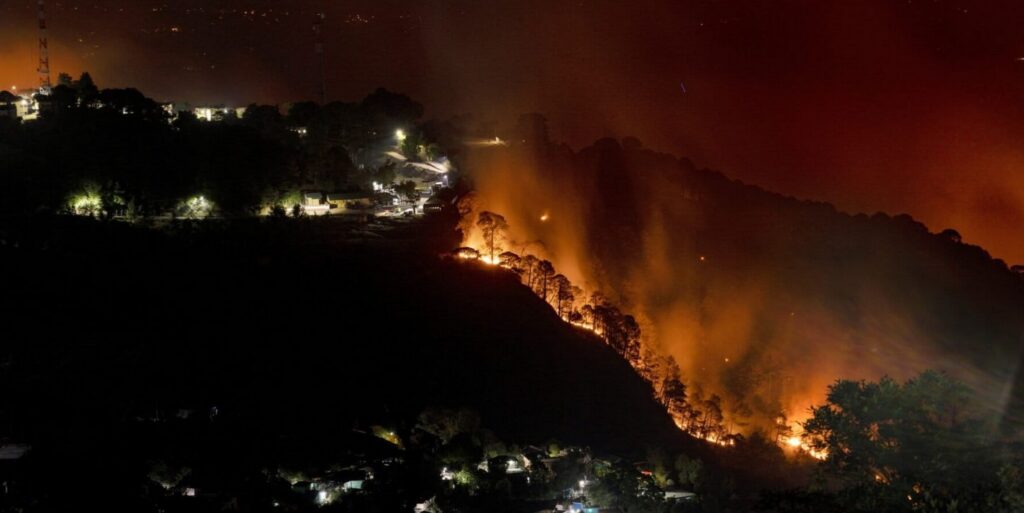
FILE PHOTO: A forest fire rages during the summer in Dharmshala, Himachal Pradesh in 2022 (AP Photo/Ashwini Bhatia)
- A new study conducted in the Western Himalayas found temperature to be the strongest driver associated with forest fires, among 39 variables.
- Every one degree celsius rise in mean summer temperatures was associated with more than 100 additional fire incidences.
- The pre-monsoon months when dry winter biomass, rising heat, and low humidity combine, become the peak fire season. Declining snowfall and rainfall further dry out forest floors.
- Experts note that reviving fire lines and clearing biomass through controlled fires and community incentives, are critical to manage forest fires.
Forest fires in the Himalayas typically occur between November and June, during the drier months. However, out-of-season and higher elevation fires have sparked concerns about their effective management in a changing climate. A new study from the Western Himalayas provides more clues into the underlying factors driving forest fires in the region.
A higher frequency of forest fires was associated with a decline in floristic diversity and the promotion of fire-dominant plant species in Uttarakhand — the most fire-prone state in the Indian Western Himalayas, according to the Forest Survey of India. Fires in the Himalayas are also particularly worrisome because they threaten to erode carbon stocks. Including the Eastern Himalayas, the Himalayan forests are estimated to hold 3,273.1 million tonnes of carbon.
For the Western Himalaya study, researchers from the Forest Research Institute, Dehradun, and Indian Institute of Technology, Roorkee, considered a host of bioclimatic, anthropogenic, and topical variables that could influence forest fire dynamics in the region. “What we tried to do was study 10 years of past data to understand how these variables interact with each other. Temperature had the biggest edge out of all of them,” said Amit Kumar Verma, a technical officer with the Forest Research Institute (FRI) and an author of the study.
Adding fuel to fire
The study’s findings add to a growing body of evidence of forests’ sensitivity to environmental fluctuations — and temperature in particular. Though most forest fires are triggered by human activity in India, every one degree celsius rise in mean summer temperatures was associated with approximately 128 additional fire incidences, the study found. The results align with other studies from across India, including central forests, which find temperature to be a leading [variable] in forest fire occurrence.
The analysis took into account over 18,000 independent fire locations between 2013 and 2022 in Uttarakhand, Himachal Pradesh, Jammu, Kashmir, and Ladakh. Across 39 different variables — including proximity to human settlements, topography, precipitation, soil moisture and wind intensity, among others — temperature thresholds proved to have an outsized impact on forest fire occurrence.
Fire incidents rose in response to degree rises in annual mean temperatures, and maximum and minimum temperatures during the hottest, coldest, wettest, and driest months. “If you don’t have good rainfall, and that is followed by a weak winter, then there’s less moisture content on the forest floor which makes it flammable,” explained Verma.
March, April, and May were months that were the most favourable for forest fire occurrence. “The pre-monsoon period represents a convergence of climatic and anthropogenic drivers, where accumulated dry biomass from winter senescence (degradation) coincides with rising temperatures, low relative humidity, and enhanced human presence in the forest for grazing, fuelwood collection, etc,” says the paper.
Significantly seasonal precipitation was also found to be a contributor, “as the accumulation of biomass during wet months becomes highly combustible when rapidly dried during seasonal drought,” the study says. Dried pine cone needles, leaf litter, and understorey are all fuel in these circumstances.
V.K. Dhawan, a former scientist and forestry expert with the Indian Council of Forestry Research and Education who was not involved with the study, said that lack of snowfall in the winter months also had a role to play in worsening fires. “Shifting glaciers, reductions in winter precipitation and rainfall have all contributed to less moisture on the forest floor,” he said.
In January, the Indian Institute of Remote Sensing (IIRS) reported an “alarming decline” in winter precipitation, of deficits between 60% and 116% from October to December 2025. Reduction in rainfall and snow “also controls the soil moisture recharge and forest fuel conditions, which has cascading implications for forest disturbance and wildlife dynamics,” the IIRS warned.
Managing forest fires
Apart from temperature, higher forest fires were also associated with closer proximity to roads and human settlements. Scatter graphs of fire locations revealed a “pronounced concentration of fires within the first 0 to 1 km from roads, beyond which fire counts drop sharply and remain consistently low at greater distances,” the FRI study says.
“Roads improve mobility and give people greater access to forests,” explained Verma.
A majority of forest fires originate in human activity. Himalayan communities have traditionally used fire to improve the soil fertility in forests and grow fodder for their cattle. Fires can also result from the improper disposal of cigarettes and bidis, or are intentionally lit by poachers. “People light the fires, but climatic conditions like hotter temperatures, low moisture, can trigger a wider spread,” said Dhawan, adding, “Accidental fires by the roadside are a common occurrence during the fire season, which is why we need better prevention methods.”
In 2018, India released its National Action Plan on Forest Fires which outlined fire management strategies that states could refer to, such as community inclusion in fire mock drills, floor biomass management, and improving fire detection and alert systems. According to Dhawan, reviving fire lines and clearing biomass through controlled fires are critical to controlling the spread of forest fires in the Himalayas.
The central government gave the Uttarakhand government permission to fell trees in order to revive and maintain fire lines at elevations exceeding 1000 meters in December 2025. Tree felling and green cover removal at these elevations had been banned by the Supreme Court earlier. “Fuel needs to be removed from the forest floor ahead of the fire season, through controlled burning along roads and fire lines. Communities should also be incentivised and compensated for co-operating with the forest department,” said Dhawan.