Mumbai’s Hidden Water Crisis: Groundwater Reliance Under Lens
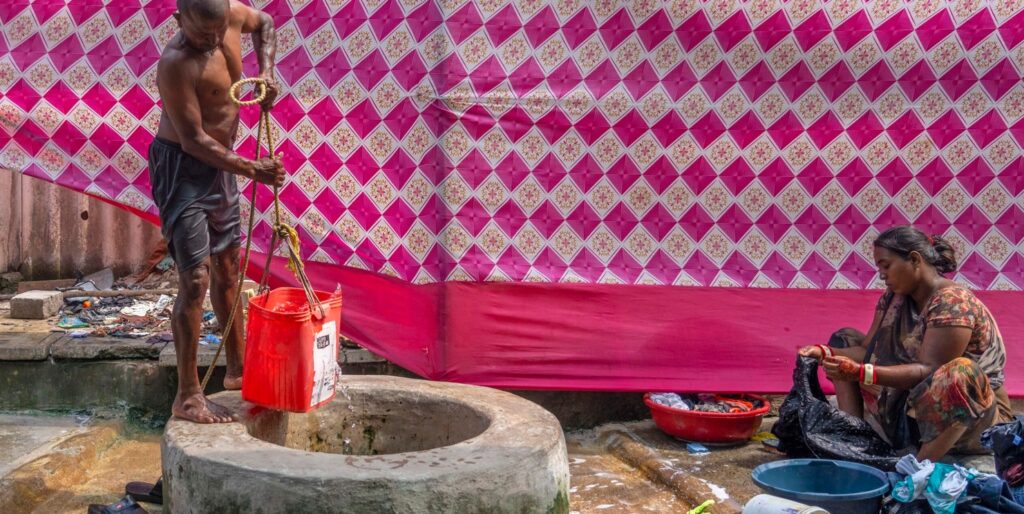
A man collects water from a well as a woman washes clothes in Mumbai (Representative image; (AP Photo/Rafiq Maqbool)
- Mumbai depends significantly on groundwater, supplied by water tankers, to meet its municipal water supply shortfall.
- However, weak regulation and monitoring has made illegal groundwater extraction rampant across the city.
- Meanwhile, the municipal corporation is running an aquifer mapping pilot in the upper catchment of the Mithi river with the long-term goal of including groundwater into Mumbai’s water resilience and climate adaptation planning.
As Mumbai anxiously awaits the arrival of the monsoon, the city’s recurring summer water crisis has once again brought attention to a less visible but increasingly critical resource: groundwater. A recent strike by the Mumbai Water Tanker Association (MWTA), coupled with a 10% reduction in municipal water supply, has highlighted the extent to which India’s financial capital depends on privately extracted groundwater to meet its daily needs.
Since May 15, the Brihanmumbai Municipal Corporation (BMC) has imposed a 10% cut in water supply after levels in the seven lakes that provide drinking water to the city declined significantly. The lakes, which rely entirely on seasonal rainfall, routinely face depletion before the monsoon arrives.
The situation became more alarming on June 7 when the MWTA launched a strike in protest against government directives requiring borewell and ring-well operators to obtain fresh licences from the Central Ground Water Authority (CGWA). Although the strike ended after Maharashtra Chief Minister Devendra Fadnavis intervened, the episode exposed deeper concerns about groundwater governance in Mumbai.
The city currently receives around 4,100 million litres per day (MLD) through its municipal supply system against an estimated demand of 4,665 MLD. The resulting deficit of approximately 565 MLD is largely met by private water tankers.
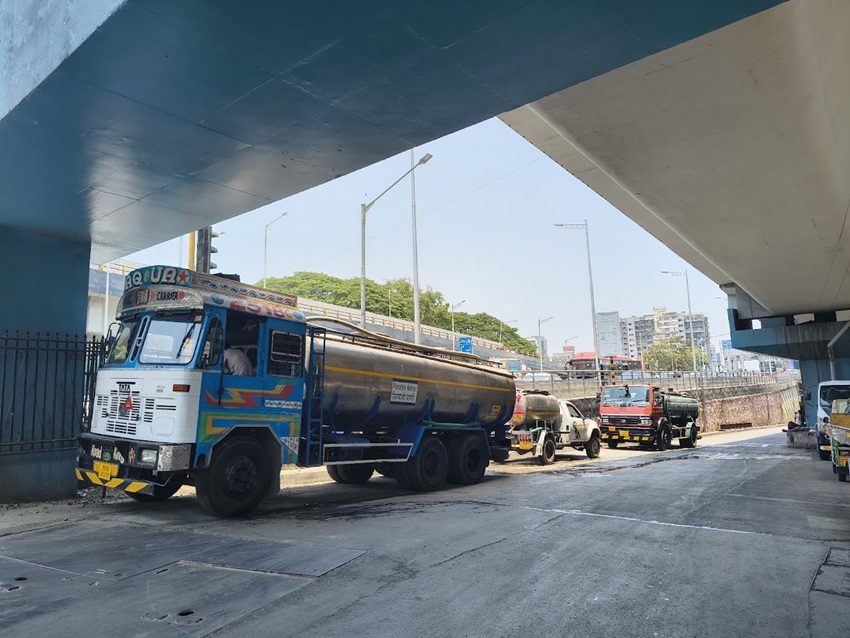
“There are 500 water tanker owners and 2,100 water tankers that operate in Mumbai. We supply around 550 MLD to Mumbai each day,” says Ankur Sharma, spokesperson of the MWTA.
The dependence on groundwater extends far beyond emergency use. Tankers routinely supply water to housing societies, malls, hotels, construction sites and commercial establishments across the city. While some tanker operators purchase water from municipal sources, a substantial portion comes from groundwater extracted through borewells.
Thousands of Wells, Limited Oversight
The scale of groundwater extraction in Mumbai remains largely undocumented and poorly regulated, according to activists and experts.
“Mumbai has more than 17,364 wells used for the commercial sale of water,” says groundwater activist Suresh Kumar Dhoka, citing information obtained through a Right to Information application.
In 2015, the National Green Tribunal made it mandatory for commercial groundwater users to obtain No Objection Certificates (NOCs) from the CGWA. However, as of May 2025, only 619 wells—primarily borewells—had secured such permissions.
Dhoka’s complaints earlier this year prompted an investigation into groundwater extraction in Mumbai’s western suburbs. Officials reportedly found dozens of wells and borewells operating without the required approvals.
Under groundwater regulations, commercial extraction without a valid NOC is considered a violation of environmental laws and can attract penalties under the Environment Protection Act, 1986.
The tanker association’s protests also received political support. Shiv Sena (UBT) leader Aaditya Thackeray wrote to Union Jal Shakti Minister C.R. Patil urging a review of CGWA regulations for densely populated cities.
He described the current norms as “impractical and highly restrictive” for urban centres such as Mumbai that face chronic water shortages and depend heavily on groundwater-based supplementary supplies.
However, water-rights advocates argue that the issue goes beyond licensing. They contend that the city lacks a comprehensive framework to monitor extraction, recharge and long-term sustainability.
Sitaram Shelar, convener of the Pani Haq Samiti, says groundwater exploitation has become deeply embedded in Mumbai’s urban development model.
“Tanker operators often buy small plots in areas with high groundwater tables and install borewells to extract water,” he says. “Almost every housing society in Mumbai has at least one borewell.”
According to Shelar, enforcement mechanisms remain weak and oversight fragmented. He alleges that illegal borewells continue to operate despite regulatory requirements.
“There is a nexus of borewell diggers, pest control officers from the BMC and housing societies,” he claims. “Many boreholes are rigged without applying for the required permissions, and officials often say they are not authorised to monitor these borewells.”
Environmental concerns are also mounting as large-scale urban construction increasingly interferes with groundwater systems.
Aquifer Mapping Offers Hope, But Experts Seek Stronger Enforcement
Environmental activist Zoru Bhathena believes rapid construction activity has become a significant factor behind groundwater depletion.
“Unlike earlier times, basements today are at least four floors deep under the ground,” he says. “This requires dewatering the immediate construction area and surrounding zones. With hundreds of projects happening simultaneously, groundwater is being depleted enormously.”
Experts warn that rampant concretisation has further worsened the situation by reducing the amount of rainwater that can naturally percolate into the ground. As roads, parking lots and buildings replace open land, groundwater recharge opportunities continue to shrink.
“There is so much priority given to infrastructure that there is hardly any space left in the city,” says Sharma of the MWTA. “There should be some limitations on infrastructure development and mandatory provisions for rainwater harvesting.”
The absence of institutional capacity remains another major concern. Nearly three decades ago, a committee headed by water expert Madhav Chitale recommended establishing a dedicated geo-hydrological unit within Mumbai’s municipal administration to monitor groundwater scientifically. The proposal has yet to be implemented.
Experts argue that groundwater management requires specialised expertise that is often missing from urban water departments.
“The water supply department is predominantly shaped by civil engineers who remain focused on surface water resources,” says Sachin Tiwale, a fellow at the Ashoka Trust for Research in Ecology and the Environment (ATREE). “There is a need for hydrogeologists who can understand and map aquifers for sustainable monitoring and management.”
Recognising these challenges, the BMC launched its first aquifer-mapping pilot project in May 2025 in the upper catchment of the Mithi River. The initiative is being undertaken in partnership with WRI India, ACWADAM and Pani Haq Samiti under the municipal Environment and Climate Change Department.
“The upstream catchment was selected strategically because springs and discharge zones are easier to identify there,” explains Deepti Talpade of WRI India. “This helps establish aquifer flow patterns.”
Hydrogeologist Himanshu Kulkarni, co-founder of ACWADAM, says groundwater management must focus on aquifers rather than isolated wells.
“Groundwater is invisible and therefore easily ignored,” he says. “Any study on groundwater is incomplete unless you study aquifers.”
Kulkarni believes understanding underground water systems can transform policymaking by linking groundwater to rivers, lakes and broader ecological processes.
“Your entire perspective on groundwater changes when you study aquifers because it isn’t fixated on the source but a larger system,” he explains.
Yet experts caution that better data alone will not solve Mumbai’s groundwater crisis.
“Without strict regulation, accountability and enforcement, even the best mapping exercises will not protect groundwater resources,” Dhoka warns.
As Mumbai waits for the monsoon to replenish its reservoirs, the recent tanker strike has underscored a critical reality: beneath the city’s dependence on lakes and pipelines lies an enormous, poorly understood groundwater network that continues to sustain millions of residents. Whether policymakers can effectively regulate and protect that resource may determine the city’s long-term water security in an era of rapid urbanisation and climate uncertainty.