A Bird Call That Signals Rains
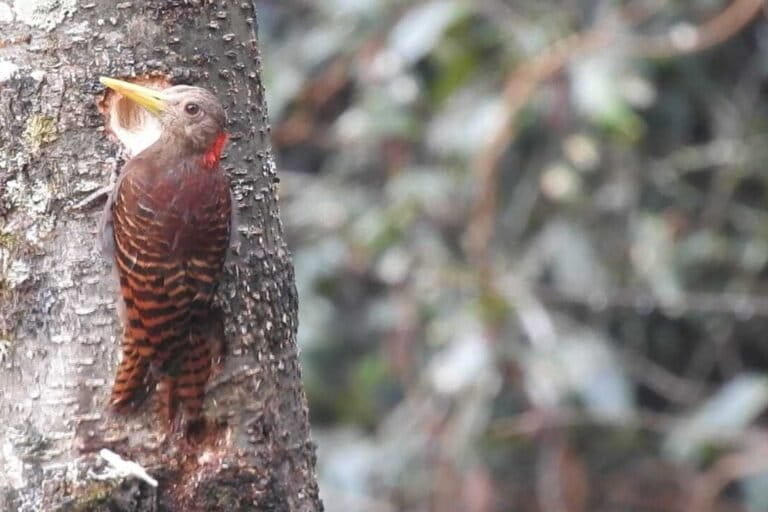
A bay woodpecker forages on a Nepalese alder tree (Alnus nepalensis) in Sirikhola-Gurdum. Elders of forest villages near the Singalila National Park in Darjeeling district, West Bengal, say within hours of the bay woodpecker’s calls, rain follows (Image by Mingma Tamang)
- In rural Darjeeling, West Bengal, communities predict the arrival of rains with a bird call that sounds like a maniacal, falling laughter, carrying through the thick canopy.
- Darjeeling hosts 21 species of this bird locally, contributing to India’s total of 32 species.
- The bird is a bridge between the knowledge held by local communities and the patterns revealed through ecological research
In the mist-draped forests of rural Darjeeling, stories travel from one generation to the next as softly and steadily as mountain rain. Among these stories is one that almost every elder in deep forest villages knows: there is a bird whose call brings the rain.
Long before weather apps and satellite forecasts, people listened to the forests, and the forests, in their own ways, signalled back.
In Sirikhola-Gurdum near the Singalila National Park in the Darjeeling district of West Bengal, this signal came from a bird whose call was said to predict rain within hours. The call was a distinctive, descending series that often resembled maniacal, falling laughter, carrying through the thick canopy. Everyone recognised the call, yet very few had ever seen the bird itself.
A village legend meets field science
I first heard this story from Mingma Tamang, an experienced field technician working at ATREE. He later worked with me during my Ph.D. research. Years before we trudged through the forests of Darjeeling together, he had listened to this call as a child.
He remembered how his father and village elders would stop suddenly when a rhythmic, tumbling sound rang through the valley — a call that began rapidly and then slowed and faded, dropping in pitch as it carried through the forest like falling laughter.
“The bird has called,” they would say. “Rain will come.”
The call was familiar, but the bird behind it remained elusive, hidden somewhere in the dense green layers above.
At the time Mingma first told me this, I had not yet begun working on this bird. It was a charming folk belief, one among many in Himalayan communities who have always interpreted nature’s rhythms with quiet accuracy. I tucked it away in memory.
A sound that echoed through the forest
A few months later, during my Ph.D. fieldwork along the fringes of Singalila National Park, that childhood legend returned to us in the most unexpected way.
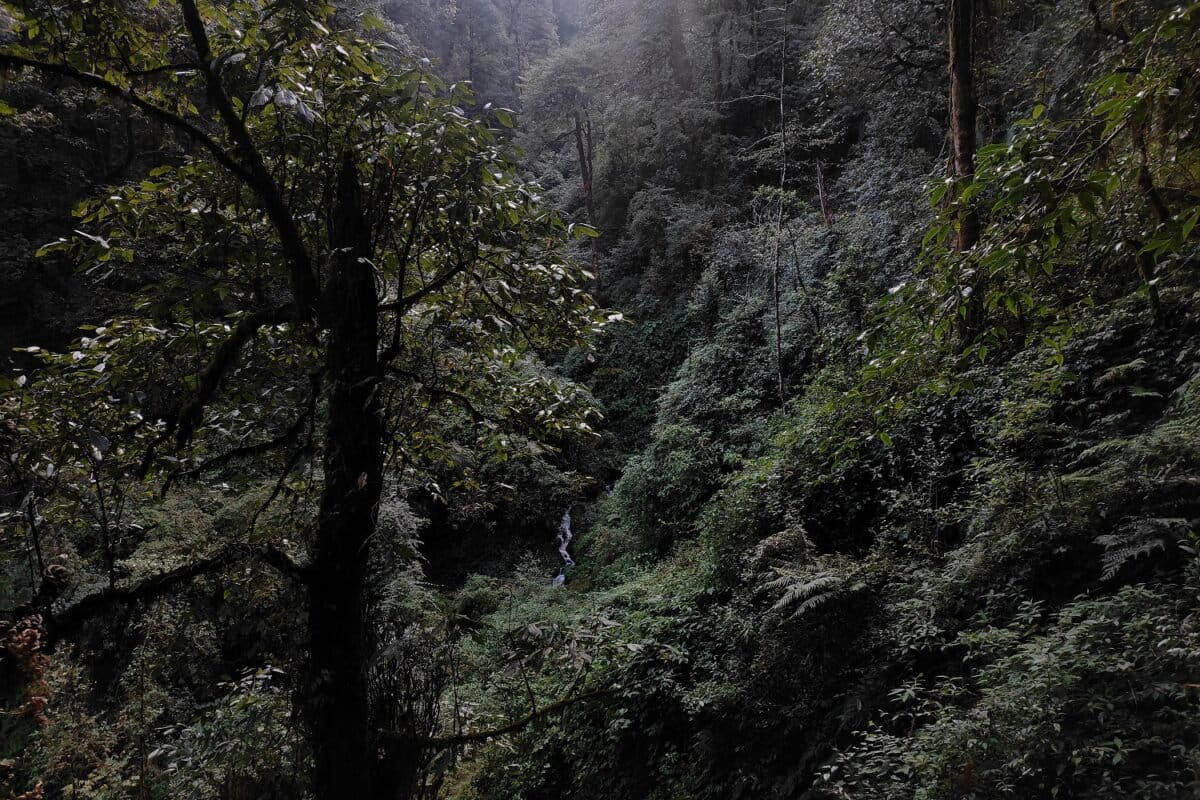
One early morning, a loud, resonant call echoed through the forest. Mingma froze. It was the call — unmistakable, the same one from his folklore. His excitement was immediate and contagious.
We scanned the trunks and canopy, and after several minutes, we found it: a deep chestnut bird clinging to a tall mossy trunk. It was the bay woodpecker or Blythipicus pyrrhotis. This bird was drumming an Alnus nepalensis, a Nepalese alder tree trunk.
For the first time, Mingma could match the sound to the bird. For me, the story from months ago suddenly had a face, feathers, and form. Although I had seen the bird before, I could finally confirm that the call Mingma was talking about in his folk belief was the bay woodpecker.
The bay woodpecker is a medium-sized bird, which has a rich, reddish-chestnut brown colour all over its body; the wings and tail may have subtle dark or rufous bars, but overall, the bird presents a smooth, velvety red-brown look.
A few months later, I spoke about this with my colleague, Pema Yangden Lepcha. Lepcha is an Indigenous tribe, and believed to be the first inhabitants of the Darjeeling-Sikkim Himalaya. She also referred to the woodpecker as a “rain-calling bird.” She further added that this belief is also prevalent in her ancestral village of Dzongu in North Sikkim. People working in the fields do not particularly like hearing this bird call, as it is believed to signal imminent rainfall, which could leave the remaining agricultural work unfinished.
The legend wasn’t entirely wrong
As the months passed and fieldwork continued, I began noticing something curious, almost unsettlingly consistent.
Whenever I heard the bay woodpecker call in the evening, rain almost always arrived the next morning, and whenever I heard it call during the day, the evening would often bring showers.
It happened often enough that I started quietly preparing for it, packing my rain gear, adjusting my field plan, or warning the team to expect wet trails. I did this not out of superstition but because the pattern kept repeating.
The elders’ belief, passed down over generations, began to feel less like folklore and more like a finely tuned reading of nature’s cues.
My research later revealed why this bird had remained legendary for so long.
Woodpeckers and forests
The bay woodpecker is strongly associated with dense, mature forests — places with high tree density, large trees and closed canopy. Such forests offer perfect hiding places, allowing the bird’s voice to travel far while its body remains unseen. Most village residents recognised the call, but only a handful had ever seen the bird itself.
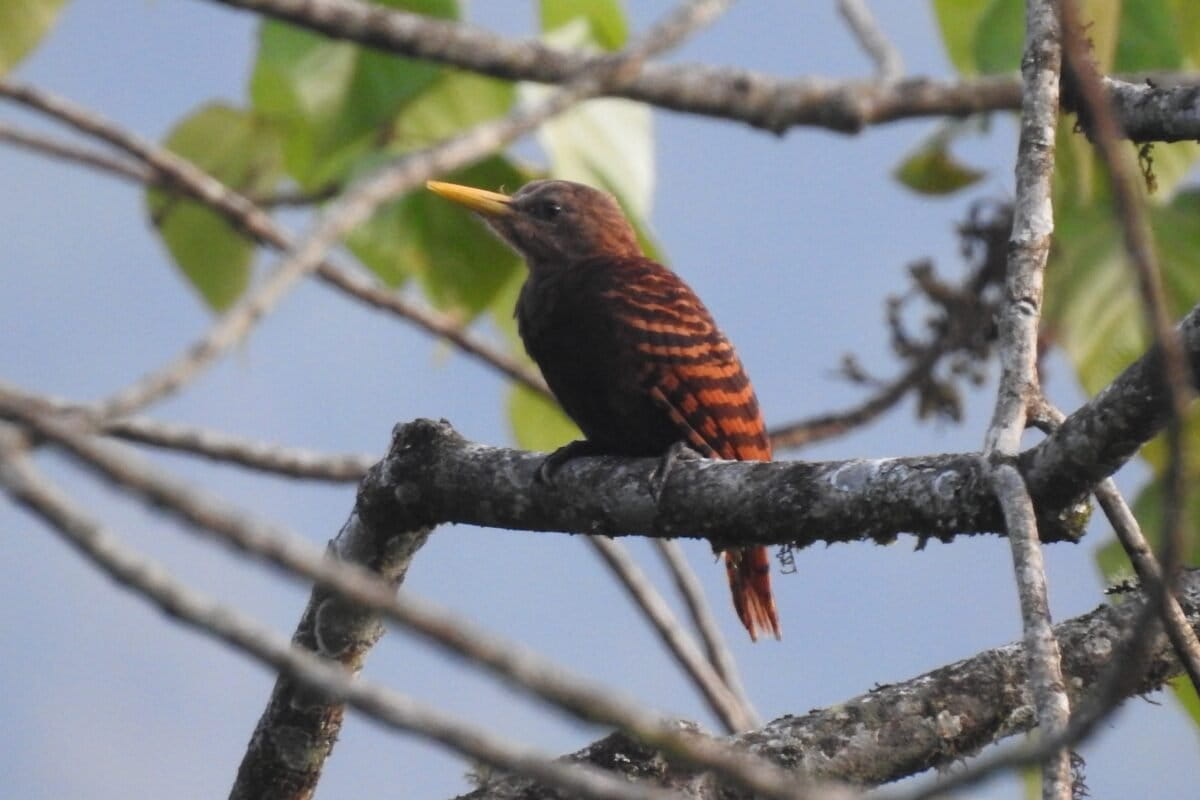
Ecologically, woodpeckers are an indicator of healthy, intact forest ecosystems. In that sense, the elusiveness of bay woodpeckers isn’t just a mystery; it is of ecological significance.
During my research on woodpecker communities across the forests of Darjeeling, a broader pattern began to emerge. Areas where the bay woodpecker occurred were not just rich in trees, but rich in woodpeckers as a group. These forests supported multiple species — each occupying slightly different niches, from canopy foragers to trunk specialists — something that only intact, mature forests can sustain. In contrast, simplified or heavily modified landscapes tended to lose these specialists first. Therefore, the bay woodpecker was never calling alone; its presence was part of a larger, functioning woodpecker community that reflected the health and complexity of the forest itself.
Darjeeling lies within one of India’s most important woodpecker hotspots, hosting 21 species locally and contributing to India’s total of 32 species — 25 of which are found in the Indian Himalayan region. Yet, despite their ecological importance, woodpeckers remain one of the least-studied bird groups in the country. Most detailed research has been confined to protected forests in the Western Ghats or the Western Himalaya, while vast landscapes like the Eastern Himalaya — dominated by tea gardens, agroforests, and community-managed forests — have remained largely overlooked. My research across Darjeeling’s forests revealed that non-protected, human-managed landscapes in the region play a surprisingly important role in sustaining woodpecker communities, often supporting high abundances even where forest structure has been altered. Woodpeckers do more than survive in these landscapes — they signal how well forests are functioning. Forests with a mix of tree sizes, standing deadwood, and a closed canopy supported richer and more stable woodpecker communities, including sensitive species such as the bay woodpecker and the Darjeeling woodpecker. Where woodpeckers were abundant, other forest birds were abundant too.
Listening to a woodpecker’s call — something local communities have done for generations — may also be a way of listening to the health of the forest itself. As forests across the Eastern Himalayas continue to change under pressure from development and plantation management, understanding and protecting these birds becomes not just an ecological concern, but a way to safeguard the resilience of the landscape as a whole.
Does the bay woodpecker truly bring rain?
Not literally. The bay woodpecker does not summon clouds or control the weather.
But local ecological knowledge is rarely meant to be taken at face value. It is observational, built slowly through generations of living close to the land. There are plausible ecological explanations for why the bird’s call so often precedes rain. The bay woodpecker may become more vocal during shifts in humidity that occur just before rainfall. Dense, moisture-laden forests can also carry and amplify sound differently as weather changes, making calls more noticeable. At the same time, the activity of insects, the bird’s primary food source, often increases in the lead-up to rain, which may trigger heightened calling and foraging behaviour.
To communities that depended on forests for their daily lives, these subtle cues mattered. They were not predictions in the modern sense, but patterns noticed, remembered, and trusted. And during my field days, I found myself doing the same.
As we work to understand and conserve Himalayan biodiversity, stories like this remind us that science and folklore often look at the same truth from different angles.
For those living in Sirikhola-Gurdum, the bay woodpecker was not just another forest bird. It was a messenger — sometimes of weather, sometimes simply of the presence of deep, healthy forests. And for me, it became a bridge between the knowledge held by local communities and the patterns revealed through ecological research.
A bird rarely seen, always heard, and forever tied to the rhythm of rain — and to the quiet health of Darjeeling’s forests.
(Published under Creative Commons from Mongabay India)