‘No Comparison Possible Between Jawaharlal Nehru And PM Modi’
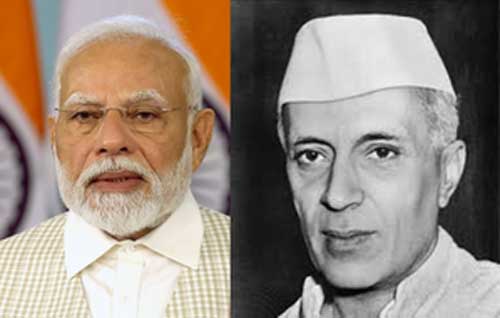
Current Prime Minister Narendra Modi and former PM Jawaharlal Nehru
Nationalist Congress Party (SP) chief Sharad Pawar on Wednesday said that Prime Minister Narendra Modi’s long tenure in office should not lead to comparisons with India’s first Prime Minister, Jawaharlal Nehru, whose contribution to the freedom struggle and the building of modern India remains unmatched.
Speaking at his party’s 27th foundation day celebrations in Mumbai, Pawar acknowledged Modi’s political achievement in becoming one of India’s longest-serving prime ministers but stressed that Nehru’s legacy was rooted in sacrifices made during the country’s fight for independence.
Nehru’s legacy cannot be measured by tenure alone
Referring to the growing narrative around Modi’s years in office, Pawar said longevity in power alone could not be the basis for judging a leader’s place in history.
“There is a perception being created that there is no leader like Narendra Modi because he has become the longest-serving prime minister,” Pawar said. “However, Jawaharlal Nehru’s contribution to the freedom movement and his role in laying the foundations of the nation cannot be forgotten.”
The veteran leader noted that Nehru endured years of imprisonment while participating in the struggle against British rule under the leadership of Mahatma Gandhi.
“He cannot be compared with anyone else. Nehru spent several years in jail during the freedom movement. His sacrifices and commitment to the country’s independence make his place in history unique,” Pawar said.
While extending respect to the constitutional office of the prime minister, Pawar maintained that historical contributions made during critical periods of India’s evolution should be viewed separately from contemporary political achievements.
“It is a good thing that Modi has served for a long period. In a parliamentary democracy, the office of the prime minister deserves respect. But Nehru is Nehru, and the people of India cannot overlook what he sacrificed for the country,” he added.
Pawar criticises remarks on Operation Blue Star
Pawar also entered the debate surrounding recent comments made by Maharashtra minister and BJP leader Girish Mahajan on Operation Blue Star and former Prime Minister Indira Gandhi.
Mahajan had sparked controversy after describing the 1984 military operation inside the Golden Temple complex as a “black day” and drawing parallels between the Army action and invasions carried out by Afghan ruler Ahmad Shah Abdali. His remarks prompted opposition parties to demand his removal from the state cabinet.
Responding to the controversy, Pawar strongly disagreed with Mahajan’s assessment and defended Indira Gandhi’s decision, arguing that it was taken in the interest of safeguarding the nation’s security and integrity.
“Such statements are unacceptable. Operation Blue Star was a sacrifice made by Indira Gandhi for the country,” Pawar said.
He highlighted the Sikh community’s significant role in protecting India’s borders and contributing to the nation’s food security, while acknowledging that a section of individuals had chosen a different course during a difficult chapter in the country’s history.
“Sikhs have made immense contributions to the country’s security and agricultural strength. At the same time, certain developments occurred during that period which cannot be ignored. Indira Gandhi never compromised when it came to the country’s prestige and security,” he said.
Pawar’s remarks come amid continuing political debate over the legacy of Operation Blue Star, which remains one of the most contentious episodes in independent India’s history. While critics view the operation as an assault on Sikh religious sentiments, supporters argue that it was undertaken to address a serious security challenge facing the nation.
Mahajan has stood by his comments, maintaining that the military operation amounted to an attack on Sikhism’s holiest shrine and alleging that the Army was deployed inside Punjab and the Golden Temple complex through the use of force under the orders of the then prime minister.