Is India Gradually Drifting Towards China-Style Authoritarianism?
Shalini Sep 4, 2026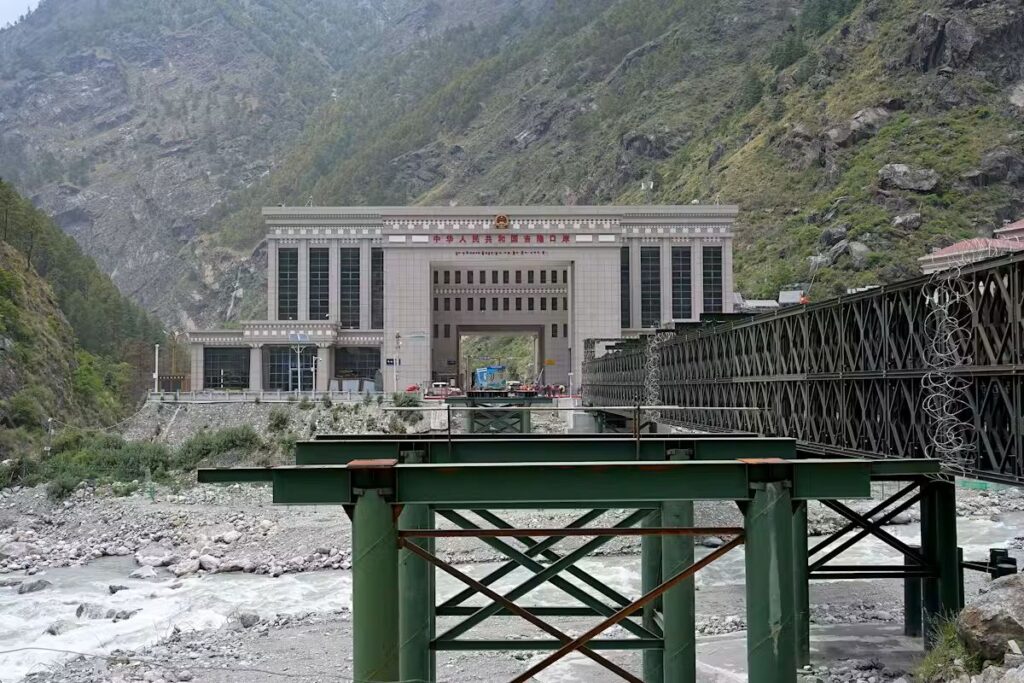
The Gyirong border crossing infrastructure, which connected Tibet (which falls under the China Autonomous Region) and Nepal, was destroyed in the August 26 flood (pacceka/Shutterstock)
India’s democratic trajectory is increasingly the subject of debate. The question is not whether India has already become like China—it plainly has not—but whether some trends in governance, information control and institutional accountability could, if left unchecked, push the country in a more authoritarian direction.
The recent disaster along the Nepal-China border provides a striking point of comparison. Following the August 26 floods, Chinese authorities faced criticism for restricting information about the scale of devastation in Tibet. Independent reporting from the Chinese side has been severely constrained, while official casualty figures have remained dramatically lower than estimates emerging from elsewhere. The contrast has naturally raised questions about the importance of transparency during a catastrophe, when accurate information can be essential for rescue, relief and public accountability.
India, however, needs to be judged on its own record rather than simply through comparison with China. During Operation Sindoor in May 2025, the Indian government initially did not publicly disclose the number of aircraft lost in combat. India’s Chief of Defence Staff later acknowledged that aircraft had been lost but declined to give a figure. In a military operation, governments have legitimate reasons to withhold sensitive operational information. But the broader question is where legitimate secrecy ends and a culture of information management begins.
That distinction matters because authoritarianism is not defined simply by governments keeping secrets. China operates a political system in which the Communist Party exercises overwhelming control over political institutions, media, civil society and dissent. India remains a competitive multiparty democracy, with regular elections, an opposition, an independent judiciary in important areas, a vibrant civil society and a constitutional framework guaranteeing fundamental rights. Freedom House continues to describe India as a multiparty democracy, even while documenting serious concerns about civil liberties, pressure on journalists and government critics.
Yet democracies can weaken without formally disappearing. Democratic erosion often happens incrementally: institutions become less independent, scrutiny becomes more difficult, dissent is increasingly portrayed as disloyal, the media becomes more politically polarised, and governments become less willing to tolerate uncomfortable information. These developments do not instantly transform a democracy into a dictatorship. But collectively, they can reduce the ability of citizens and institutions to hold power accountable.
India’s experience since 2014 therefore deserves scrutiny without exaggeration. Critics have pointed to pressure on journalists and NGOs, concerns about minority rights, the use of investigative agencies against political opponents, and the weakening of institutional checks and balances. Freedom House says harassment of journalists, NGOs and government critics has increased under the Modi government. Reporters Without Borders similarly describes India’s press freedom environment as being in crisis, citing violence against journalists, concentrated media ownership and increasing political alignment of news outlets.
At the same time, equating every controversial government decision with authoritarianism can be counterproductive. National security requires some secrecy. Military operations cannot be conducted through continuous public disclosure. Governments also have legitimate reasons to control sensitive information during disasters, security crises or diplomatic negotiations. The real democratic test is whether secrecy is exceptional, proportionate and subject to institutional oversight—or whether it becomes the default method of governing.
The real danger is democratic erosion, not becoming China overnight
This is where the comparison with China becomes useful. India does not need to become a replica of the Chinese political system for democratic freedoms to deteriorate. The more relevant concern is whether accountability mechanisms gradually become weaker while executive power becomes stronger.
Information is particularly important. A democracy depends on citizens being able to distinguish between fact, propaganda, official claims and independent reporting. When governments consistently control inconvenient information, discourage scrutiny or attack those who question official narratives, citizens lose the ability to make informed judgments. The problem is not merely that people may receive incomplete information; it is that the government can increasingly determine what counts as legitimate information.
The August 26 disaster demonstrates why this matters. Accurate information about casualties, infrastructure damage and environmental risks is not merely a political luxury. It can determine whether neighbouring countries receive timely warnings and whether communities downstream can prepare for further hazards. Reporting from the region has highlighted how China’s restrictions on access and information have complicated efforts to establish the full scale of the disaster.
Democracy is rarely lost in a single dramatic moment. More often, it is weakened through a succession of seemingly defensible decisions—each one narrowing transparency, accountability or dissent a little further. India still has considerable democratic resilience. But preserving it requires recognising that elections alone are not enough. A healthy democracy also depends on the freedom to question the government, access reliable information and demand answers from those who exercise power.