Asiatic Black Bear Habitat To Shrink By Area The Size Of Belgium
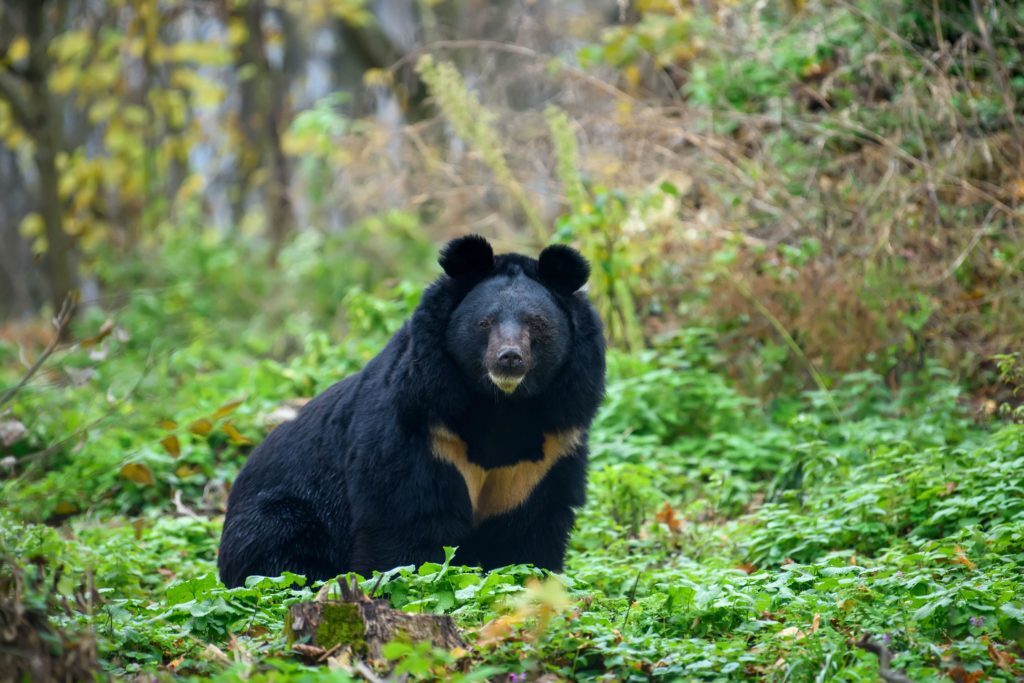
The Asiatic black bear is also known as the ‘moon bear’. It depends on forest vegetation for food, making the species vulnerable as climate change alters the altitude at which trees grow (Image: Volodymyr Burdiak/Alamy)
Once, the Asiatic black bear ranged as far west as Germany and France. Native to the hill forests of Asia, the bear’s range currently extends from Iran, through the Hindu Kush Himalayas, to Japan and the Russian Far East. But by 2100, researchers say, climate change will further change the distribution of the species.
The Asiatic black bear is also known as the ‘moon bear’, a reference to the white crescent-shaped mark on its chest. Listed as a vulnerable species by the International Union for Conservation of Nature (IUCN), this medium-sized bear is threatened by habitat loss and poaching.
As temperatures warm, forests start to grow at different altitudes. The bears depend on forest vegetation for food, which means the location of suitable habitat will change. This, along with land development, agriculture and deforestation could result in habitat fragmentation, forcing the bear into isolated sub-populations and making them vulnerable to population decline.
In a new study published this month, a team of researchers from Australia, China and the US modelled the impact of climate change on the range of the Asiatic black bear in the Hindu Kush Himalayas (HKH), an area of 4.19 million square kilometres across Afghanistan, Bangladesh, Bhutan, China, India, Myanmar, Nepal and Pakistan. The researchers used two climate scenarios in the study: a worst-case scenario (Representative Concentration Pathway — RCP 8.5) and a ‘likely’ scenario (RCP 4.5).
The authors modelled the suitability of current and future habitat for Asiatic black bears using 561 records of the bear’s presence, 19 climatic variables (such as annual temperature range and precipitation seasonality) and five non-climatic variables (such as elevation, human influence index and land-use change).
There was an overall predicted reduction in suitable habitat across the eight countries studied, from 487,036 square kilometres currently to 458,060 sq km under the RCP 4.5 scenario – a loss of nearly 30,000 sq km. Even in areas where suitable habitat is projected to increase, habitat fragmentation and human-bear conflict could threaten populations.
The model found the largest amount of current suitable habitat to be in China, followed by India, Nepal and Myanmar.
BLACK BEARS FORCED TO HIGHER GROUND
The study found that suitable habitat for Asiatic black bears is found primarily at elevations of 1,501-3,000 metres above sea level. In the future, under both climatic scenarios, this is projected to shift both northwards and to elevations of above 3,500 m, with a decline in suitable habitat in the south of the species’ current range.
For example, the bears’ habitat is projected to shrink in the lower altitudes of Nepal and in the south of Sichuan province in China, but increase in northwest Sichuan, in north and northeast Kashmir (in India and Pakistan), Himachal Pradesh and along the Pakistan-Afghanistan border.
Babar Zahoor, an ecologist at Tsinghua University in China and lead author of the study, told The Third Pole: “Our results indicated a shift in habitat range towards higher altitudes. Thus, in countries or regions having mountains or forest not above this elevation, the species could experience maximum threat of extinction.”
“It is expected that the treeline shift would happen in the future due to climate change and there could be a little gain in black bear habitats at higher elevations and a little loss at the lower elevations,” said S Sathyakumar, senior scientist in the Department of Endangered Species Management at the Wildlife Institute of India, a government-affiliated research institution.
Sathyakumar, who was not involved in the study, added that as the black bear is a forest-dwelling species and largely feeds on fruits, nuts and vegetation, climate change could impact the forest’s ability to supply suitable food for black bears in the future.
The study projected that in China and Myanmar, suitable habitat will decline by around 30% and 50% respectively under the RCP 4.5 climate change scenario. In Bangladesh, the model predicted a reduction in suitable habitat of 35-58%. With Asiatic bear populations already low and fragmented in Bangladesh, the authors say this could increase the risk of the species’ extinction in the country.
One of the highest reductions (48%) in suitable habitat was projected in the lower-altitude areas of Nepal.
However, Rabin Kadariya, conservation officer at the Bardia Conservation Programme, a project of Nepali NGO the National Trust for Nature Conservation, questioned whether black bear habitat will in fact decline in Nepal. Kadariya, who was not involved in the study, said that “studies have shown that forest coverage has increased in hilly regions in Nepal where black bears are found due to [the] Community Forestry Programme, reduced dependency on forests due to change in livelihoods and people migrating from the hills to nearby cities.”
He added that the black bear has been recorded across a wide range of elevations in Nepal, from 260 m in the Babai valley of Bardia National Park to mountains at around 3,600 m. “[Over] the last 20 years, the habitat of the black bear must be improving as a result of successful community forest management in hilly region.”
In the central area of the HKH, in the Kashmir region (in India and Pakistan), Uttarakhand and Bhutan, the model predicted that suitable habitat for the Asiatic black bear would remain largely unchanged in the future. Meanwhile in Afghanistan and Pakistan, suitable habitat was projected to increase. However, the authors warn that anthropogenic activities, such as habitat fragmentation, poaching and conflict with humans could affect bear populations.
Melissa Songer, one of authors of the study from the Smithsonian Conservation Biology Institute in the US, said: “The decline in suitable habitat in Nepal and Bangladesh and increases in Pakistan and Afghanistan are related to shifts in vegetation along geographical dimensions.” She explained that this shift is due to temperature variability across the HKH region, resulting in habitat loss in the east, but areas of continuing suitability in the central and western HKH.
A CONFLUENCE OF THREATS
Both Sathyakumar and Kadariya said that retaliatory killings and illegal trade in bear parts – current threats to the Asiatic black bear – will likely have a bigger impact than climate change on the species’ future.
Sathyakumar said: “We need regular monitoring of conflict hotspots by well-trained frontline staff to prevent and manage conflicts, and upscale intelligence-gathering to control poaching and smuggling of bear parts.”
According to the IUCN, Asiatic black bears are mostly poached for their gall bladders and paws. Bear paws are consumed as a delicacy in parts of China and Southeast Asia, while bear bile – extracted from the gall bladder – is used in some traditional Asian medicine. Elsewhere in the species range, such as Pakistan, live bears are illegally captured for bear baiting.
Songer said that as climate change affects the range of Asiatic black bears, there will be an increase in human-bear conflict and the intensity of poaching. “The overall prediction of the model is a reduction in available habitat for the bears. Ultimately, less habitat will mean less available forage and [an increased] need for crop raiding.”
A study of human-bear conflict in Jammu and Kashmir, Pakistan, found that between 2013 and 2015, 40,280 kilogrammes of maize and 149,300 kg of fodder were damaged, with an estimated loss of USD 22,040 for farmers.
Human-bear conflicts have increased in Kashmir in the past decade, resulting in serious injuries and deaths. Studies have found that 90% of attacks happen during the day, around agricultural areas.
“Increased poaching could result due to loss of livelihood from crop raiding and in an effort to reduce the bear population in order to decrease conflict,” said Songer.
Sathyakumar recommended working with local communities to reduce losses to crops and livestock. Measures include using barriers, bear repellents, better livestock shelters, insurance schemes, and most importantly, providing victims of bear attacks with support for treatment and livelihoods.