Nepal’s Flood Disaster Puts Global Loss-And-Damage Fund To The Test
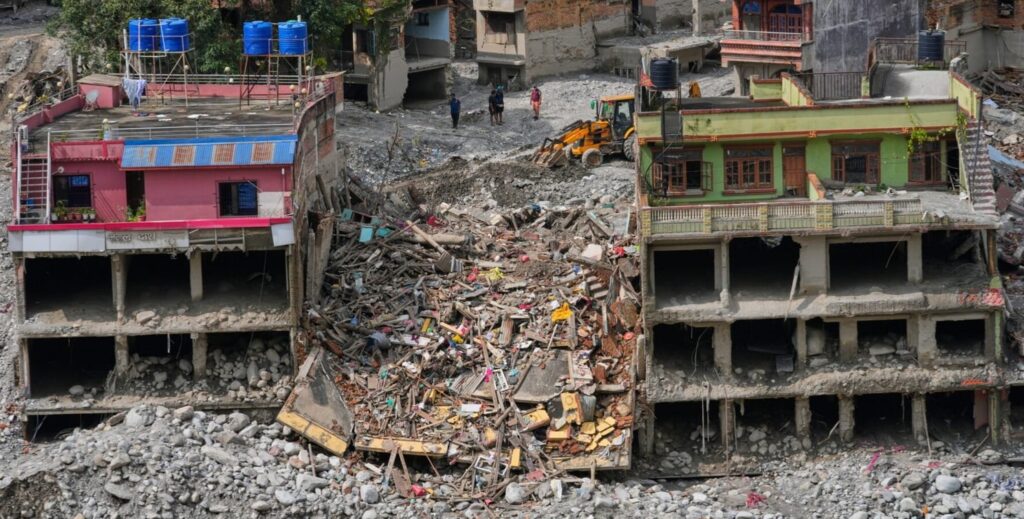
Houses damaged by recent flash floods stand amid thick layers of sludge, mud and debris in Nepal’s Nuwakot district on September 8, 2026 (AP Photo/Dar Yasin)
- Nepal has approached the Fund for Responding to Loss and Damage for quick relief following the August 26 floods.
- Himalayan warming is accelerating, but experts say this specific flood can’t yet be conclusively linked to climate change alone.
- The global climate fund’s resources are insufficient to meet global demand as well as Nepal’s losses, and it’s unclear if the fund can respond quickly enough when there is a crisis.
Nepal has asked a new UN climate fund for urgent help after catastrophic floods killed more than 1,386 people and left over 5,130 missing. But questions over climate attribution, limited funding and the fund’s ability to respond quickly could complicate the appeal.
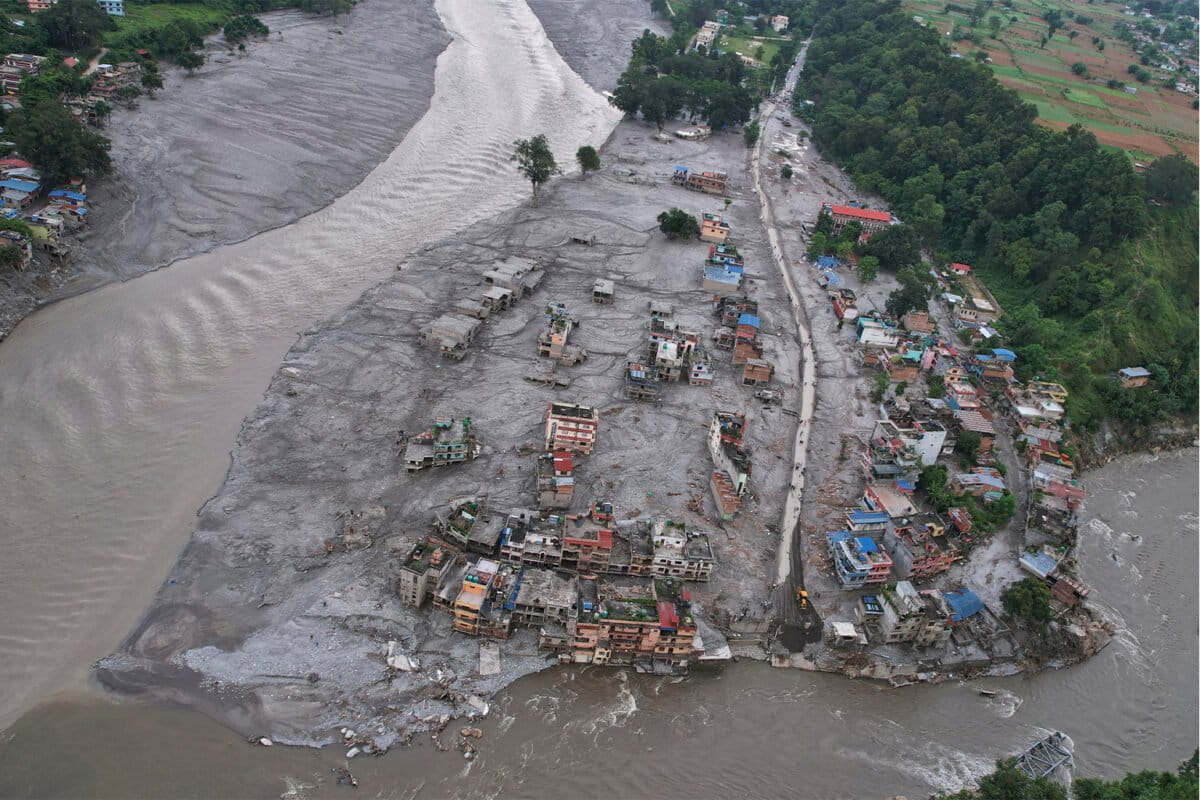
Nepal is seeking emergency support from the United Nations’ Fund for Responding to Loss and Damage (FRLD) after a devastating August 26 disaster swept through communities along the Bhote Koshi river.
The government has asked the fund’s board to make a special decision allowing it to respond “rapidly, directly and effectively” to the crisis.
In a letter dated August 31, Finance Minister Swarnim Wagle and Agriculture, Forest and Environment Minister Gita Chaudhary said a swift response would “demonstrate that the Fund can translate international solidarity into timely support for vulnerable countries and communities when it is most urgently needed.”
The appeal comes as Nepal struggles to assess the scale of destruction. Direct damage from the disaster is estimated at about $2.6 billion, according to Sravan Shrestha, a remote sensing and geoinformation specialist with the International Centre for Integrated Mountain Development (ICIMOD).
Reconstruction and recovery could cost another $4–5 billion or more, he estimates.
Nepal contributes only around 0.027% of global greenhouse gas emissions, yet it is among the countries most vulnerable to climate change. The government says the disaster demonstrates how hazards originating in the high mountains can cascade rapidly into densely populated areas, disrupting water, food, energy, health, infrastructure and ecosystems.
A disaster with an uncertain climate link
The disaster began high in the Himalayas.
On August 26, a bedrock slope beneath a hanging glacier failed at roughly 5,200 metres on the north face of the Langtang Himal. The resulting rock-ice avalanche plunged about 1,200 metres before reaching the Lhende Khola, a tributary of the Bhote Koshi.
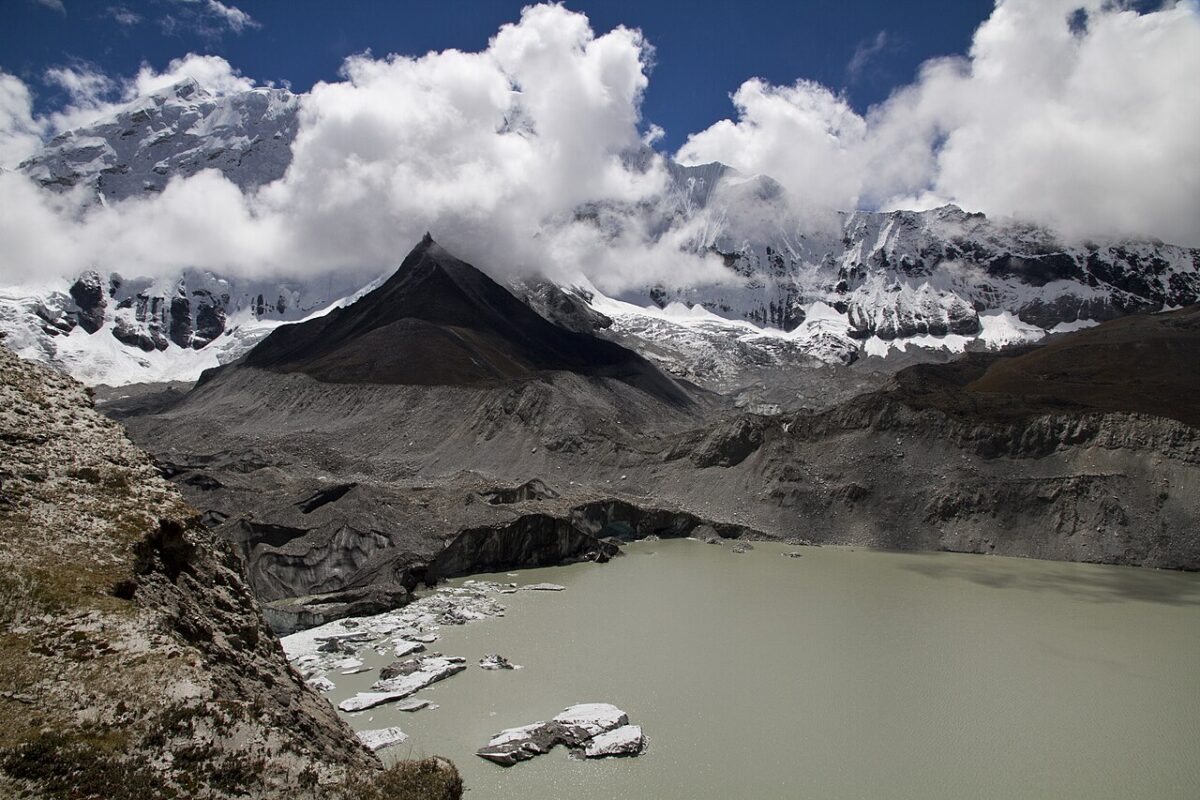
Friction from the fall melted ice and generated enough water to transform the avalanche into a debris flow. The resulting surge moved downstream into already swollen rivers, according to an ICIMOD assessment.
But whether climate change directly caused the slope collapse remains unanswered.
“Not all of the devastating impacts of the Nepal-Tibet floods are due to climate change,” says Emily Wilkinson, a Principal Research Fellow at ODI’s Global Risks and Resilience Programme.
Warming temperatures may have intensified the flooding, she says, but the scale of the human toll was also shaped by uneven development, weak investment in disaster-risk reduction, social marginalisation and geopolitical factors.
A formal climate attribution study will be needed to determine how much of the loss can be attributed to climate change, Wilkinson says.
Shrestha agrees that climate change could be a major factor but cautions against drawing a direct causal link too soon.
“Whether it caused that particular slope to collapse on that particular morning is a question nobody has answered,” he says.
The broader trend, however, is unmistakable.
The Hindu Kush Himalaya is warming at roughly twice the global average. Glacier loss is also accelerating, raising concerns about increasingly unstable mountain slopes and extreme events.
“In the 2000s, we expected a glacial-origin flood in the HKH roughly once every 5 to 10 years,” Shrestha says. “In 2025 alone, three such events hit the region, and now this in 2026.”
Warning systems failed to catch the threat
The disaster also exposed gaps in Nepal’s early-warning systems.
The country has identified 47 potentially dangerous glacial lakes and operates warning systems at two of them, Tsho Rolpa and Imja Tsho.
But the August 26 disaster did not originate in a glacial lake. It began with a collapsing bedrock slope beneath a hanging glacier — a hazard that existing regional inventories do not monitor.
River gauges at Bhote Koshi and Syabrubesi, designed to detect rising water and trigger alerts, were swept away by the flood before warnings could be issued.
The surge reached Syabrubesi in roughly 10 minutes after crossing into Nepal.
Existing warning systems are largely designed for gradual monsoon flooding, Shrestha says, not a hyper-concentrated debris flow capable of reaching downstream communities within minutes.
Can the loss-and-damage fund deliver?
Nepal’s appeal is also an early test for the FRLD, a mechanism created after decades of pressure from climate-vulnerable countries.
The fund was established at the UN climate summit in Sharm el-Sheikh in 2022 and operationalised the following year. Countries have since pledged more than $820 million.
But demand has already far outstripped available resources.
By the fund’s July board meeting, 119 countries had submitted 176 requests worth approximately $2.8 billion. The board decided it needed more time to assess the portfolio and postponed funding decisions until its next meeting in December.
“The resources currently available are orders of magnitude below the scale of actual loss and damage needs,” says Vera Künzel, Senior Advisor for Climate Change Adaptation and Human Rights at Germanwatch.
Nepal’s request presents an additional problem: it is seeking rapid emergency assistance rather than conventional project-based funding.
The FRLD’s governing instrument allows for rapid response, but its current Barbados Implementation Modalities do not yet spell out how such assistance should be delivered.
Wilkinson says the fund does not yet have the operational machinery needed for emergency response. She points instead to the UN’s Central Emergency Response Fund as an institution better equipped to provide immediate humanitarian assistance.
Raju Pandit Chhetri, Executive Director of Kathmandu-based Prakriti Resource Centre, takes a more flexible view.
The FRLD Board, he says, could treat Nepal as an urgent case while developing the detailed procedures for rapid response later.
Nepal’s appeal has received backing from least developed and other developing countries. At a September 3 ministerial meeting in Timor-Leste, the Least Developed Countries Group warned that demand for FRLD assistance already exceeds available resources and called for clearer ways to mobilise additional funding.
For Künzel, the stakes extend beyond Nepal.
The response will show whether the global loss-and-damage system can function when vulnerable countries face disasters that overwhelm their own capacity.
“Support for countries like Nepal is not charity but an obligation rooted in responsibility and fairness,” she says.
Nepal’s request is therefore more than a plea for emergency funding. It is a test of whether a global climate mechanism created to address loss and damage can turn promises of international solidarity into assistance when it is needed most.
(Published under Creative Commons from Mongabay-India)