Drought, Fodder Shortages Leave Bundelkhand’s Farmers Vulnerable
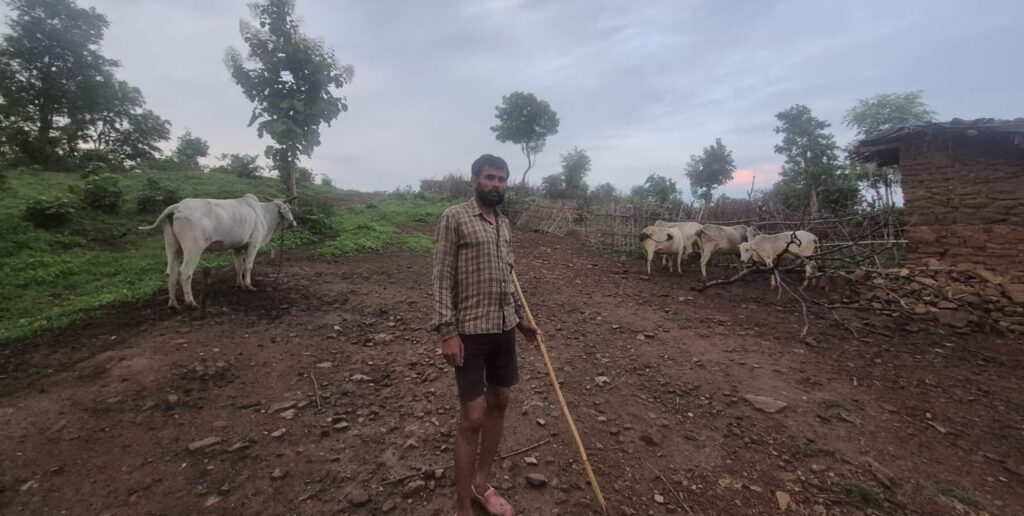
Rama Shankar with his family’s cattle in Doda Mafi village in Bundelkhand (Image by Shivam Bhardwaj)
In drought-prone Bundelkhand, livestock often bear the earliest and harshest impact of extreme weather. Repeated droughts, shrinking grazing lands and limited access to irrigation have intensified fodder shortages, forcing farmers to take increasingly desperate measures to feed their animals.
For 65-year-old livestock farmer Faujdar Singh Yadav of Doda Mafi village in Chitrakoot district, the search for fodder ended in tragedy. Yadav has been missing for more than three months. His family owns 14 cattle, which he would take into the forest to graze during summer when fodder at home ran out.
“In the third week of April, he went out to graze the cattle. In search of fodder, the cattle went deeper into the forest and disappeared from his sight. While searching for the cattle, he probably got lost too,” recalled his son, Rama Shankar. “The cattle returned home by late evening, but my father hasn’t returned to this day. An FIR was registered, but there is still no information about my father.”
Yadav’s disappearance reflects a broader crisis facing livestock-dependent households across Bundelkhand. The historically drought-prone region has experienced increasingly frequent droughts, with severe drought conditions now occurring roughly every five to seven years. Because rural livelihoods depend heavily on farming and animal husbandry, livestock are among the first to suffer when crops fail and fodder becomes scarce.
The consequences can be severe. During the 2015-16 drought, thousands of cattle reportedly died because of shortages of food and water. Many farmers continue to remember the crisis.
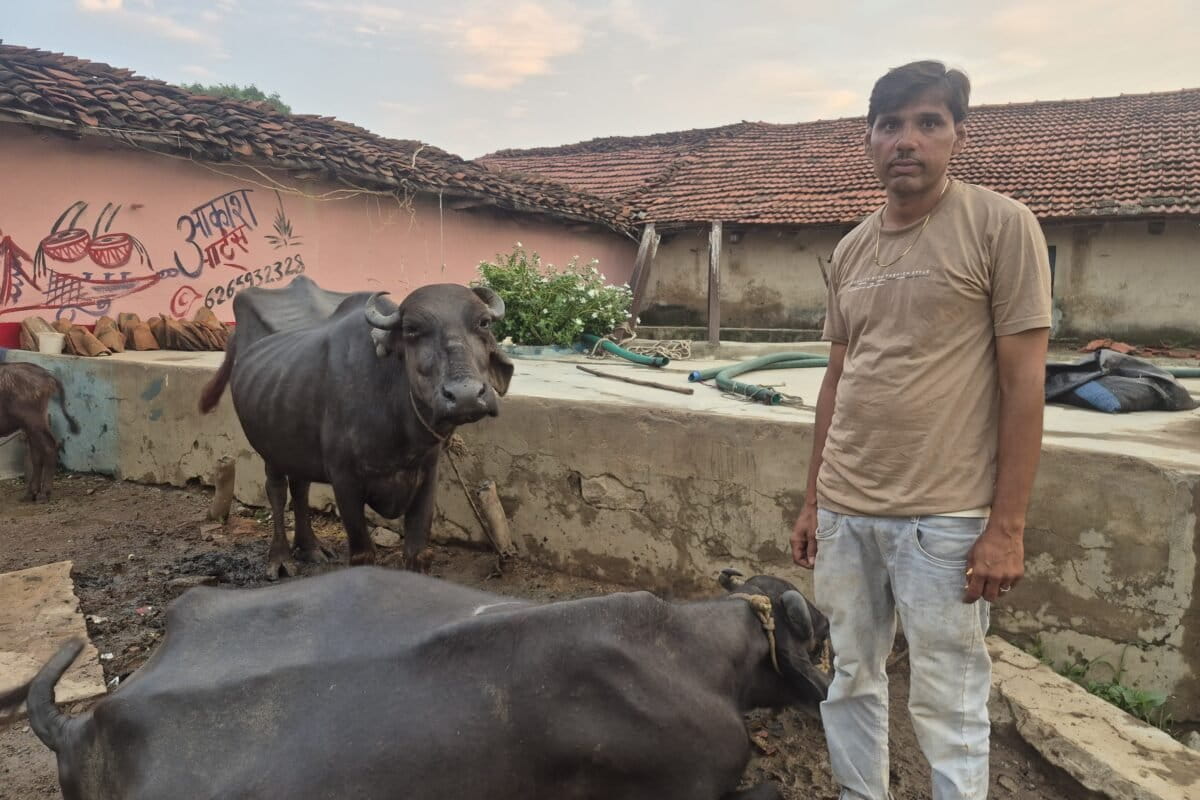
In Mahoba district, 55-year-old livestock farmer Kalka Prasad recalled losing two cows during that drought. “A decade ago, I had six cattle, including three cows and three buffaloes. Now I have three buffaloes. Two of my cows died during the 2015-16 drought. One cow survived, which I abandoned because there was nothing left to feed her.”
One major consequence of fodder scarcity is the widespread practice of free grazing, locally known as anna pratha. A study found that around 67% of farmers in Bundelkhand allow cattle to roam freely, primarily because of shortages of fodder and water during summer. The practice can also damage standing crops.
A 2020 ICRISAT study estimated that free-roaming cattle damage 25-35% of the kharif crop in Bundelkhand every year, discouraging farmers from cultivating their land.
The shortage of fodder becomes particularly acute when rainfall is poor. Prasad explained that farmers depend heavily on crop residues such as wheat straw for livestock feed.
“This year, rainfall is low. In years with low rainfall, water doesn’t reach the canal. Without irrigation, wheat yields drop drastically, leading to a severe shortage of straw (bhusa). The lower the straw output, the higher its price, making it unaffordable to buy,” he said.
The problem is reflected in scientific assessments. According to ICAR-IGFRI, Banda, Mahoba, Chitrakoot and Hamirpur face severe dry-matter deficits, with availability below 40%. Across Bundelkhand, the overall dry-matter deficit stands at about 42%.
Farmers say the shortage directly affects milk production and household incomes. “A buffalo that usually yields 5 to 6 litres of milk yields only 2 to 2.5 litres,” Prasad said.
Improved fodder varieties yet to reach farmers
Scientists and government agencies have developed several drought-tolerant fodder options. The ICAR-IGFRI’s Uttar Pradesh Fodder Resources Development Plan recommended varieties of berseem, cowpea, guar, oat and anjan grass for Bundelkhand. It has also developed newer varieties, including Bundel Berseem-9 and Bundel Marvel-2.
However, awareness and access remain major barriers.
“What are these names? We don’t know anything about them. No one in the village knows,” Prasad said when asked about the improved varieties.
Mahoba’s Chief Veterinary Officer Ranjan Singh also said the varieties had not come to his department’s notice. The department promotes Napier grass, but it requires irrigation.
Scientists suggest alternatives for farmers without irrigation. ICAR-IGFRI principal scientist Arun Kumar Shukla said farmers can grow Anjan and Dhaman grass instead of Napier.
Yet distribution remains limited. Chitrakoot’s Chief Veterinary Officer Jitendra Singh said his department distributes Napier roots to “five farmers every year.”
Farmer Bharat Kumar questioned the pace. “If root slips are given to only five farmers every year, the distribution will take decades to reach all farmers in the district,” he said.
Fodder banks remain largely out of reach
Fodder banks and improved crop-residue storage are another potential solution. Government contingency plans recommend permanent fodder banks, drought-tolerant crops and emergency grazing camps.
But these facilities remain scarce. “No such fodder bank has been established in our area,” Kumar said. “There isn’t even enough fodder available, so what would we even store in a bank?”
Experts point to hay-making and preservation of leguminous fodder as practical alternatives. But such solutions will have little impact unless they are made accessible to farmers.
The scale of the crisis is visible in Chitrakoot’s livestock numbers. Between the 2019 Livestock Census and 2024-25, the district’s cattle and buffalo population fell from 5,19,428 to 4,19,678—a decline of nearly 100,000 animals.
The figures underline a stark reality: without reliable fodder, irrigation, grazing land and accessible resilience measures, Bundelkhand’s livestock economy will remain increasingly exposed to drought and extreme weather.