Study Links Female Legislators To Faster Forest-Cover Growth
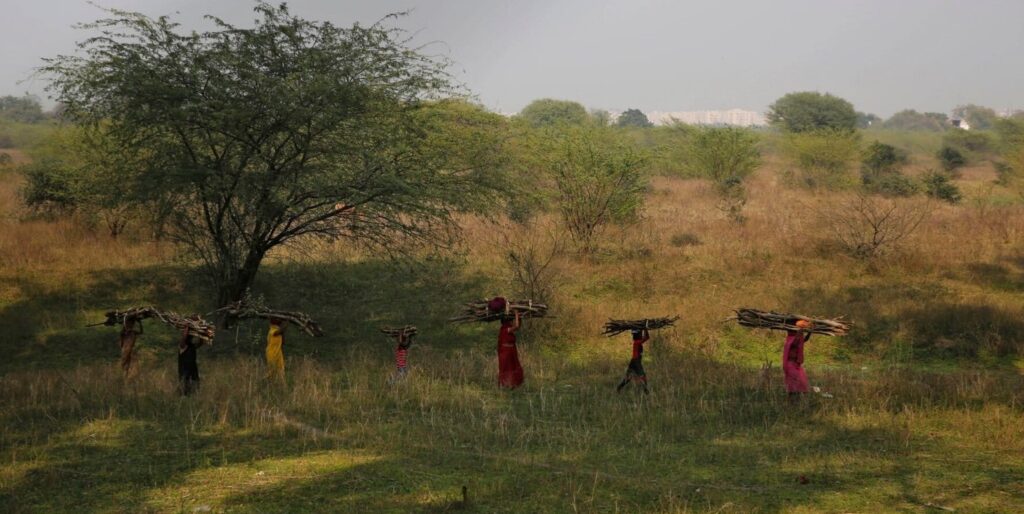
Women walk after collecting firewood for their homes from a forest area in Lucknow, Uttar Pradesh (AP Photo/Rajesh Kumar Singh)
A recent study reveals that the gender of elected representatives can significantly shape environmental outcomes, particularly forest conservation in India. Titled “Female legislators and forest conservation in India” and published in the Journal of Economic Behavior & Organization early this year, the research examines the causal impact of female Members of the Legislative Assembly (MLAs) on forest-cover growth. Its central finding is striking: electing a female MLA increased annual forest-cover growth by about six percentage points in constituencies reserved for historically marginalised communities such as Scheduled Castes (SCs) and Scheduled Tribes (STs).
The authors employed a regression discontinuity design (RDD) to isolate the effect of legislator gender. They compared forest-cover trajectories in constituencies where a woman narrowly defeated a male candidate against those where a man narrowly prevailed in close mixed-gender contests.
“Closely contested state assembly elections reveal a clear pattern: where women narrowly win against male candidates, forest cover grows faster in subsequent years,” the authors note in a related piece published in The Policy Edge. They further explain the methodological strength of this approach: “In extremely close mixed-gender elections, the outcome is often shaped by small, contingent factors rather than systematic differences between constituencies. Comparing such razor-thin contests allows a credible estimate of the effect of legislator gender.”
To reach these conclusions, the researchers assembled a rich dataset spanning forest-cover measurements from 2000 to 2014, detailed state assembly election results, the gender of winning candidates, and information on whether each constituency was reserved for SCs or STs. This combination enabled them to identify a robust pattern linking female representation to improved forest outcomes specifically within reserved seats.
The study explores several mechanisms that may explain why female legislators appear more effective at promoting forest conservation in these settings. Drawing on existing literature, the authors suggest that women, who are often disproportionately affected by climate change, may prioritise environmental protection more strongly than their male counterparts.
Women from marginalised communities, in particular, may possess heightened awareness of climate vulnerability. Moreover, SC/ST-reserved constituencies already contain legal and institutional frameworks related to forest rights and environmental governance. Female representation may interact productively with these existing structures, amplifying conservation efforts.
The authors elaborate on the lived experience of marginalisation: “Individuals from marginalised communities often face the additional constraint of limited resources to adapt to environmental degradation and climate shocks. Female politicians from these communities may therefore be particularly aware of the challenges faced by women and girls in their constituencies. This awareness can translate into stronger emphasis on environmental conservation in their political priorities.”
Age emerges as another potential factor. Female legislators in the sample tended to be younger than their male counterparts, and the positive effect on forest cover over an electoral term was especially pronounced among these younger women. This observation raises the possibility that generational differences in environmental attitudes or political priorities contribute to the observed outcomes. Taken together, the findings highlight how identity—specifically gender intersecting with caste and community status—can influence policy priorities and environmental results.
By focusing on close elections, the study provides unusually strong causal evidence that electing women, particularly in reserved constituencies, can accelerate forest-cover recovery. The results suggest that expanding opportunities for women from historically marginalised groups to hold elected office may yield tangible benefits not only for representation and equity but also for the health of India’s forests and the resilience of communities that depend on them.