Stop ‘Appeasing’ Trump, Don’t Sign Skewed Trade Deal: Congress To PM
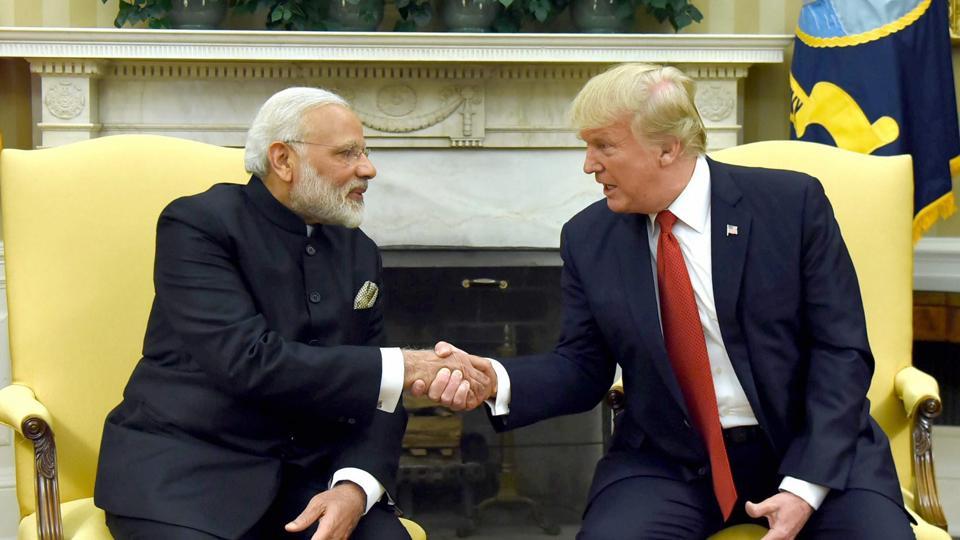
FILE PHOTO: US President Donald Trump and Indian PM Narendra Modi during the latter's state visit to Washington D.C.
As crucial trade negotiations between India and the United States gather pace, the Congress has urged Prime Minister Narendra Modi not to rush into a trade agreement that it claims could disproportionately benefit Washington at India’s expense.
The opposition party’s criticism came on Tuesday as US Trade Representative Jamieson Greer arrived in New Delhi for a two-day visit aimed at advancing discussions on an interim trade pact between the two countries. Congress general secretary Jairam Ramesh accused the government of prioritising political considerations over national economic interests and warned that any agreement lacking adequate safeguards could hurt Indian farmers, manufacturers and domestic industries.
Taking to social media, Ramesh said there was no justification for India to hurry into a deal that remained uncertain in both structure and outcome.
“PM Modi must stop appeasing his good friend President Trump. There is absolutely no need for India to be bamboozled into signing any trade agreement which, as it stands now, is heavily against India’s interests,” he said.
His remarks have added a political dimension to ongoing trade discussions that have gained momentum in recent weeks. The talks trace their origins to the meeting between Prime Minister Modi and US President Donald Trump on February 6, 2026, when both leaders announced plans to deepen economic cooperation and work toward a trade agreement.
According to Ramesh, the framework discussed at that meeting envisioned substantial tariff concessions and expanded market access between the two countries. He claimed that under the proposed arrangement, the United States would reduce tariffs on Indian exports from 25 per cent to 18 per cent, while India would lower or remove tariffs on a range of American agricultural and industrial products.
The agreement, he said, also involved India significantly increasing purchases from the United States, with bilateral trade targets reportedly reaching as high as USD 500 billion over a five-year period.
Congress questions trade framework and tariff assurances
While the government has projected the negotiations as an opportunity to strengthen economic ties with the world’s largest economy, the Congress argues that the circumstances surrounding the proposed deal have changed considerably since February.
Ramesh pointed to a ruling by the US Supreme Court on February 20 that reportedly declared President Trump’s reciprocal tariff strategy unlawful. According to him, that judgment undermined one of the central assumptions behind the original trade framework.
“The very tariff concession that the US had offered India in the 6 February joint statement effectively disappeared overnight,” he claimed.
He further argued that Washington’s trade policy remains uncertain. Following the court ruling, the United States imposed a temporary 10 per cent tariff on imports from all trading partners, including India. Ramesh noted that the legal validity of those tariffs is expected to expire on July 24, creating additional uncertainty for countries negotiating trade arrangements with the US.
According to the Congress leader, India should be cautious about committing to significant market-opening measures while questions remain over the future direction of American trade policy.
He also alleged that the United States is using ongoing investigations into the trade practices of India and dozens of other countries as leverage during negotiations.
“Such an agreement is not a deal but a steal by the US,” Ramesh said.
The Congress leader warned that easier access for American agricultural products could adversely affect farmers across several Indian states. He specifically cited Jammu and Kashmir, Himachal Pradesh, Bihar, Madhya Pradesh, Rajasthan and Maharashtra as regions that could face increased competition if import barriers are lowered.
Ramesh argued that policymakers must carefully assess the long-term implications of any agreement before making commitments that could affect rural livelihoods and domestic production.
Political criticism amid renewed trade momentum
Beyond economic concerns, Ramesh also questioned whether India could rely on long-term assurances from Washington even if a trade agreement is eventually signed.
Referring to previous trade disputes involving US allies, he noted that countries with existing agreements have still faced tariff threats and trade restrictions.
“Even if a deal is signed, what guarantee is there that tariffs will not be unilaterally imposed or threatened thereafter?” he asked.
The Congress leader also linked the trade debate to broader political issues involving India-US relations. Taking a swipe at Prime Minister Modi, he referred to President Trump’s repeated claims regarding Operation Sindoor and accused the Prime Minister of remaining silent on the matter.
“President Trump has claimed over a hundred times that he halted Operation Sindoor, yet Mr Modi has not challenged that assertion,” Ramesh said.
His comments come at a time when both governments appear eager to conclude at least an interim agreement. Prime Minister Modi and President Trump recently met on the sidelines of the G7 Summit in France, where trade cooperation featured prominently in their discussions.
Following that meeting, Trump expressed optimism about the negotiations and said that India and the United States were “very close” to reaching a trade deal.
Greer’s visit is expected to focus on narrowing differences on key issues and establishing a roadmap for a formal agreement. Officials from both sides are likely to discuss tariffs, market access, investment opportunities and measures to boost bilateral trade.
The Indian government has not yet responded publicly to the Congress party’s criticism. However, with negotiations entering a critical phase, the debate over the costs and benefits of a potential trade pact is likely to intensify.
As trade officials continue discussions in New Delhi, the central question remains whether India can secure an agreement that strengthens economic ties with the United States while protecting the interests of its farmers, industries and consumers. The outcome of the talks could shape one of the most significant economic partnerships in the coming years.