What Will An El Niño Bring Next To India?
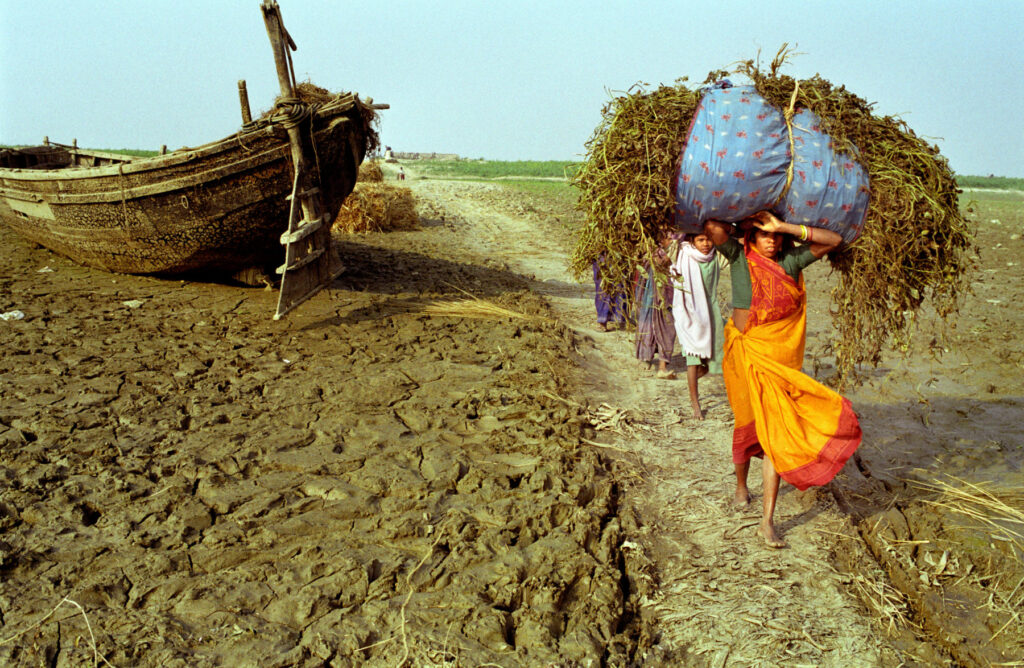
Drought dries up a tributary of the Ganga river in Sonepur, Bihar. Efficient irrigation and water management practices will play an essential role in reducing the water requirements of Indian agriculture (Image: Alamy)
India’s vital monsoon rains can be disrupted by an El Niño, which is a major concern for crop production.
India’s monsoon was delayed by three weeks this year.
This meant far lower rainfall across the subcontinent in early June and a vicious heatwave which saw temperatures in some areas of Uttar Pradesh hit 47 degrees Celsius.
A delayed and weak monsoon is usually the case when an El Niño develops in the (northern-hemisphere) Spring, as has been the case this year, after three consecutive years of La Niña. Predictive models suggest the El Niño will continue strengthening in coming months.
El Niño events profoundly influence extreme weather events around the world, with far-reaching consequences for food production, water availability, and the wellbeing of both people and ecosystems.
Implications for India are significant, with the impact on agricultural production being one of the most pressing concerns.
El Niño events have been associated with amplifying temperature rise, heat extremes, and inducing more erratic rainfall patterns over the subcontinent.
Historically, at least half of the instances of El Niño have been directly linked to droughts during the summer monsoon season.
In 2015, Chennai in southern India experienced an extraordinary rainfall event, in which the region witnessed its heaviest one-day rainfall in over a century.
This event has been attributed partly to the extreme El Niño event between 2014 and 2016. The torrential downpour resulted in over three million people being deprived of essential services, and the costs to the Indian economy were estimated at USD$3 billion.
The impact of these events serves as a stark reminder of the far-reaching effects that escalating extreme weather events can have on communities and economies.
The collective impacts of these changes on agricultural production can compromise food and water security.
It is essential, therefore, to dissect how future changes in climate and El Niño events will combine to affect India’s monsoon in the coming years.
With the oceans absorbing around 93 percent of the additional heat from global warming, El Niños are becoming stronger.
Most climate models project that fluctuations in rainfall related to El Niños will increase significantly in the next few decades.
This increase is attributed to the global warming-induced rise in atmospheric moisture content.
According to climate models, the connection between El Niño and the Indian summer monsoon will intensify in the future, especially if we continue with high carbon emissions.
In simple terms, this means that the impact of El Niño on the Indian monsoon will become even more pronounced.
In addition to projected increases in erratic rainfall, prolonged droughts, and heatwaves due to climate change, the forecast of amplifying El Niño impacts on the Indian monsoon have led the Intergovernmental Panel on Climate Change’s sixth report to assess India as the most vulnerable nation in Asia concerning impacts on crop production.
This underscores the urgency of wide-ranging adaptation and risk mitigation actions in India.
How Indian Farmers Can Adapt To Change
It is essential to embrace crop varieties and livestock more resilient to the changing climate. We can reduce reliance on specific crops by altering cropping patterns and promoting diverse crop systems.
The Indian Council of Agricultural Research actively develops crop varieties resilient to climate variations and can withstand diseases.
Despite some improvements in irrigation infrastructure, around 50 percent of agriculture still depends on rainfall. Efficient irrigation and water management practices will play an essential role in reducing the water requirements of Indian agriculture.
Implementing water and soil moisture conservation methods, along with agroforestry and forestry initiatives, can help retain soil moisture, prevent erosion, and maintain a healthy ecological balance.
Adaptation strategies must also encompass the livestock and fishery sectors, which are susceptible to climate impacts.
Diversifying livestock breeds, and improving animal health management, can enhance the resilience of these sectors.
Similarly, ensuring sustainable fishing practices, protecting and restoring fish habitats, and monitoring fish populations are crucial to enhancing resilience.
Indigenous communities’ knowledge is vital in adapting to the challenges posed by a changing climate. In India, Indigenous farmers have preserved many climate-resilient varieties of seeds that can withstand droughts, floods, and high salinity. By utilising these seeds, farmers can enhance their resilience to an increasingly variable climate.
Investing in training and capacity-building programs for farmers is crucial in addition to embracing traditional knowledge.
These initiatives give farmers the knowledge and skills to adapt to a changing climate and practice resilient agriculture. Financial incentives, such as agriculture insurance, play a significant role in providing a safety net for farmers and can help protect them from potential losses caused by extreme weather events.
During May and June, heatwave forecasts and a close monitoring of the monsoon can help inform early warning systems.
These systems can alert farmers about impending extreme conditions and provide guidance on potential remedial measures. The ongoing Agrometeorological Advisory Services led by the Indian Meteorological Department have already disseminated weather forecasts to farmers through TV, radio, and SMS.
Scaling up these initiatives to reach more farmers and ensure everyone can access necessary weather information will be essential.
Originally published under Creative Commons by 360info™.