Sonia Gandhi’s Memoir Takes Aim At Modi Government’s Record
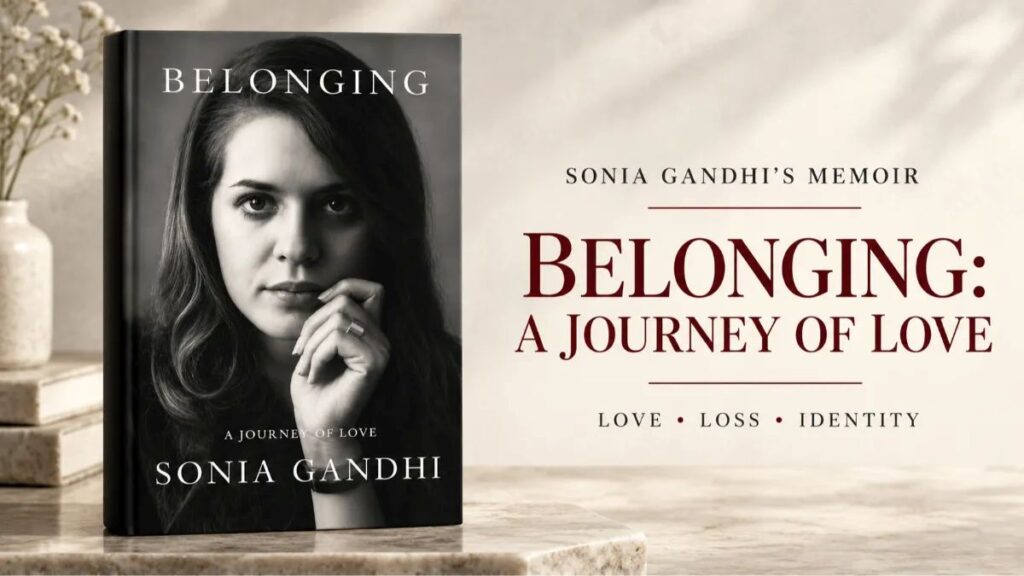
A 544-page memoir titled 'Belonging: A Journey of Love', written by Congress leader Sonia Gandhi, has recently been published in India and abroad
Congress Parliamentary Party chairperson Sonia Gandhi has accused the Narendra Modi government of weakening India’s democratic institutions over the past 12 years, warning that restoring their credibility and functioning will require sustained political effort even after the present government leaves office.
In an interview with The Hindu ahead of the release of her 544-page memoir, Belonging: A Journey of Love, Gandhi expressed concern over what she described as deep damage to the country’s democratic fabric. However, she said she remained optimistic that India would eventually return to what she called proper governance.
“Over the last 12 years, great damage has been done to the fabric of our country, our democracy and our institutions. Even after this government goes, it will take time to restore our systems back to health and great effort from political parties,” she said.
“I am optimistic and I know that the people of India will welcome a return to proper governance,” she added.
Gandhi’s remarks come amid continuing Opposition allegations that democratic institutions have faced growing political interference and that the electoral process has been compromised. Her comments also reflect the Congress’s attempt to position itself as a principal defender of constitutional values against the ruling BJP.
‘An increasingly unequal political environment’
Responding to questions about the Congress’s electoral decline and prospects for revival, Gandhi rejected suggestions that she was pessimistic about the party’s future. She argued that the challenges confronting the Congress needed to be understood in the context of what she described as an increasingly unequal political environment.
Gandhi alleged that the ruling establishment exercised overwhelming influence over institutions, particularly the Election Commission of India (ECI), while enjoying control over mainstream media and access to substantial financial resources. She also accused the BJP of using religion as a political instrument.
“Take into account the complete stranglehold they have on all institutions, especially the Election Commission, their control of mainstream media, their money power and their exploitation of religion,” she said.
Despite these constraints, Gandhi maintained that the Congress had demonstrated considerable resilience. She said its leaders and workers had faced different forms of persecution but continued to defend constitutional principles across the country.
She also reiterated the party’s allegations of electoral manipulation, claiming that recent developments had strengthened its contention that several elections had been stolen.
“What is more, it has been amply proved in recent months that many elections have been stolen, and people are now more aware of it,” she said.
Gandhi added that the Congress was working with like-minded Opposition parties and believed its electoral prospects were improving. Her remarks underline the party’s effort to build a broader political challenge to the BJP by placing institutional accountability and electoral integrity at the centre of its campaign.
Asked what the Congress could learn from Prime Minister Narendra Modi’s political rise, Gandhi said his ideological background was fundamentally different from that of her party. She cited former Prime Minister Manmohan Singh and Congress president Mallikarjun Kharge as examples of political success within the Congress.
“It’s true that he comes from a very different ideological world. But there are many ways that people succeed in politics within the Congress party, take for example Dr Manmohan Singh and Congress president Mallikarjun Kharge. I don’t think we have much to learn from the RSS,” she said.
Gandhi also dismissed the suggestion that she had ever regretted declining the prime minister’s post after the Congress-led United Progressive Alliance (UPA) won the 2004 general election. She said the thought had never crossed her mind.
Describing the UPA years as a largely positive experience, she recalled working closely with Singh, with responsibilities divided between him heading the government and her leading the party.
A personal journey shaped by political upheaval
Unlike a conventional political memoir, Belonging: A Journey of Love, published by HarperCollins India, places personal experiences at the centre of its narrative, with political developments providing the backdrop.
Gandhi has described politics as “a kind of framework” for the story. Last month, she said that others had spent decades telling her story and that she had now decided to tell it herself. She also anticipated public attention and controversy around its release, remarking that there was bound to be “some tamasha”.
The memoir’s publication in India follows a breakdown in negotiations between Gandhi’s representatives and Penguin Random House India (PRHI), which had initially been keen to publish the book. The disagreement reportedly concerned editorial changes sought in the manuscript.
The withdrawal prompted concerns among some Congress leaders about possible government pressure and its implications for freedom of expression. Some alleged that Penguin India had faced pressure to remove passages relating to Modi, the RSS and China’s alleged occupation of Indian territory during the present government’s tenure.
PRHI denied that external pressure had influenced its decision. Describing the memoir as a “hard-won acquisition”, the publisher said negotiations had reached a stalemate over a particular issue. It declined to disclose further details, citing confidentiality obligations and its agreement with the author.
The book traces Gandhi’s life from her childhood in post-war Veneto, Italy, to her eventual arrival in India. It recounts her move to Cambridge, where she met Rajiv Gandhi in 1965, their marriage and her introduction to her mother-in-law, former Prime Minister Indira Gandhi.
It also describes her gradual adjustment to Indian society, including learning Hindi, adopting the sari and becoming familiar with the country’s food and cultural traditions.
Some of its most poignant passages deal with the tragedies that transformed the Gandhi family: the death of Sanjay Gandhi in a plane crash, Indira Gandhi’s assassination in 1984 and Rajiv Gandhi’s assassination in 1991.
Through its personal recollections and political reflections, the memoir offers Gandhi an opportunity to present her own account of a life shaped by family loss, public responsibility and decades at the centre of Indian politics. Its release is likely to renew attention not only on her personal journey but also on her assessment of the country’s democratic institutions and the political challenges confronting the Congress.