India & Climate Rankings: Different Indices Tell Different Stories
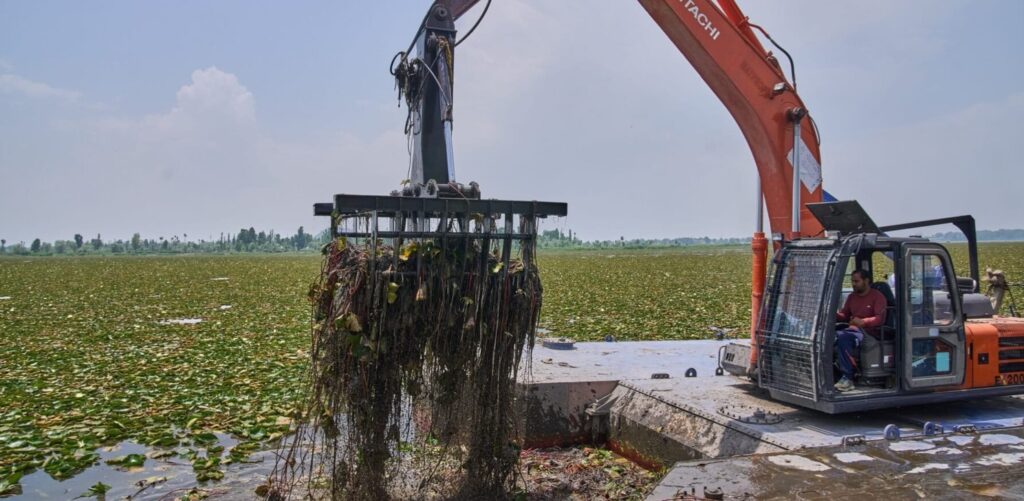
A worker clears weeds from Dal lake in Srinagar, Kashmir (Image: AP Photo/Dar Yasin)
India’s poor showing in the 2026 Environmental Performance Index (EPI) has revived a familiar debate: are international environmental rankings fair to developing countries? The question matters because different climate indices can place the same country at dramatically different points on the global scale. But this divergence does not necessarily mean that one index is right and another wrong. More often, they are asking different questions, shaped by different scientific and ethical assumptions.
The EPI, produced biennially by Yale and Columbia universities, has repeatedly placed India among the world’s weakest performers. Its 2022 ranking triggered sharp criticism from Indian environmental and policy experts. Navroz K. Dubash and Sharachchandra Lele described its methodology as “indefensible and tone-deaf” on questions of ethics. India’s Ministry of Environment, Forest and Climate Change also issued a strong rebuttal, prompting an unusual counter-response from the EPI’s developers.
Yet another major index offered a strikingly different picture. The Climate Change Performance Index (CCPI), produced by Germanwatch, the NewClimate Institute and Climate Action Network International, ranked India among the world’s better climate performers in 2022. The Indian government welcomed that assessment.
The contrast has appeared again in the EPI’s 2026 edition, released on July 9. European countries dominate the top ranks, while India remains near the bottom. Morocco and the United States offer particularly revealing examples. Morocco performs poorly on the EPI’s climate component but ranks among the strongest performers in the latest CCPI. The United States shows almost the opposite pattern: it sits relatively high on the EPI but among the world’s worst performers in the CCPI.
Why do credible, science-based assessments disagree so sharply?
The fairness question
The answer lies partly in what each index means by “climate performance”. The EPI’s climate-change assessment relies heavily on absolute and projected greenhouse-gas emissions. Its underlying premise is scientifically straightforward: the atmosphere responds to the total quantity of greenhouse gases emitted, regardless of why those emissions occurred.

But this approach can sit uneasily with questions of historical responsibility and development. A rapidly industrialising country may be penalised for rising emissions even when those emissions are associated with providing basic infrastructure, energy and economic opportunities to a relatively poor population.
The CCPI approaches the issue differently. By giving significant weight to emissions per person, it reflects a fairness principle under which individuals have broadly equal claims to the atmosphere as a shared resource. This places greater responsibility on countries whose citizens produce very high levels of emissions.
A 2024 study we published in Climate Policy demonstrates how consequential these choices can be. We modified the EPI’s climate-change module by replacing its two most heavily weighted indicators with fairness-oriented alternatives while keeping the rest of its architecture unchanged. The result was dramatic: South Asian and other Global South countries moved substantially upward, while several affluent countries that performed well under the standard EPI fell sharply.
This supports criticisms that the EPI is insufficiently attentive to equity. But it does not mean the EPI is illegitimate. Rather, the two indices are answering different questions. The EPI essentially asks: Is a country’s contribution to global warming increasing or decreasing? The CCPI asks a different question: Is a country using more than its fair share of the atmospheric commons?
Both questions are legitimate.
India illustrates the distinction particularly well. Its annual carbon dioxide emissions now exceed 3 billion tonnes and continue to rise. Judged by absolute emissions, India is undeniably a significant contributor to global warming. Yet, measured against population and historical use of the global carbon budget, India has consumed far less than its fair share. Its poor EPI performance and comparatively strong CCPI performance therefore need not contradict each other.
The roots of this debate go back decades. In 1990, the World Resources Institute argued that developing countries, including India and China, were responsible for a substantial share of global warming. Anil Agarwal and Sunita Narain of the Centre for Science and Environment responded with Global Warming in an Unequal World. They challenged the idea that responsibility could be allocated without considering historical emissions and argued that the atmosphere’s limited absorptive capacity should be shared equally among people. Their argument became an important part of the developing world’s case for equity before the 1992 Rio Earth Summit.
The larger lesson is that environmental indices are not neutral scientific verdicts. The choice of indicators, baselines, weights and ethical assumptions inevitably reflects a view of what constitutes good performance. As a result, choosing which index to emphasise is also, to some degree, a political choice.
That does not mean countries should simply reject rankings that make them uncomfortable. Thailand offers a more constructive example. In 2022, its National Environment Board established a subcommittee to study the EPI methodology, required government agencies to report data against its indicators and incorporated the framework into planning. Thailand subsequently rose from 106th in the EPI-2022 to 53rd in the latest ranking. The improvement cannot automatically be attributed to this institutional response, but Thailand demonstrates the value of engaging seriously with an external benchmark rather than dismissing it.
There is, however, a danger in becoming too focused on any single ranking. Goodhart’s law warns that “when a measure becomes a target, it ceases to be a good measure.” Policymakers can end up optimising for the score rather than the underlying environmental outcome. The famous colonial-era rat bounty in Hanoi illustrates the problem: efforts to reward rat tails reportedly encouraged people to breed rats after removing their tails, defeating the purpose of the policy.
The same principle applies to environmental rankings. The goal should not be to manufacture a higher position on an international league table, whether through selective data or by creating a new index designed to make India look better.
India’s environmental problems are real, regardless of its position in any ranking. Air pollution, water pollution, biodiversity loss and inadequate waste management demand urgent action. Rejecting an uncomfortable index because it exposes weaknesses would risk confusing criticism of a measurement system with denial of genuine environmental challenges.
The better approach is to read several indices together and acknowledge what each reveals. India can accept that its absolute emissions must decline and that its growth trajectory needs to become cleaner. At the same time, it can legitimately argue that historical responsibility, per-capita emissions and unequal access to the atmospheric commons justify greater climate finance and technological support for developing countries.
Such a position would be more credible than either embracing or rejecting a single ranking wholesale. It would recognise that climate performance has both scientific and ethical dimensions.
Ultimately, India does not need an index that tells it what it wants to hear. Nor should it treat any international ranking as the final word. The more useful response is to understand the assumptions behind each index, act on the environmental problems they reveal, and maintain a consistent argument for equity where fairness demands it.
That combination—environmental responsibility at home and principled advocacy for fairness abroad—would give India a stronger claim to genuine climate leadership in the Global South.
(Published under Creative Commons from Mongabay India)