How Social Media Turns Into A Happy Hunting Ground For The Far-Right
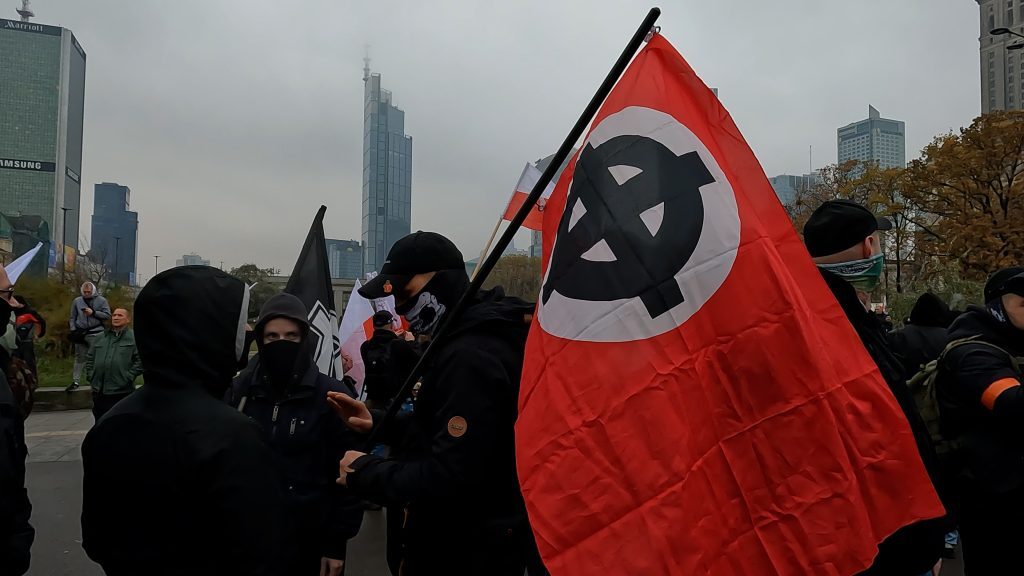
White nationalists (political activists) protesting in Warsaw, Poland in February 2024 (Photo: Callum Darragh, Public domain, via Wikimedia Commons)
In the digital age, social media has become a powerful tool for connection, expression and community-building, helping reduce isolation and giving voice to marginalised groups. Yet the same platforms that foster inclusion can also be weaponised by extremist movements. The online world has become fertile ground for radicalisation and recruitment, particularly among violent far-right groups.
Algorithms designed to maximise engagement often trap users in echo chambers, reinforcing beliefs and creating ideal conditions for spreading extremist content and targeting vulnerable individuals.
Open-source research on far-right arrests shows a recurring pattern: social media platforms are used to infiltrate online spaces and recruit new members.
Case studies in France and Germany
In the last few years, analysis of arrest reports in France and Germany revealed that suspects had used social media to coordinate planned attacks and procure the necessary materials.
In July 2024, in France, for example, the authorities arrested a suspected neo-Nazi who had threatened to attack the Olympic torch relay in Paris, finding that his recruitment and incitement activities were conducted through apps and digital platforms.
Similarly, in recent years, in Germany, Bavarian police arrested members of the “Reichsbürger” movement who, according to investigations, communicated online to organise subversive initiatives and acquire resources for their activities.
To understand the phenomenon, it is necessary to identify which social media platforms play a crucial role in spreading extremist ideas, because radicalisation can lead to hate crimes, violence, and social division.
Italy’s far-right arrests and online presence
Based on these events, a study was launched by the Italian Team for Security, Terroristic Issues & Managing Emergencies (ITSTIME) to look into arrests in Italy in order to understand whether social networks had been used and which of them were most commonly used.
From January 2024 to July 2025, 21 arrests were made in Italy against members of the national and international far-right ecosystem. Those arrested ranged in age from 18 to over 30 (with the exception of one 70-year-old individual), with a prevalence of those over 31. The data analysed was obtained through open-source information released by local authorities.
For this reason, the data considered refers to arrests in which the authorities explicitly stated the social media (messaging platforms or social networks) on which the defendants operated. The data collected showed that 86 percent of those arrested had an active online presence.
Telegram as the main hub
In particular, recruitment, radicalisation, and proselytising activities took place through social media. The platforms most commonly used for these activities in the 21 Italian cases studied were Telegram (89.5 percent), TikTok (5.3 percent) and Discord (5.2 percent), often used in combination, especially by younger people. Specifically, the most frequent combinations were Telegram and TikTok and Telegram and Discord.
Based on open-source research, it can be said that Telegram is the social media platform most used by far-right militants in Italy, followed by TikTok and Discord. The results obtained can be attributed to the fact that far-right users have long considered Telegram to be secure, useful and effective for sharing propaganda, recruiting members and organising themselves into smaller operational cells.
TikTok and Discord among the young
Currently, propaganda and recruitment have begun to be more systematically present on other platforms, such as TikTok and Discord, especially among 18–30-year-olds, but always with the aim of directing new members to Telegram, using other social networks as entry points to the online far-right ecosystem.
Based on the materials collected, it can be said that, despite the arrest of Pavel Durov, which happened in France in August 2024 and Telegram’s subsequent increased cooperation with the authorities, far-right militants in Europe still consider this platform to be the best alternative for their radicalisation activities.
The potential of other social networks, on the other hand, is exploited to spread propaganda to a wider audience with the aim of attracting new members to Telegram for more private and organised communication, within which radicalisation continues and deepens.
The strategic and combined use of different social media, especially those that allow their content to go viral, such as TikTok, enables the creation of an interconnected network of pages and groups that support each other and fuel a digital ecosystem in which extremist content spreads quickly and effectively.
From gaming to private chats
From the analyses presented and based on the data collected, it emerged that in Italy, as in France and Germany, Telegram is the most widely used social network in the contexts analysed. However, in Italy, there is a peculiar trend among younger people, who use platforms such as TikTok and Discord alongside Telegram.
These latter platforms deserve increasing attention: TikTok, due to its widespread use among very young people, and Discord, due to its more private nature and links to the world of gaming. Both of these social media are becoming increasingly attractive spaces for propaganda and possible recruitment by violent far-right groups.
In particular, the gaming environment on Discord could represent the next frontier of online radicalism, where group dynamics, anonymity and shared languages offer fertile ground for ideological grooming.
Moreover, the analysis highlighted a potential risk stemming from the simultaneous use of different social networks. Extremist groups’ use of multiple platforms makes the threat harder to detect and counter. Each social media site has its own way of conveying content and serves a specific purpose – from viral sharing on TikTok to organised communication on Telegram – creating a fragmented yet coordinated ecosystem.
Users within extremist circles also develop tailored communication strategies for each platform. For instance, group dynamics can thrive on Telegram and Discord due to chat functions, while this is harder on TikTok because of its format. This fragmentation complicates monitoring by authorities and allows extremists to evade platform restrictions, making the threat more agile, adaptable and resistant to moderation.
Limiting online radicalisation
Combating online radicalisation remains a major challenge. It requires regulation, platform accountability and community action, while safeguarding fundamental rights such as free speech.
In recent years, the European Union has introduced legal measures mandating the swift removal of terrorist content and launched initiatives such as the Radicalisation Awareness Network to strengthen cooperation against extremism.
Other measures could include stricter oversight of encrypted channels such as Telegram to reduce their appeal to extremist groups, and greater transparency over algorithms to curb the echo chambers fuelling polarisation. Education and digital literacy campaigns are also crucial to reduce vulnerability among younger users, particularly on fast-growing platforms like TikTok and Discord.
While these efforts have achieved some progress, the evolving nature of online platforms and the adaptability of extremist groups demand constant coordination among institutions, governments, social media firms and civil society. Without sustained international cooperation, the same tools that connect communities risk remaining powerful weapons in the hands of violent far-right movements.
(Published under Creative Commons from 360info.org)