“This Is The Stark Reality Of ‘Viksit Bharat’…”
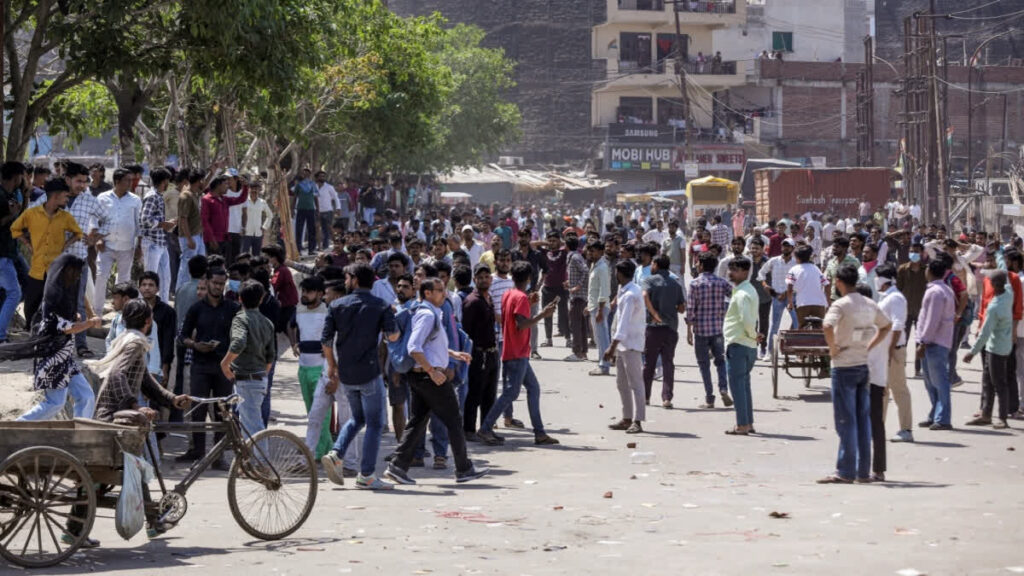
The workers' protests, which began peacefully on Monday across key industrial zones, escalated into violence by the afternoon. Incidents of arson, vandalism, and stone-pelting were reported, bringing traffic to a standstill on major routes, including those connecting Noida to Delhi (Image: PTI)
Leader of Opposition Rahul Gandhi on Tuesday launched a scathing attack on the Centre following violent protests by factory workers in Noida, describing the unrest as the “final cry” of labourers grappling with rising costs and stagnant wages.
In a post on X, Gandhi framed the protests as a reflection of deep-rooted economic distress among the country’s working class. “What unfolded on the streets of Noida yesterday was the final cry of this nation’s workers — a voice that went unheard at every turn, a voice weary from ceaseless pleading,” he said.
The protests, which began peacefully on Monday across key industrial zones, escalated into violence by the afternoon. Incidents of arson, vandalism, and stone-pelting were reported, bringing traffic to a standstill on major routes, including those connecting Noida to Delhi. Thousands of commuters were stranded as chaos unfolded across industrial hubs such as Sector 62, Sector 63, and Phase-2.
Police later intervened to disperse the crowds, using mild force and registering multiple FIRs. Authorities confirmed that over 300 individuals had been arrested, and investigations were underway to determine whether an organised network played a role in escalating the violence. A state government panel has also been constituted to address the grievances raised by workers.
“Unbridled Inflation Strangles Life”
At the heart of Gandhi’s criticism was the growing financial strain on daily-wage earners, which he argued has been exacerbated by rising living costs and stagnant incomes. Highlighting the precarious balance many workers face, he pointed out that earnings often fail to keep pace with basic expenses.
“Many workers earn around Rs 12,000 a month, while paying Rs 4,000–Rs 7,000 in rent,” he said. “Before their wages can catch up, unbridled inflation strangles life, plunging them into debt — this is the stark reality of ‘Viksit Bharat’.”
He reinforced his point by citing the lived experiences of workers struggling to cope with everyday expenses. “As one female worker remarked, ‘Gas prices keep rising, but our wages do not’,” Gandhi noted, adding that “some have had to spend up to Rs 5,000 for a single cylinder just to keep their homes running.”
According to Gandhi, these pressures are not isolated incidents but part of a broader economic pattern that disproportionately affects the most vulnerable. He argued that while inflation and global economic shifts have impacted many sectors, the burden has fallen most heavily on those least equipped to absorb it.
“The burden of America’s tariff wars, global inflation, and fractured supply chains has not fallen upon Modi ji’s ‘industrialist friends’,” he said. “The heaviest blow has landed squarely upon the daily-wage labourer.”
Gandhi emphasised that workers, who have little influence over global economic forces, are being forced to bear the consequences. “The labourer who played no part in any war… what does he receive when he demands his rightful dues? Coercion and oppression,” he added.
Labour Reforms, Wage Demands and Political Stand
Gandhi also used the moment to criticise recent labour reforms, particularly the implementation of new labour codes in November 2025, which he claimed have worsened conditions for workers. He alleged that these changes have effectively extended working hours without corresponding improvements in pay or job security.
“Is the demand of a labourer, who works 12 hours a day and still struggles to pay school fees, unreasonable?” he asked, directly backing the workers’ demand for a minimum monthly wage of Rs 20,000. “This is not greed, it is his right.”
Positioning himself firmly alongside the protesting workers, Gandhi reiterated his support for their cause and criticised what he described as the government’s attitude towards labour. “I stand with every worker who is the backbone of this country, and whom this government has come to view as a burden,” he said.
The protests in Noida have brought renewed attention to the conditions in India’s industrial workforce, particularly in rapidly urbanising hubs where migrant labour forms a significant portion of the population. While the immediate trigger for the unrest was wage-related demands, the scale and intensity of the protests have highlighted deeper structural issues, including rising living costs, job insecurity, and limited avenues for redress.
Officials stated that what began as peaceful demonstrations in the morning spiralled into large-scale disruption by the afternoon, affecting key arterial roads such as National Highway-9 and major entry points into Delhi. Law enforcement agencies are continuing their investigation into the incidents, including the role of social media in spreading rumours that may have contributed to the escalation.
As the situation stabilises, the formation of a government panel signals an attempt to address the concerns raised by workers. However, Gandhi’s remarks underscore the broader political and economic debate that the protests have reignited.
By framing the unrest as a “final cry,” he has sought to draw attention to what he views as systemic neglect of the working class, linking localised protests to national and even global economic dynamics. Whether this moment leads to substantive policy shifts or remains part of ongoing political contestation will likely depend on how both the government and opposition respond in the coming weeks.