Human Impact Upon Wildlife Behaviour In India
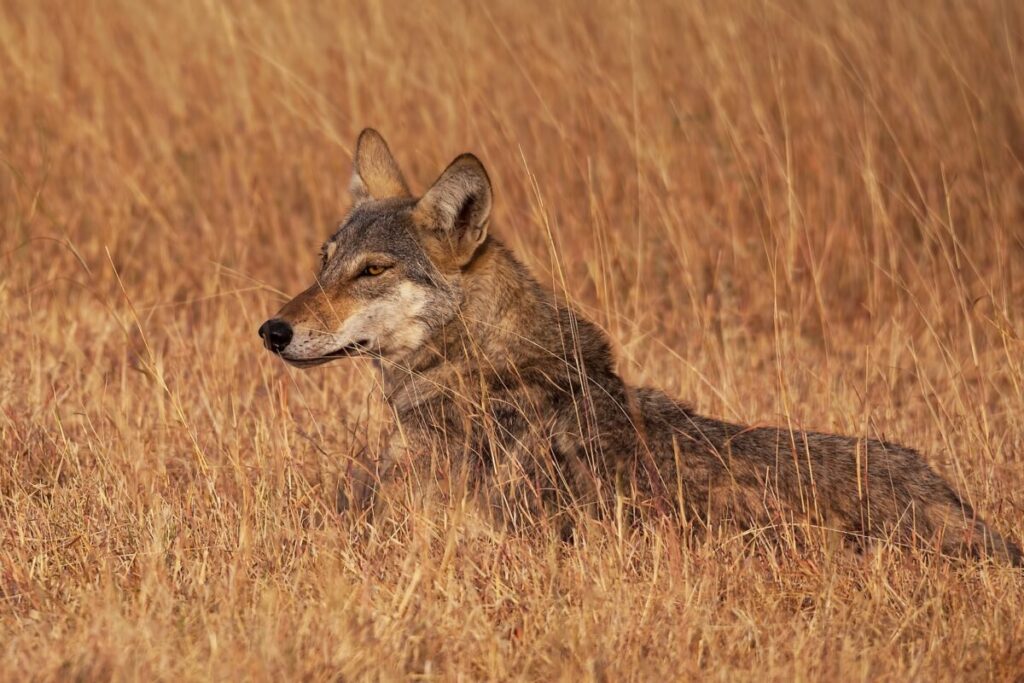
The Indian wolf might be adapting to human-led changes around them by suppressing their howl (Photo by Vadyarupal/Flickr)
- In landscapes heavily altered by human activity in Maharashtra, a study suggests that the Indian wolf may be adapting by suppressing its iconic howl.
- The Anthropocene-induced alterations in wolf behaviour could emerge as a crucial predictor for their long-term survival and for maintaining ecological balance.
- As of 2022, 3100 Indian wolves remain in the wild.
In landscapes modified by human activity, the Indian wolf may be adapting by suppressing their iconic howl, finds a 2023 study from Maharashtra. Initially intended to look into the frequency and timing of wolf howls to use acoustics as a tool for population surveys, the results took the researchers by surprise.
“However, early patterns guided us down an unforeseen path. The striking and frankly worrying revelation that emerged was that in heavily human-altered landscapes, wolves might be adapting by suppressing their howl,” explains Sougata Sadhukhan, one of the study authors and an assistant professor at the Institute of Environment Education and Research, Bharati Vidyapeeth University, Pune.
The Indian wolf (Canis lupus pallipes) occupies a distinctive position in the evolutionary history of the wolf. Recent scientific studies (Hennelly et al. and Wang et al.) highlight how it could be a frontrunner for the title of the oldest surviving wolf lineage. A silent custodian of the grasslands, it regulates herbivore populations to prevent overgrazing.
A scientific population estimate in the country, conducted by the Wildlife Institute of India (WII) and published in 2022, reveals that only 3,100 Indian wolves currently remain in the wild. Though classified under Schedule I of the Wild Life Protection Act, 1972, the wolves continue to confront challenges such as habitat loss, hybridisation with domestic dogs, accidents on high-speed roads, diseases and persecution by humans.
“Historically labelled as ‘wastelands’, grasslands (where wolves reside) pose conservation challenges, including encroachment and illegal activities. Wolves also lack the glamour of charismatic megafauna like the elephant or tiger. Lastly, limited research on Indian wolf populations hinders effective conservation strategies,” says Mahesh Singh, an independent researcher, not associated with the study. Singh has partnered with the Madhya Pradesh forest department in the past for wolf conservation efforts. In this context, behavioural changes of the Indian wolf, induced by human activities, including its howls, emerge as a valuable tool for studying its long-term survival.
Studying Wolf Howls In Maharashtra
According to the 2022 WII population estimate, wolf populations are most concentrated in Madhya Pradesh (772), followed by Rajasthan (532), Gujarat (494), Maharashtra (396) and Chhattisgarh (320).
The team now studying the wolf howling behaviour, consisting of researchers from Bharati Vidyapeeth and WII, selected Maharashtra for its unique landscape and challenges that are crucial for understanding wolf ecology, behaviour and conservation needs.
In the grasslands of western Maharashtra, for instance, wolves face constant threats from habitat encroachment and fragmentation owing to agricultural expansion and infrastructure development, the study found. “Studying their resilience and coexistence strategies in this dynamic environment is essential for informing conservation efforts,” says Sadhukhan.
On the other hand, in the tiger buffer zones of eastern Maharashtra, wolves demonstrate another level of adaptability, having developed nuanced spatial organisational skills and resource use patterns from coexisting with apex predators.
The team focused on howls used for maintaining territories, intra-pack communication and social bonding. Beyond indicating their physical presence, howls play a crucial role in instilling fear and influencing foraging behaviour among the lower cascade.
Through playback surveys, where the team plays simulated howls, the study uncovered a disparity in their howl response based on the distance to villages. In areas of eastern Maharashtra that were relatively less disturbed by human activity, wolves largely avoided responding to howling surveys within 1200 metres of villages but responded to those conducted farther away (more than 1200 metres). In areas of western Maharashtra that were highly occupied by human settlements, wolves exhibited a high response rate within 1200 m from villages, but the rate decreased within 500 m of the villages to perhaps avoid easy detection of the wolves.
Data obtained from collared wolves demonstrated significantly high response rates in their home-range core, but decreased if the core area was close to a village. The researchers concluded that howling too close to a village was disadvantageous, despite the increase in their tolerance for responding to surveys in human-dominated landscapes.
“This finding, while surprising, isn’t entirely shocking. Human disturbance can impact animal behaviour and howling can draw unwanted attention, potentially increasing conflict and risk. However, the lack of response in the home range core is surprising, if the core is close to the village,” says Sadhukhan.
The researchers also noted that as villages expand due to further development, wolves may find fewer areas to defend territory with their long-range howls. This behavioural adaptation to a human-modified landscape, while potentially helping conserve wolf populations, could have adverse repercussions on their behaviour and habitat.
Pondering The Impacts Of Behavioural Changes
The actual impact, however, remains elusive. Previous studies, such as those conducted by Wilson et al. (2020), show strong evidence that human activity can trigger ecological changes through various mechanisms. “These cascading effects can influence predator-prey dynamics, competition and nutrient cycling,” says Singh.
Sadhukhan agrees. “Behavioural changes can cause enduring impacts on individual fitness, population growth, and species persistence. They have the potential to reshape community composition, resource utilisation and overall ecosystem stability.”
While ecologists conventionally prioritise studying species extinction, this research sheds light on the vulnerability of a keystone species undergoing human-induced contemporary evolution. “It is crucial to grasp these intricate changes, not solely to preserve wolves but also to safeguard their ecological melody and the wild symphony they contribute to. Only through such understanding can we protect their future, transcending mere survival, in our ever-changing world,” says Sadhukhan.
(Published under Creative Commons from Mongabay-India. Read the original article here)