Cong Alleges ₹10,000-Crore Black-Money Racket Through RUPPs
Former Congress MP Shakti Singh Gohil has accused the BJP-led government of following a “dual approach” in dealing with the issue of tax evasion and black money (Image: AI)
The Congress on Wednesday, September 9, alleged that more than ₹10,000 crore in black money has been generated through “fake” Registered Unrecognised Political Parties (RUPPs), accusing the BJP-led Union government of turning a blind eye to a system that allegedly facilitates tax evasion and laundering of illicit funds.
The allegation has opened another front in the long-running political battle over electoral funding, transparency and the use of tax exemptions available to political parties. While the Congress has presented the issue as evidence of a major financial racket, the ₹10,000-crore figure and the allegation of government complicity should, at this stage, be treated as political allegations requiring independent investigation, rather than established findings.
What are RUPPs?
Registered Unrecognised Political Parties are political organisations registered with the Election Commission of India (ECI) under Section 29A of the Representation of the People Act, 1951, but which have not acquired recognition as a State or National political party.
Being unrecognised does not mean that a party is illegal or fake. Many RUPPs are legitimate new or small political organisations. The problem arises when a party is registered primarily to access regulatory and tax benefits while having little or no genuine electoral activity.
The ECI has itself identified serious compliance problems in the RUPP ecosystem. In 2021, the Commission said a large number of registered parties were neither participating in elections nor complying with financial and reporting requirements.
The cleanup has continued. In 2025, the ECI ordered 334 RUPPs to be delisted after finding that they had not contested elections for six consecutive years and, in several cases, were not found at their registered addresses. Such delisted parties became ineligible for benefits available under relevant election and tax provisions.
How can the alleged tax-evasion mechanism work?
The controversy centres on the special tax treatment of registered political parties.
Under Section 13A of the Income Tax Act, qualifying political parties can receive exemption on certain categories of income, including voluntary contributions, provided they satisfy prescribed conditions, maintain accounts and comply with reporting requirements.
There is also a tax deduction for individuals contributing to registered political parties or electoral trusts under Section 80GGC, subject to the statutory conditions. Cash contributions are not eligible for this deduction.
This framework is intended to encourage legitimate political donations and provide transparency around political financing. But the same provisions can potentially be exploited if a bogus party is used as a financial intermediary.
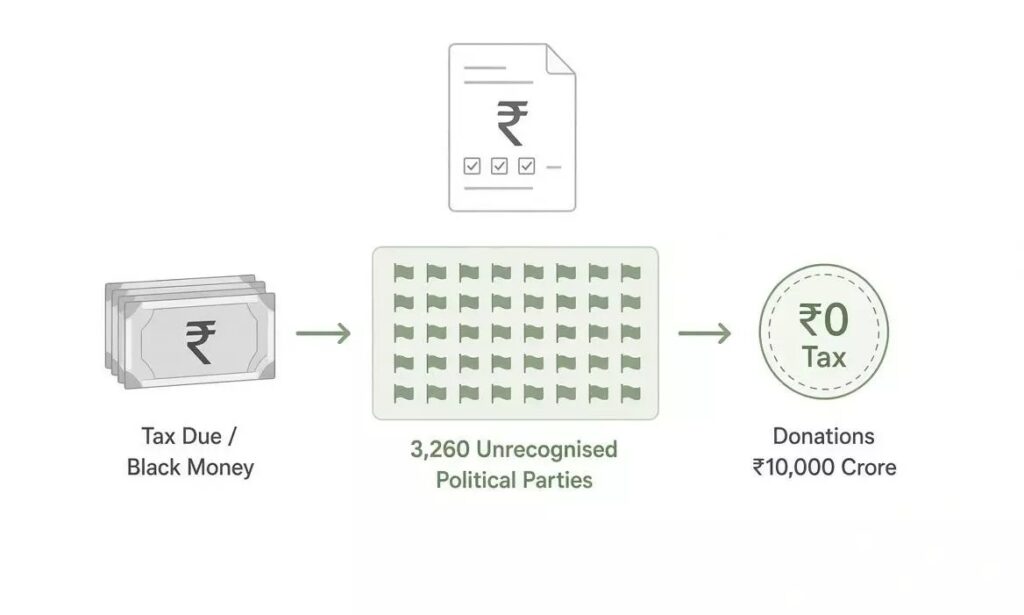
The alleged model is relatively straightforward: money is shown as a political donation, the donor obtains a tax advantage, and the recipient party allegedly returns a substantial portion of the money to the donor through cash or other channels after retaining a commission. If proved, such transactions could involve tax evasion, fraudulent accounting and potentially money laundering.
There is evidence that authorities have encountered such practices. An Income Tax investigation discussed in a 2026 court record involved allegations that a RUPP accepted bogus donations for a commission and subsequently returned the money in cash.
Why is the ₹10,000-crore allegation significant?
The figure is politically explosive because it suggests that the alleged problem is not limited to isolated shell organisations but could represent a large-scale parallel channel for moving unaccounted money.
Why is the government being accused?
The Congress’s political argument is that government agencies had sufficient warning signs and investigative information to act more aggressively against suspicious parties.
That criticism needs to be separated from the question of whether the government deliberately protected a racket. The latter is a much more serious allegation and would require documentary evidence, investigative findings or judicial conclusions.
There is, however, a genuine institutional question: who should be responsible for detecting and preventing abuse?
The ECI regulates registration and electoral compliance, while the Income Tax Department examines tax matters. Financial intelligence and money-laundering concerns can involve other agencies. This division of responsibility can create gaps if information is not shared quickly and systematically.
What needs to happen next?
The controversy ultimately calls for evidence rather than political accusations. Authorities should establish how the ₹10,000-crore figure was calculated, identify the parties and donors involved, publish the relevant audit and investigation findings wherever legally possible, and trace the ultimate beneficiaries of suspicious transactions.
The ECI and tax authorities could also strengthen real-time information sharing, conduct risk-based audits of parties receiving unusually large donations, verify whether parties have genuine political activity, and automatically flag organisations with large financial flows but negligible electoral participation.
Political parties require legitimate avenues for fundraising, but those avenues cannot become vehicles for converting unaccounted money into apparently legitimate donations.
The allegations therefore raise a fundamental question about India’s electoral system: can political funding remain both tax-privileged and sufficiently transparent to prevent its misuse? The answer will depend not on political claims, but on the quality of investigations, public disclosure and enforcement that follows.