Activists Question ECI’s Decisions On Nationwide Voter Roll Revision
Activists have flagged discrepancies in the ECI’s SIR affidavit, citing RTI replies, alleged database centralisation and voter appeals
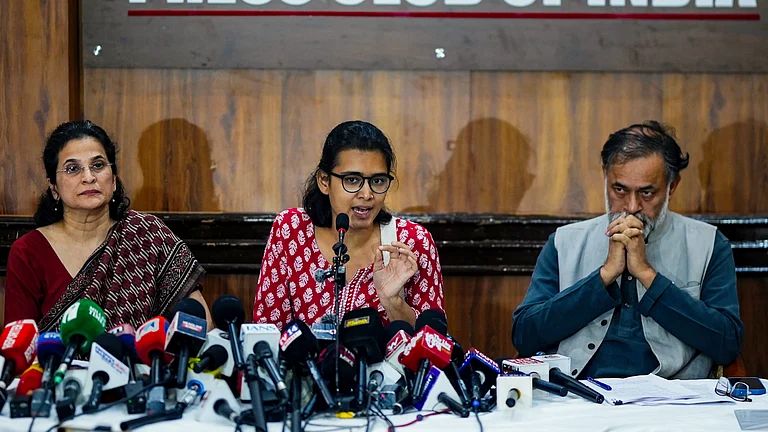
Activists Prashant Bhushan, Anjali Bhardwaj, Yogendra Yadav and All India Students’ Association (AISA) president Neha Bora on Thursday, October 29, questioned the Election Commission of India’s (ECI) decision-making process behind the nationwide Special Intensive Revision (SIR) of electoral rolls. They alleged that the Commission’s latest affidavit before the Supreme Court failed to address critical questions about the authorisation, implementation and oversight of the exercise.
At a press conference at the Press Club of India in New Delhi, the activists examined the ECI’s counter-affidavit filed on October 26. They pointed to what they described as contradictions between the Commission’s claim that decisions concerning the SIR were taken unanimously and its earlier responses to queries filed under the Right to Information (RTI) Act.
The activists said an RTI response had indicated that the Commission had not taken a decision to initiate a nationwide SIR in 2025, raising questions about when and how the exercise was authorised.
Bhardwaj said she had sought records relating to the decision to undertake the nationwide revision but was informed by the ECI’s public information officer that no such file was available. She subsequently approached the first appellate authority, where the Commission’s principal secretary reportedly stated in writing that the ECI had not taken a decision to initiate the SIR across the country in 2025.
“If the Election Commission did not take this decision, then who did?” Bhardwaj asked, questioning the absence of documentary evidence establishing the decision-making process.
The activists said the ECI’s affidavit maintained that three orders relating to the SIR, issued on June 24, 2025, October 27, 2025, and May 14, 2026, had been approved unanimously. They questioned why records demonstrating such unanimity had not been provided in response to the RTI application or during the subsequent appeal.
Bhushan alleged that the affidavit acknowledged objections raised by the two election commissioners over aspects of the exercise but attempted to portray them as suggestions or differences of opinion. He also questioned the Commission’s explanation that decisions could be approved electronically in urgent situations and subsequently entered into official records.
The activists demanded details of decisions taken through such electronic approvals, particularly whether the decision to conduct the nationwide SIR had been made through this process. They called for relevant emails and electronic communications to be examined to establish how the exercise was authorised.
Questions over centralisation of electoral data
The activists also raised concerns about the alleged centralisation of electoral roll data and the authority to add or delete voters’ names.
According to their reading of the affidavit, election commissioners Sukhbir Singh Sandhu and Vivek Joshi had previously expressed concerns about the gradual centralisation of the electoral roll database. They had reportedly proposed an audit to ensure that only officials authorised under electoral laws could make changes to voter records.
The ECI’s affidavit stated that a high-level committee had been constituted on October 14 to examine whether its ECINet system complied with applicable laws and rules. The committee reportedly includes senior deputy election commissioners, state chief electoral officers and independent experts from IIT Bombay and the Indian Institute of Science (IISc), Bengaluru.
The activists questioned why the concerns raised by the election commissioners had not been addressed earlier and sought clarity on who had the authority to modify electoral records.
Bhushan alleged that the process of adding and deleting names had been centralised through information technology units at the Commission’s Delhi office, potentially bypassing the statutory responsibilities of electoral registration officers.
They also questioned changes to Form 6, the application used for inclusion of names in electoral rolls. The activists alleged that an additional declaration had been introduced in its online version without the required authorisation.
They said the ECI’s affidavit acknowledged that the online form had been altered and that certain decisions needed correction because they did not conform to the steps approved by the Commission. The activists sought an explanation of who authorised the changes and how they were implemented.
West Bengal appeals under scrutiny
The activists also referred to the Supreme Court hearing on October 28 concerning the SIR exercise in Delhi. They said the court had clarified that the use of logical discrepancies as a criterion was permitted as an interim measure in West Bengal, while its legal validity remained to be adjudicated.
They further said the court had observed that asking voters whose names had been deleted during the revision to submit Form 6 applications was an error.
Another major concern was the filing of around 16 lakh appeals against the inclusion of voters’ names in electoral rolls in West Bengal. According to the activists, the ECI’s affidavit stated that these appeals had been filed by officials in the office of the state’s chief electoral officer and that the matter had not been brought to the Commission’s attention.
They questioned who had instructed officials to file the appeals, who had submitted them and whether the software had generated them automatically.
The activists called for an inquiry to establish the circumstances surrounding the appeals and determine whether the process had been authorised. They also questioned whether any disciplinary or other action had been initiated against officials who may have acted without the Commission’s approval.
The activists said the affidavit did not adequately clarify whether action had been taken against those responsible.
They called on the ECI to disclose the relevant records and explain the decision-making process behind the nationwide SIR, including the authorisation of changes to electoral data, the role of technology systems and the accountability of officials involved.
At the centre of their concerns is whether the nationwide revision has been conducted through a transparent and legally authorised process, with adequate safeguards to protect voters’ rights. They argued that the Commission must provide clear answers on these issues, particularly as the exercise has implications for the inclusion of eligible citizens in electoral rolls.