The Iran Conflict Could Turn Into A Prolonged Crisis; Is India Prepared?
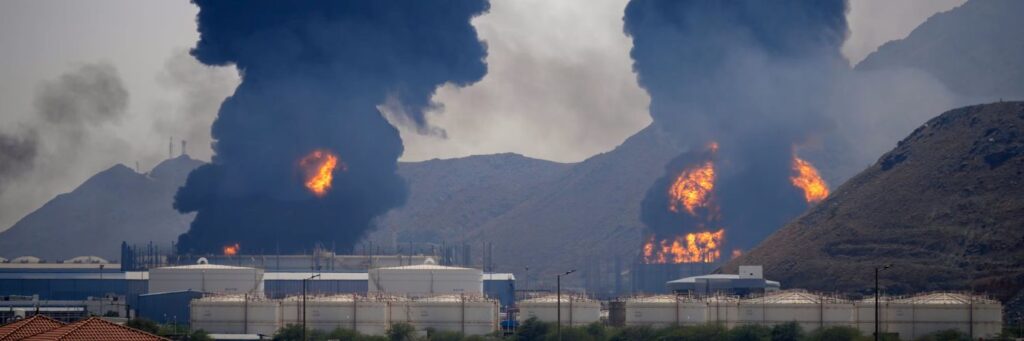
Plumes of smoke and fire rise after debris from an intercepted Iranian drone struck an oil facility, according to authorities, in Fujairah, United Arab Emirates, on March 14, 2026 (AP Photo/Altaf Qadri)
The ongoing conflict involving Iran is increasingly showing signs of becoming a prolonged geopolitical crisis rather than a short-lived military episode. What initially appeared to be a limited escalation has now expanded into a wider confrontation affecting critical energy routes, global markets, and economic stability. As tensions deepen and supply disruptions worsen, the ripple effects are being felt worldwide—particularly in energy markets, where oil prices are surging and uncertainty remains high.
Recent developments indicate that the conflict is not only intensifying but also becoming structurally entrenched. Analysts warn that the duration of the crisis will be the single most important factor shaping its global economic impact. A short conflict might have caused temporary price spikes, but a drawn-out confrontation risks embedding higher costs into the global economy for months—or even years.
Why This Conflict May Drag On
Several factors suggest that the Iran conflict is unlikely to end quickly. First, the strategic importance of the region makes any resolution complicated. The Strait of Hormuz, through which nearly one-fifth of the world’s oil supply passes, has become a central flashpoint. Disruptions in this narrow but vital route have already triggered sharp increases in oil prices and raised fears of a sustained supply crunch.
Military escalation has further complicated the situation. Recent reports indicate that oil prices have surged above $110 per barrel amid fears of prolonged disruptions and continued attacks on energy infrastructure. The lack of a clear diplomatic pathway, combined with retaliatory strikes and widening regional involvement, suggests that a quick resolution is unlikely.
Economic analysts have also pointed out that even if active hostilities pause, the geopolitical risk premium on oil may persist. Markets are already factoring in long-term uncertainty, with traders willing to pay significantly more for immediate oil supplies due to fears of shortages. This reflects a broader concern: the conflict is not just about current supply disruptions but about the risk of recurring instability.
Moreover, history shows that conflicts in this region often evolve into prolonged standoffs rather than decisive outcomes. As long as strategic interests remain unresolved, the situation is likely to remain volatile. Economists warn that sustained disruption could push inflation higher globally and weaken economic growth, particularly in energy-importing countries.
Rising Oil Prices and India’s Growing Vulnerability
The most immediate and visible impact of the Iran conflict is the sharp rise in global oil prices. Crude has already crossed critical thresholds, with prices fluctuating between $90 and $120 per barrel in recent weeks, and even spiking higher during periods of intense escalation. This surge is not merely speculative—it reflects real fears of constrained supply in a market heavily dependent on Middle Eastern oil.
For India, the implications are particularly serious. As a country that imports over 80% of its crude oil requirements, India is highly exposed to global price shocks. Any sustained increase in oil prices directly translates into higher fuel costs, increased inflation, and pressure on household budgets.
The impact is already being felt. Rising crude prices are expected to push up the cost of petrol, diesel, and aviation fuel, which in turn affects transportation, logistics, and food prices. Over time, this creates a cascading effect across the economy, making everyday essentials more expensive.
Equally concerning is the potential disruption in liquefied petroleum gas (LPG) supplies. India relies significantly on imports for LPG, and prolonged instability in the Middle East could strain availability. If shipping routes remain disrupted or insurance costs for tankers rise, supply chains could tighten, leading not only to higher prices but also to periodic shortages.
This raises a critical question: are Indian households prepared for a scenario where LPG cylinders become more expensive—or even temporarily unavailable?
The possibility of fuel shortages cannot be dismissed. If the conflict escalates further or leads to a sustained blockade of key routes, countries across the world may begin stockpiling energy resources, tightening global supply. In such a scenario, developing economies like India could face disproportionate challenges in securing adequate supplies.
The warning signs are already visible globally. Businesses in several countries are preparing to raise prices due to rising energy costs linked to the conflict. Inflation expectations are climbing, and central banks are being forced to reconsider monetary policies in response to the energy shock.
For Indian consumers, this could mean a prolonged period of high fuel costs, expensive cooking gas, and increased cost of living. Rural households, small businesses, and lower-income groups are likely to be the hardest hit, as energy costs form a significant portion of their monthly expenses.
In the long run, the situation demands both awareness and preparedness. Households may need to plan for higher fuel expenses, adopt energy-saving practices, and prepare for potential supply disruptions. Policymakers, on the other hand, will need to balance subsidies, fiscal pressures, and energy security concerns in an increasingly uncertain global environment.
The Iran conflict, therefore, is no longer a distant geopolitical issue—it is rapidly becoming a direct economic challenge for countries like India. If the crisis continues to drag on, its consequences will extend far beyond the battlefield, shaping inflation, growth, and everyday life for millions.
What makes the situation particularly worrying is not just the current spike in prices, but the possibility that this may be the beginning of a longer cycle of instability. And if that is the case, both governments and citizens will need to prepare for a future where energy is not just expensive—but uncertain.