Why India’s Biodiversity Report Must Recognise Community Rights
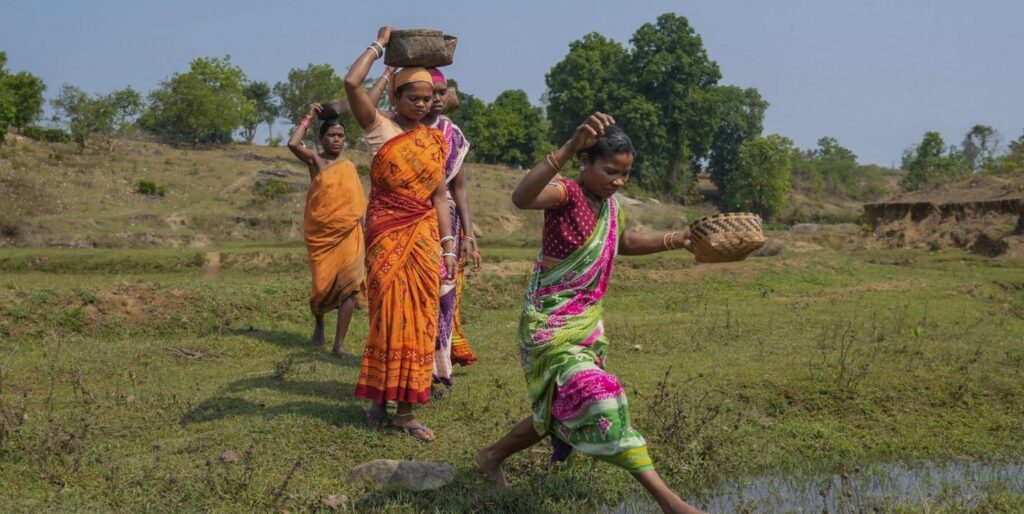
Women from the Gadaba Indigenous community walk to collect vegetables and wood from the forest in Hatipakna village, Koraput district, Odisha (AP Photo/Rafiq Maqbool)
- India’s first national report on implementation of Nagoya Protocol, mentions that there are no Indigenous Peoples and Local Communities (IPLC) in the country. While this could be an oversight, it is problematic.
- Such a negation prevents the government from recognising community consent and benefit sharing.
- The Biodiversity Act must be implemented with the constitutional provisions and relevant human rights legislations.
India is widely recognised for its efforts to protect biodiversity. The Biological Diversity Act, 2002, was enacted to implement the UN Convention on Biological Diversity (CBD), and later became the country’s main law for implementing the Nagoya Protocol, an international agreement that promotes fair access to genetic resources and equitable sharing of benefits from their use.

A key feature of the law is the Access and Benefit Sharing (ABS) mechanism, which ensures that people and communities who have protected biological resources and traditional knowledge receive a fair share of the benefits when these resources are commercially used.
India’s first national report on implementing the Nagoya Protocol, submitted in February 2026 ahead of the 17th Conference of the Parties (COP17), highlights several achievements. It states that more than 12,000 access approvals have been granted, around ₹268 crore has been collected under the ABS mechanism, and nearly ₹139 crore has been distributed as benefit-sharing. The report also records 395 approvals involving non-monetary benefit-sharing, such as technology transfer and capacity building.
These figures show that India has made significant progress in implementing its biodiversity laws.
However, one statement in the report has raised serious concerns. In the section dealing with Indigenous Peoples and Local Communities (IPLCs), the report says that “there are no IPLCs in the country.”
This statement is surprising because India has millions of people whose lives, livelihoods and cultures are closely linked to forests, rivers, grasslands and other natural ecosystems. These include Adivasis, traditional forest dwellers, fishing communities, pastoralists and farmers who possess valuable traditional knowledge about biodiversity.
Under the Nagoya Protocol, Indigenous Peoples and Local Communities enjoy special rights over their biological resources and traditional knowledge. These include the right to Prior Informed Consent (PIC) before anyone can use their resources and the right to negotiate Mutually Agreed Terms (MAT) to ensure fair benefit-sharing.
Community consent is not just a formality. It gives communities the right to decide whether access to their resources should be allowed and under what conditions. It also allows them to refuse projects that could damage their environment, livelihoods or cultural identity.
Interestingly, the same national report uses the term “local communities” in several other sections. India’s updated National Biodiversity Strategy and Action Plan also repeatedly refers to local communities. This makes the statement that there are no IPLCs in India appear inconsistent and creates confusion about the government’s position.
Existing laws already protect community rights
The concern is not only about terminology. By stating that there are no IPLCs, India did not answer several questions in the reporting format that ask countries to explain how they protect the rights of these communities. As a result, many important legal safeguards already available in India were left out of the report.
The report explains that community participation under the Biological Diversity Act takes place mainly through Biodiversity Management Committees (BMCs). Under the Biological Diversity Rules, 2024, these committees are responsible for ensuring Prior Informed Consent whenever biological resources belong to communities, individuals or other entities.

According to the report, India has established 2,76,653 Biodiversity Management Committees. While this is an important achievement, questions remain about whether these committees have enough capacity and clear guidelines to obtain genuine community consent.
India also has several constitutional and legal provisions that support community rights over natural resources.
The Constitution gives special protection to Scheduled Tribes, especially in the Fifth and Sixth Schedule Areas, where communities enjoy greater authority over local governance and natural resources. The Panchayats (Extension to Scheduled Areas) Act, 1996 (PESA) empowers Gram Sabhas to protect community resources, customs and traditional knowledge. These institutions could play a much stronger role in implementing the Nagoya Protocol.
Similarly, the Forest Rights Act, 2006 (FRA) recognises the rights of both Scheduled Tribes and Other Traditional Forest Dwellers. It also recognises community rights over traditional knowledge and empowers Gram Sabhas and Community Forest Resource Management Committees to conserve biodiversity and regulate access to community forest resources.
Although the FRA still faces implementation challenges, more than 1,24,000 Community Forest Rights titles covering nearly 75,000 square kilometres of forest land have already been recognised.
Other laws also protect community knowledge. The Protection of Plant Varieties and Farmers’ Rights Act, 2001, safeguards traditional farming practices such as saving, exchanging and reusing seeds while recognising thousands of farmers’ varieties. The Geographical Indications Act also protects many agricultural products that are closely linked to the traditional knowledge of local communities.
Outside the legal framework, several communities have developed biocultural protocols to define how outsiders should access their biological resources and knowledge. Examples include the Maldharis of Banni, the Raika camel pastoralists of Rajasthan, and the Danus and Takulis of Jhuni. Some of these initiatives have even been supported by State Biodiversity Boards.
Including these examples would have presented a much stronger picture of India’s efforts to protect biodiversity through community participation.
India has made remarkable progress in implementing the Nagoya Protocol. But recognising the rights of Indigenous Peoples and Local Communities is equally important. Future reports should build on existing constitutional protections and laws such as the Biological Diversity Act, PESA, the Forest Rights Act, and the Protection of Plant Varieties and Farmers’ Rights Act to ensure that community consent and fair benefit-sharing become central to biodiversity governance.
As the Kunming-Montreal Global Biodiversity Framework places increasing emphasis on human rights, acknowledging the role of local communities will strengthen both India’s biodiversity conservation efforts and its international commitments.