System Failures, Not Just Climate Stress, Push People To Migrate
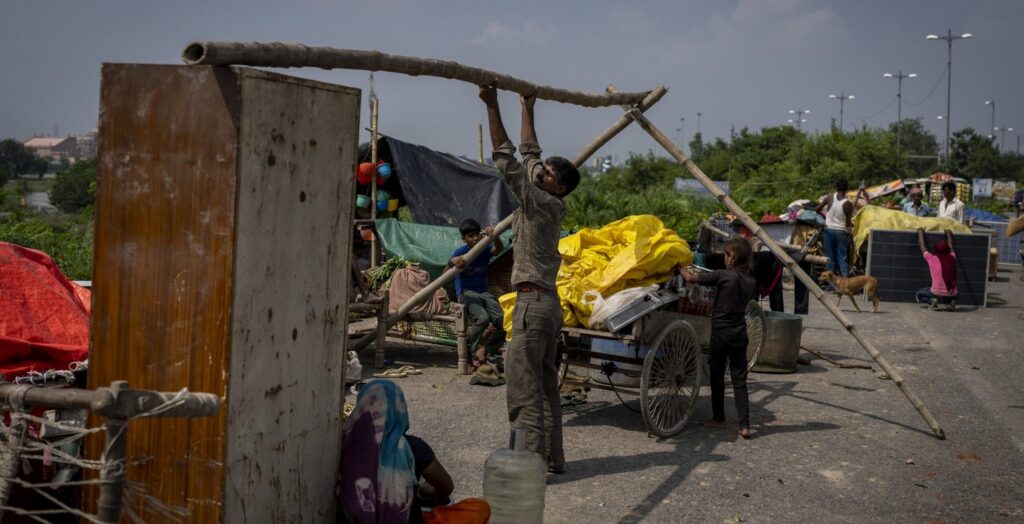
A family prepares a makeshift tent on a road after evacuating the flooded banks of Yamuna River. Representative image (AP Photo/Altaf Qadri)
Climate change may intensify environmental distress, but it does not directly force people to migrate, according to a recent study examining climate-induced migration and internal displacement in rural India. Instead, migration emerges through a complex chain of environmental, economic, social, and political pressures that gradually erode people’s ability to survive in their native places.
The study, conducted by researchers using secondary data, focused on Meenakshipuram, a village in Tamil Nadu that eventually turned into a ghost settlement after residents abandoned it due to worsening climatic conditions and the collapse of livelihoods. The village had earlier attracted national attention because of Kandaswamy, its last remaining resident, who chose to stay back even after his children and neighbours left.
Researchers found that declining rainfall, repeated droughts, rising temperatures, and prolonged water scarcity severely damaged agriculture in the region, pushing the local economy into crisis. However, the study argues that environmental degradation alone did not trigger migration. What ultimately compelled people to leave was the absence of institutional support systems, inadequate infrastructure, limited livelihood opportunities, and entrenched social marginalisation.
“The decision to migrate or not was not just driven by environmental or economic factors; it was also shaped by social change and emotional factors,” said Prasanta Moharaj, assistant professor of sociology at Dayananda Sagar University, Bengaluru, and lead author of the study.
According to Moharaj, climate change acts more as a “threat multiplier” than a direct cause of migration. Environmental stress becomes critical when communities already face weak governance, poverty, social exclusion, and a lack of adaptive support mechanisms. In such circumstances, migration becomes less a matter of choice and more a survival strategy.
Meenakshipuram represents one such case where climate-induced distress intersected with long-standing structural vulnerabilities. Agriculture, the primary source of livelihood for villagers, steadily collapsed due to water shortages and changing weather patterns. As economic opportunities disappeared, residents began moving out in search of work and security elsewhere.
Yet, Kandaswamy’s decision to remain in the village until his death reveals another dimension of climate migration — emotional attachment to a particular place.
Moharaj explained that Kandaswamy refused to abandon his ancestral home because of his deep emotional connection to the land and memories associated with it. “Kandaswamy continued to live in Meenakshipuram even when everyone left due to emotional attachment to his land, his home, and memories of his family,” he said.
The study highlights that not everyone living in climate-stressed regions chooses to migrate. The ability to stay often depends on what researchers describe as the “adaptive capacity” of a place — the extent to which communities receive institutional support, access alternative livelihoods, and benefit from resilient infrastructure.
“Better infrastructure, policy support, and alternative livelihoods can alter the decision and encourage people to stay on,” Moharaj noted.
The findings challenge simplistic narratives that portray climate change as a direct and singular driver of migration. Instead, the research underscores the importance of governance systems and socio-economic resilience in determining how communities respond to environmental crises.
Moharaj also drew parallels between Meenakshipuram and his hometown in Odisha’s Kendrapara district, a coastal region frequently cited in discussions on climate-induced displacement.
“There is a cluster of seven island villages there, locally called ‘Satabhaya’, meaning ‘seven brothers’. These villages were once inhabited, with people dependent on agriculture and fishing,” he said. “Today, most of them have been evacuated, and the situation is quite similar to Meenakshipuram.”
The Satabhaya region has long experienced coastal erosion, cyclones, salinity intrusion, and rising sea levels, all of which have steadily undermined traditional livelihoods. According to Moharaj, displacement in the region has also been shaped by social and political complexities.
“Many of the residents have been displaced there, partly because the area is socio-politically complex, with a large number of long-settled migrants,” he explained.
The comparison between the two regions highlights a broader national reality: climate-induced migration in India is rarely caused by environmental factors alone. Rather, it emerges when ecological pressures combine with inadequate governance, economic precarity, and social inequalities.
The study further argues that migration should not automatically be viewed as voluntary mobility. In many climate-vulnerable regions, people move only after local systems fail to support their survival. Communities first attempt to adapt through coping strategies such as changing crops, borrowing money, reducing consumption, or seeking temporary work elsewhere. Permanent migration often becomes the final option when all other avenues collapse.
“Migration, therefore, emerges as a compelled response, not a voluntary choice,” the study states. “It represents the last available survival strategy when communities lose the ability to sustain livelihoods locally.”
Researchers say the findings carry important implications for climate adaptation policy in India. Strengthening rural infrastructure, ensuring water security, creating diversified livelihood opportunities, and improving governance systems could significantly reduce distress migration.
The study ultimately calls for a shift in how climate migration is understood — not merely as an environmental issue, but as a deeply social and political one, where human vulnerability is shaped as much by institutions and inequality as by changing weather patterns.