Who, How Many Bought NEET-UG Question Papers For Rs 15 Lakh?
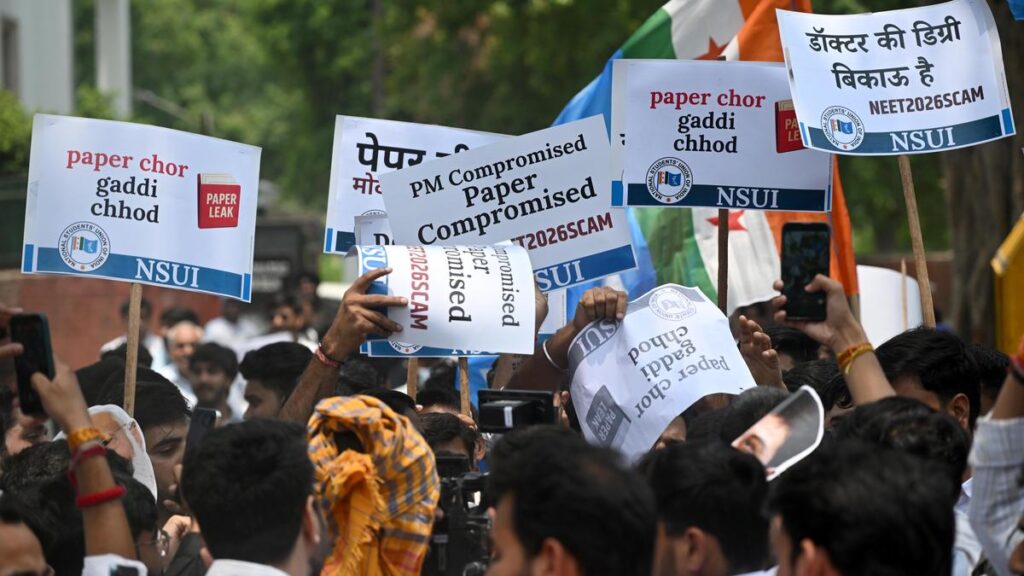
Members and supporters of the NSUI stage a protest against the alleged NEET 2026 scam in New Delhi on May 12, 2026 (Photo: Shashi Shekhar Kashyap)
Arrests carried out in Sikar, Nashik and Dehradun have exposed what investigators believe was a widespread racket involving the alleged sale of question papers ahead of the national medical entrance examination, NEET-UG. According to police officials probing the case, sets containing between 400 and 600 questions were allegedly being sold to aspirants across the country for amounts ranging from Rs 10 lakh to Rs 15 lakh, weeks before the examination was conducted.
Investigators say the scale of the operation has raised serious concerns about the integrity of one of India’s largest competitive examinations. Police inquiries have reportedly found that nearly 120 questions from these “guess papers” eventually appeared in the actual examination, which consisted of 180 questions. The high prices allegedly paid for these question sets have led investigators to suspect that buyers were convinced the questions would appear in the exam.
Officials believe the large number of questions included in each set may have been part of a deliberate strategy to create plausible deniability. By circulating 400 to 600 questions instead of the exact paper, sellers and buyers could later claim that they were merely dealing in “guess papers” and that any overlap with the final exam was coincidental.
Career counselling expert and founder of Careers360, Maheshwar Peri, publicly alleged that the similarities between the leaked material and the actual exam went far beyond coincidence. In a post on social media, Peri stated, “What we know is that 140 of the 180 questions in NEET were part of a guess paper of 410 questions. What is alarming is that the order of the questions and the options were exactly the same.”
Peri further described what he claimed was the modus operandi of the racket. “In Sikar, the students are called in for a mock test, a day before the actual exam and made to prepare for each of the questions in the guess paper,” he wrote. According to him, “The students had 140 of the 180 questions prepared, which guaranteed them 600 of the 720 marks even before they entered the exam hall.”
The allegations gained further weight after Vishal Bansal, Additional Director General of Police of Rajasthan’s Special Operations Group (SOG), confirmed that investigators had recovered a “guess paper” containing more than 400 questions. “Around 120 appeared in the actual examination,” Bansal stated during the investigation.
He also disclosed that the material had reportedly been circulating long before the examination date. “This guess paper was with students weeks before the examination, as far back as a month,” he said. According to Bansal, investigators are still trying to determine where the paper originated. “It was found on WhatsApp – in the mobile phones of students appearing for this examination. It is a .pdf file of about 150 pages with over 400 questions,” he added.
The controversy has once again highlighted the enormous logistical challenges involved in conducting the NEET-UG examination. This year, the examination was held at more than 5,432 centres across 551 cities in India and 14 international locations. Around 22.79 lakh students reportedly appeared for the test, making it one of the largest entrance examinations in the world.
Experts point out that physically transporting question papers to thousands of centres across the country inevitably increases the risk of leaks. The process reportedly involves multiple agencies, transport systems, storage facilities and examination personnel, making it difficult to identify the exact point where a breach may have occurred.
The National Testing Agency (NTA), which conducts the examination, has stated that it first received information regarding a possible leak on 7 May, four days after the exam was held. According to the agency, the matter was referred to the police the following day. After receiving confirmation about the alleged leak, the NTA decided to cancel the examination and announced that a fresh test would be conducted.
Peri argued that the examination system itself remains vulnerable because of the scale at which it is conducted. “NEET is a pen & paper examination. The physical paper is transported to over 5000 centres and involves at least 200,000 hands,” he said during a television interview. “With question papers being transported for weeks before the examination, their vulnerability is high,” he added.
Former Union Minister P. Chidambaram also criticised the system, arguing that leaks are almost inevitable in such large-scale examinations. “It is common sense that in the conduct of such an examination over a large geographical area, the question paper has a very high probability of being leaked and such leaks have happened in the past too,” he said. Chidambaram further remarked that “the answer is not attempts to ‘plug’ the leaks but the answer is to abolish NEET.”
Analysts say another major factor behind recurring paper leak scandals is the massive disparity in the cost of medical education between government and private institutions. While a seat in a government medical college may cost around Rs 5 lakh in fees, admission to a private medical college can reportedly cost as much as Rs 1.5 crore. In that context, investigators believe some families may view paying Rs 10 lakh to Rs 15 lakh for advance access to questions as a worthwhile gamble if it secures admission to a government institution.
Meanwhile, political controversy has also intensified around the issue. Former Rajasthan Chief Minister Ashok Gehlot accused the BJP-led Rajasthan government of attempting to suppress information related to the case. “The BJP government in Rajasthan deliberately tried to cover it up for two weeks and played with the future of the youth,” Gehlot alleged.
He further claimed that the state government had previously attempted to conceal irregularities in recruitment examinations as well. “The BJP government in Rajasthan had previously concealed the OMR sheet scam in the Employee Selection Board recruitment exam to avoid tarnishing the government’s image,” Gehlot said, adding that “due to weak prosecution, the accused in that case were even granted bail.”
Senior advocate and Rajya Sabha MP Kapil Sibal also questioned why repeated incidents of paper leaks were allegedly emerging from BJP-ruled states. Referring to several national-level entrance examinations cancelled since 2014, Sibal asked whether enough safeguards had been put in place to protect the future of millions of students competing in high-stakes examinations across the country.