Delhi’s Collapsing Buildings: Why Does India Keep Failing To Learn?
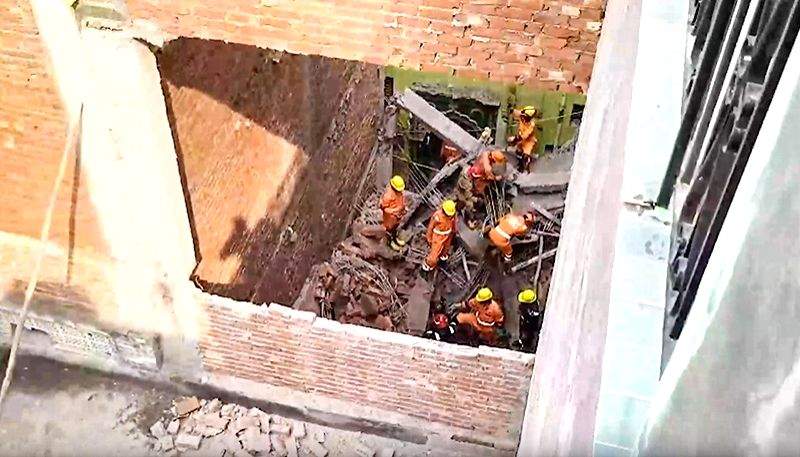
The three-storey building was under construction in Gali Sitara in Chawri Bazar when it collapsed on the morning of November 5, killing two people and with atleast 15 people feared trapped in the rubble (Photo: IANS)
The collapse of another building in Delhi, this time in the congested Chawri Bazaar area, killing two people, is a grim reminder that India’s urban disasters are rarely without warning. Every such tragedy is followed by expressions of grief, promises of investigations and assurances that unsafe structures will be identified. Yet, before the outrage fades, another building gives way, burying residents, workers and passers-by under the rubble.
The recurring nature of these incidents raises a troubling question: why does a country that has witnessed so many building collapses continue to treat them as isolated accidents rather than symptoms of a systemic failure?
Building collapses are often attributed to old structures, heavy rainfall, poor construction or unauthorised alterations. These may be immediate triggers, but the underlying causes are more persistent: weak enforcement of building regulations, fragmented responsibility among civic agencies, corruption, poor maintenance and the absence of reliable structural safety audits. The result is a system in which risks are allowed to accumulate until a disaster makes them impossible to ignore.
The Chawri Bazaar collapse makes this failure particularly difficult to excuse. The three-storey building was under construction in Gali Sitara when it collapsed on the morning of November 5. According to reports, slabs were being poured on the third floor when the structure gave way. The narrow lanes of the locality also complicated rescue operations, with heavy machinery unable to reach the site easily.
More disturbing are reports that the Delhi Police had alerted the Municipal Corporation of Delhi (MCD) about unauthorised construction at the property in June, nearly five months before the collapse. The civic body allegedly failed to stop the work. The MCD has since suspended a junior engineer and an assistant engineer, while an FIR has been registered against the contractor.
A cycle of warnings, inquiries and inaction
This is not an isolated administrative lapse. In May, six people died when an unauthorised building collapsed in Saidulajab, south Delhi. A magisterial inquiry subsequently described the disaster as preventable, finding that the MCD had already flagged violations but failed to take effective enforcement action. Police had also alerted the civic body about possible deviations from the sanctioned building plan. The inquiry pointed to ignored complaints, inadequate monitoring and even inspection records allegedly created retrospectively.
The pattern extends beyond building collapses. Investigations into major fires in Delhi have repeatedly exposed illegal extensions, blocked escape routes, inadequate firefighting arrangements and poor coordination among agencies. The common thread is that violations are often known to authorities, but inspections do not translate into timely corrective action.
The problem is compounded by the sheer scale of unsafe construction. A June 2026 report on the Delhi High Court-monitored structural safety exercise found that the MCD had identified 4,762 high-risk and old structures. Although notices had been issued to 4,571, structural audit reports had been received for only 1,155. Retrofitting had been carried out in just 47 buildings, while 56 had been demolished. These figures expose the enormous gap between identifying a danger and addressing it.
Why does this continue? First, enforcement is fragmented across municipal bodies, police, fire services, development authorities and other departments. Each can identify a violation, but responsibility for acting on it is often passed from one office to another. Second, unauthorised construction is sustained by a combination of political patronage, corruption, weak oversight and the commercial incentive to add floors or expand buildings without meeting safety requirements.
There is also a tendency to treat building safety as a matter of paperwork. Notices are issued, committees constituted and inquiries ordered, but there is little public information about whether dangerous structures are repaired, evacuated or demolished. Suspending junior officials after a disaster may demonstrate administrative action, but it cannot substitute for examining the accountability of senior officials and the wider system.
From post-disaster action to prevention
Preventing another tragedy requires a shift from reactive inspections to continuous enforcement. Every city must maintain a publicly accessible, GIS-based inventory of buildings, recording their age, structural condition, sanctioned plans, ownership and previous violations. High-risk structures, particularly in densely populated and earthquake-prone areas, should undergo mandatory independent structural audits at regular intervals.
Unauthorised construction must trigger immediate action. Complaints should be digitally registered, assigned to specific officials and tracked against time-bound deadlines. Residents and police reporting dangerous construction must be able to see what action has followed. Officials who ignore documented warnings should face disciplinary and, where warranted, criminal accountability.
Building codes must also be enforced during construction, not merely when plans are approved. Independent engineers should certify critical stages, including foundations, columns and additional floors. Contractors and developers responsible for serious violations should face meaningful penalties, including blacklisting.
Finally, old neighbourhoods need practical safety plans. Residents should receive assistance to repair unsafe buildings, while temporary accommodation must be arranged where evacuation is necessary. Narrow lanes must be mapped for emergency access, with rescue equipment and local response teams suited to congested settlements.
India does not lack regulations, expert committees or judicial directions. What it lacks is consistent implementation. Until authorities act on warnings before buildings collapse, every inquiry will risk becoming another exercise in recording failures after lives have been lost. The real test of governance is not how swiftly officials respond to rubble, but whether they prevent people from being buried beneath it.