The Iran Crisis Runs Through Banks As Much As Oil Routes…
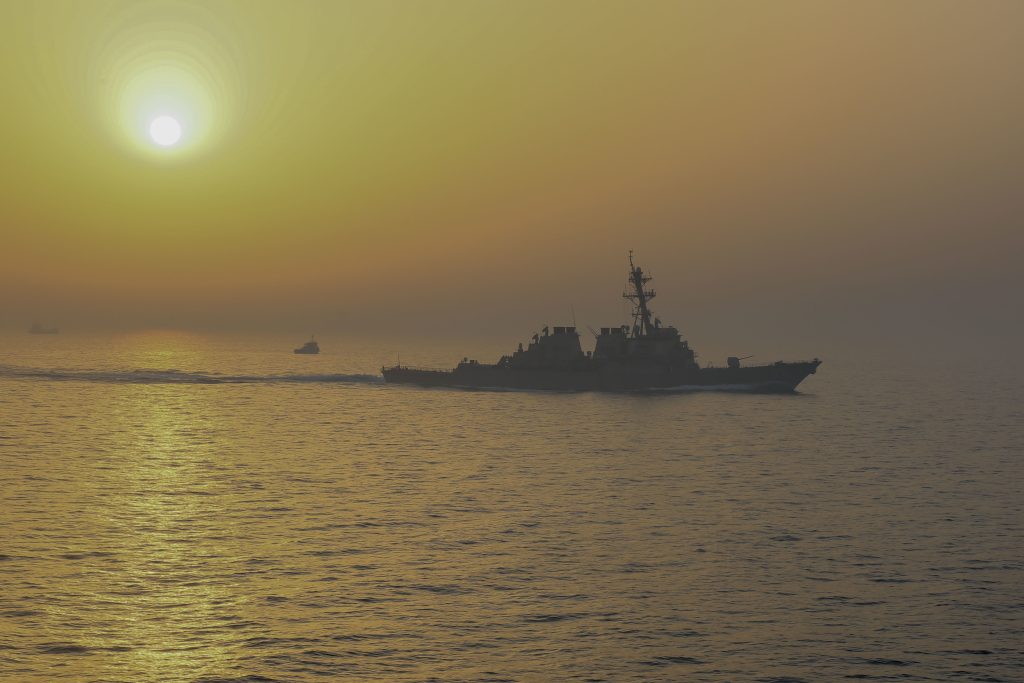
The standoff over Hormuz highlights a broader contest over financial infrastructure and the weaponisation of interdependence
Middle East diplomacy appeared to falter on Monday, September 14, as a planned meeting between Iran and other Gulf states was postponed, while attacks near two of the region’s most important oil transit routes intensified concerns over global energy supplies.
The escalation had gathered pace over the weekend. Houthi strikes on Saudi Arabia forced the closure of its 1,200-kilometre east-west oil pipeline, a crucial route for moving crude across the kingdom while bypassing the Strait of Hormuz. Oil prices rose by more than 3 percent following the shutdown.
Hormuz itself remained vulnerable. The British maritime security agency UKMTO reported on Sunday, September 13, that a vessel had been struck by a projectile while transiting the strait. The resulting fire forced the crew to evacuate.
Together, the incidents underscored the fragility of both the principal maritime chokepoint and the alternative routes designed to circumvent it.
Washington targets Iran’s financial arteries
The security crisis has unfolded alongside renewed economic pressure from Washington. On August 7, the US Treasury’s Office of Foreign Assets Control sanctioned a network operating between the Gulf and Asia, accusing it of helping Iran’s shadow banking system move hundreds of millions of dollars.
The measures targeted two Dubai-based exchange houses, financial intermediaries, front companies linked to an Iranian bank, and shell companies in Hong Kong and Singapore.
On August 24, the Treasury secretary announced “Operation Economic Outcast”, signalling a renewed focus on Iran’s financial infrastructure after months in which military escalation had dominated attention.
The approach differs from the broad sanctions imposed after Washington withdrew from the nuclear agreement in 2018. The newer campaign focuses on entities accused of exploiting loopholes that allow sanctioned trade and financial activity to continue.
The objective is therefore not simply to impose more sanctions, but to identify and close the channels through which Iran continues to move money.
From frozen assets to financial networks
The evolution of US pressure on Iran stretches back almost five decades.
On November 14, 1979, ten days after the seizure of the US embassy in Tehran, President Jimmy Carter issued Executive Order 12170, freezing Iranian government and central bank property under US jurisdiction. The measure also affected balances held at foreign branches and subsidiaries of American banks.
But the architecture of financial coercion evolved considerably after that.
One of its most important components became SWIFT, the international financial messaging system established in Belgium in 1973. SWIFT does not itself transfer money; it transmits the instructions that enable financial institutions to execute payments. Its central position in global finance has nevertheless made it an important source of leverage.
Political scientists Henry Farrell and Abraham Newman described this dynamic in their 2019 theory of “weaponised interdependence”. Global networks, they argued, tend to concentrate around powerful nodes, allowing states that exercise jurisdiction over those nodes to exploit them in two ways: by monitoring flows — the “panopticon effect” — and by restricting access — the “chokepoint effect”.
Iran has experienced both.
SWIFT and the weaponisation of finance
Following the September 11 attacks, the US Treasury obtained access to financial messages stored at SWIFT’s American operating site through its Terrorist Finance Tracking Program. That demonstrated the surveillance potential of financial networks.
The exclusion mechanism became more explicit in 2012, when the European Union banned specialised financial messaging services from serving Iranian institutions subject to asset freezes. SWIFT subsequently suspended services to affected Iranian banks.
The dynamic changed again after Washington withdrew from the Joint Comprehensive Plan of Action in 2018. Although the European Union opposed the extraterritorial reach of US sanctions, SWIFT suspended access for some Iranian banks when the second tranche of American sanctions returned that November.
Europe’s attempt to create an alternative through INSTEX, established in 2019, ultimately produced only one transaction before the mechanism was wound up in 2023.
The lesson was stark: political opposition to financial sanctions is considerably easier than constructing an alternative financial infrastructure capable of replacing SWIFT.
Is Hormuz really a “chokepoint”?
The Strait of Hormuz is undoubtedly one of the world’s most important geoeconomic chokepoints. But describing it as an example of Farrell and Newman’s “weaponised interdependence” risks confusing two fundamentally different forms of power.
The distinction is geographical and economic.
The nodes in global financial networks emerge from “concentration produced by economies of scale” — decades of economic decisions that make alternative systems expensive or inefficient. Hormuz, by contrast, derives its strategic importance from geography and the military ability to restrict passage.
Control of the strait primarily creates what can be described as a transit advantage. Control of a financial network provides something different: visibility into transactions and the ability to pressure intermediaries.
That distinction matters because financial power can ultimately be used to neutralise the economic leverage associated with physical chokepoints.
The real price of reopening Hormuz
Iran’s demands for reopening the Strait illustrate the connection between these two forms of power. On August 8, Tehran outlined six conditions, including compensation for war damage, sanctions relief and the release of frozen assets.
These demands show that the dispute is not merely about shipping lanes. Access to international finance is embedded in the bargaining over the future of Hormuz itself.
The August 7 sanctions demonstrate that Washington is concentrating on precisely these financial channels. By identifying companies, intermediaries and individuals involved in the networks, US authorities can not only disrupt transactions but also create the risk of losing access to American correspondent banking.
That threat can produce “overcompliance”, as financial institutions avoid transactions that might expose them to US penalties even when those transactions are not directly prohibited.
The invisible chokepoint
The strategic contest around Iran is therefore about more than the Strait of Hormuz.
Hormuz is the visible chokepoint: a narrow waterway whose disruption immediately affects energy markets. The financial system is the less visible one, operating through banks, exchange houses, intermediaries and payment networks.
Nearly five decades of sanctions have not produced a fully viable Iranian alternative to the dominant international financial infrastructure. Alternative channels exist, including those involving Russia, but remain limited, while Iranian oil exports continue to rely heavily on opaque financial circuits.
The central question is consequently not simply who controls Hormuz, but who controls the networks through which Iran can continue to trade.
In this contest, the most powerful pressure point may be the one that attracts the least attention: the financial infrastructure connecting Iran to the global economy.