Udhayanidhi’s Comments On Trisha Expose India’s Enduring Misogyny
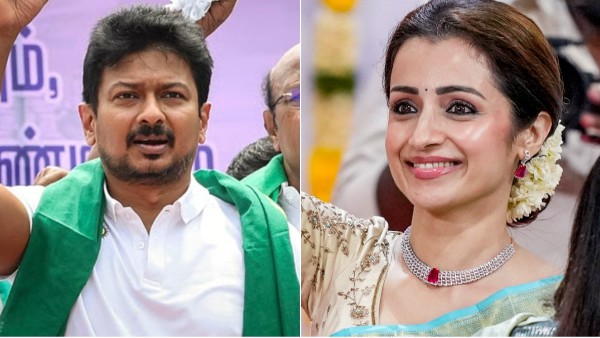
The Trisha controversy resonates beyond Tamil Nadu because it is less about one politician's alleged remarks than about a culture that still treats women as rhetorical props rather than autonomous individuals deserving of respect
The arrest of DMK leader and Tamil Nadu Opposition leader Udhayanidhi Stalin over his alleged objectionable remarks involving actor Trisha Krishnan has triggered a political storm. While the legal battle will take its own course, the controversy has once again highlighted a deeper and more persistent social problem: the casual misogyny that continues to shape public discourse in India.
Stalin was arrested following an FIR over remarks made during a public rally in Thanjavur, where his comments, widely interpreted as a vulgar double entendre involving actor Trisha, drew widespread criticism across political lines. Police invoked multiple provisions under the Bharatiya Nyaya Sanhita (BNS), the Information Technology Act and the Tamil Nadu Prohibition of Harassment of Women Act before questioning him. He was later granted station bail, while the DMK described the action as politically motivated and vowed to challenge the case legally.
Regardless of the political contest between the ruling Tamilaga Vettri Kazhagam (TVK) and the DMK, the controversy raises a question that extends beyond partisan politics: Why do women continue to become convenient targets in political sparring?
The alleged remarks did not merely mention Trisha; critics argued they reduced a successful actor to the subject of a sexually suggestive joke in front of a cheering crowd. It is a familiar pattern in Indian politics, where women—particularly those in public life—are routinely objectified, mocked or dragged into political battles despite having no role in the underlying dispute.
This incident is not an isolated aberration. Indian public life has repeatedly witnessed women journalists, actors, sportspersons and politicians being subjected to sexist insults, character assassination and innuendo. Social media has amplified this behaviour, but it has long existed in political speeches, television debates and everyday conversations.
What makes such remarks particularly damaging is that they reinforce the idea that a woman’s dignity is expendable if it serves a political objective or entertains a partisan audience.
The response to Stalin’s remarks reflected that concern. Political leaders and members of the film industry condemned the comments, with several public figures arguing that vulgar, double-meaning remarks have no place in democratic discourse.
The episode also illustrates how misogyny often transcends ideological divides. Politicians from opposing camps frequently condemn sexist remarks when directed at women associated with their side, while remaining silent when similar language is used against others. Such selective outrage weakens the broader fight against gender-based discrimination.
India has made undeniable progress in women’s education, workforce participation and political representation. Yet these advances coexist with deeply entrenched patriarchal attitudes that continue to police women’s identities and reduce them to objects of ridicule or speculation.
Female actors, in particular, often face a disproportionate burden. Their professional achievements are frequently overshadowed by discussions about their personal lives, appearance or relationships. They become symbolic figures onto whom political rivals project insults aimed at one another. The individual woman disappears; what remains is a stereotype deployed for maximum political effect.
That is precisely why the Trisha controversy resonates beyond Tamil Nadu. It is less about one politician’s alleged remarks than about a culture that still treats women as rhetorical props rather than autonomous individuals deserving of respect.
At the same time, the legal proceedings have generated debate over proportionality and political motivation. The DMK has argued that the arrest amounts to political vendetta, while the ruling establishment has maintained that no public figure should be above the law. Those competing claims will ultimately be tested through the judicial process.
However, irrespective of how the case concludes, the public conversation should not end with questions of arrest, bail or electoral rivalry.
The larger issue is the normalisation of misogynistic language in public life. Every time a sexist joke is dismissed as harmless humour, every time a woman is dragged into a political feud without reason, and every time audiences applaud such remarks, the message extends far beyond the stage or rally. It signals that women’s dignity is negotiable.
A healthy democracy demands more than elections and political competition; it also requires a public culture rooted in respect. Leaders occupy influential positions, and their words shape public attitudes. When those words reinforce sexist stereotypes, they legitimise prejudice rather than challenge it.
The controversy surrounding Udhayanidhi Stalin should therefore serve as more than another political flashpoint. It should prompt a broader reckoning with the misogyny that continues to permeate Indian public life. Until sexist rhetoric is rejected consistently—regardless of who utters it or which party they belong to—such incidents will continue to recur, leaving women to bear the cost of a political culture that too often treats them as collateral damage.