PIL Alleges CJP Members, Followers Subjected To Police Surveillance
Shalini Jul 17, 2026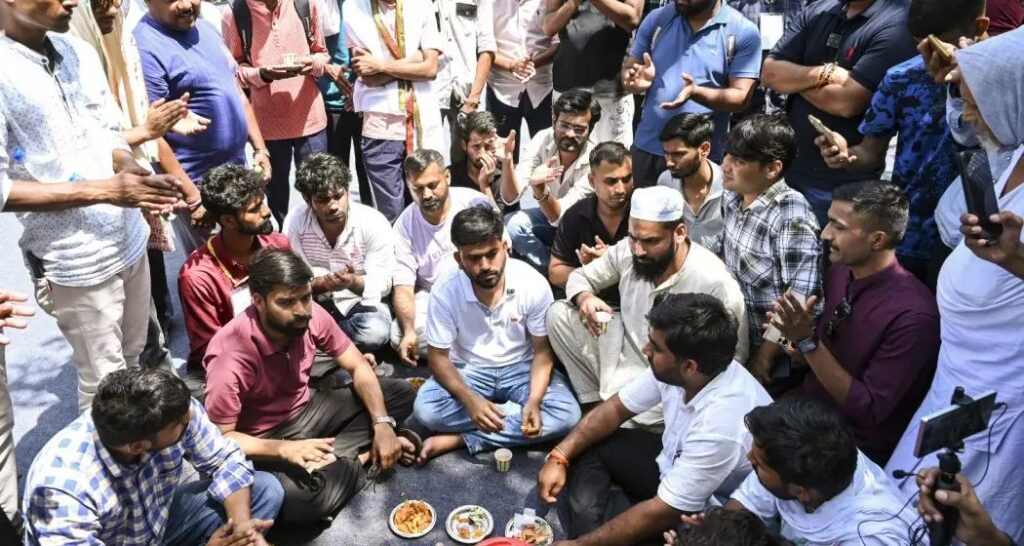
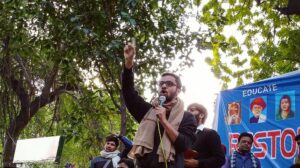
CJP members, including founder Abhijeet Dipke sit in protest at New Delhi's Jantar Mantar. The petition comes against the backdrop of the group's ongoing demonstrations and its planned "Chalo Sansad" march on July 20
* A petition in the Delhi High Court raises questions over privacy, free speech and the right to dissent
The Delhi High Court is set to hear a public interest litigation (PIL) alleging that members and supporters of the Cockroach Janta Party protesting in the national capital have been subjected to intrusive police surveillance, raising wider concerns over the balance between security, civil liberties and the constitutional right to dissent.
The petition comes against the backdrop of the group’s ongoing demonstrations at Jantar Mantar and its planned “Chalo Sansad” march on July 20, organised alongside activist Sonam Wangchuk’s indefinite hunger strike and protests surrounding alleged irregularities in the NEET examination. While the specific facts of the allegations will ultimately be tested before the court, the case has already sparked debate over how law enforcement monitors political protests and whether surveillance measures are becoming increasingly common in response to public demonstrations.
According to the petition, protesters have allegedly faced extensive monitoring by police authorities. The claims reportedly include surveillance of organisers, monitoring of participants and other forms of observation that the petitioners argue go beyond legitimate policing and infringe upon fundamental rights guaranteed under the Constitution.
The Delhi Police has not yet publicly responded in detail to the allegations before the court. As the matter is sub judice, the High Court’s proceedings are expected to examine whether the actions complained of fall within the lawful powers of the police or amount to disproportionate interference with citizens exercising their democratic rights.
The case touches upon several constitutional protections. Article 19 guarantees citizens the right to freedom of speech and expression, the right to assemble peacefully without arms and the right to form associations. These rights, however, are subject to reasonable restrictions in the interests of public order, national security and other grounds specified in the Constitution.
The Supreme Court has repeatedly held that peaceful protest is an essential feature of a constitutional democracy. At the same time, courts have also recognised that authorities may regulate assemblies to maintain law and order. The legal question is therefore not whether surveillance is ever permissible, but whether it is necessary, proportionate and authorised by law in a given case.
The petition is also likely to invoke privacy concerns following the Supreme Court’s landmark 2017 judgment in Justice K.S. Puttaswamy v. Union of India, which recognised privacy as a fundamental right under Article 21. That judgment established that any state intrusion into privacy must satisfy tests of legality, legitimate state purpose and proportionality.
If surveillance measures are found to have exceeded those constitutional limits, the case could have implications extending well beyond the present protest.
Growing concerns over surveillance and democratic participation
The petition also feeds into a broader national conversation about the increasing use of surveillance technologies and monitoring practices in public life.
Over the past decade, digital technologies have significantly expanded the state’s ability to monitor public spaces. CCTV networks, facial recognition systems, drone surveillance, mobile phone analysis and social media monitoring have become increasingly common tools used by law enforcement agencies. Governments argue these technologies improve public safety, assist criminal investigations and help manage large public gatherings.
Civil liberties advocates, however, have consistently argued that these tools require robust legal safeguards and independent oversight. Their concern is not simply that surveillance exists, but that inadequate transparency or accountability could create a chilling effect on democratic participation.
When citizens believe that attending a protest, signing a petition or expressing dissent may result in heightened monitoring, some may choose not to participate at all. Scholars and rights organisations have long described this as the “chilling effect” on free expression, where people modify their lawful behaviour because they anticipate surveillance or other consequences.
Whether such a chilling effect exists in this particular case remains a matter that the court will examine based on the evidence presented. The allegations themselves have not been judicially established.
The petition nevertheless reflects a broader concern expressed by some civil society groups and legal experts that individuals who publicly oppose government policies increasingly perceive themselves to be subject to closer scrutiny than those engaged in ordinary civic activities. Governments, on the other hand, maintain that surveillance or monitoring associated with protests is aimed at preventing violence, maintaining public order and ensuring public safety rather than targeting dissent itself.
The distinction is an important one. Democratic policing requires authorities to facilitate peaceful protests while responding proportionately to genuine security risks. Equally, surveillance powers—particularly where they affect political expression—must operate within constitutional and statutory limits.
Legal experts have frequently argued that India would benefit from a clearer legislative framework governing surveillance. Although various laws permit interception and monitoring under specified circumstances, critics say there is no comprehensive legal architecture providing independent authorisation, regular audits, notification mechanisms or effective remedies against misuse. Such safeguards exist, in varying forms, in several other democracies.
The outcome of the Delhi High Court proceedings could therefore prove significant beyond the immediate dispute involving the Cockroach Janta Party. If the court examines the permissible scope of surveillance during public protests, it may help clarify the standards that police agencies must follow when balancing public order with individual rights.
Ultimately, the case raises a larger constitutional question that extends beyond any single organisation or protest movement: how can the state ensure security while preserving the freedoms that enable democratic participation? The answer is likely to shape not only future policing of protests but also public confidence that citizens can express dissent without being subjected to unlawful or disproportionate surveillance.