The Insect That Syncs Up With The Football World Cup
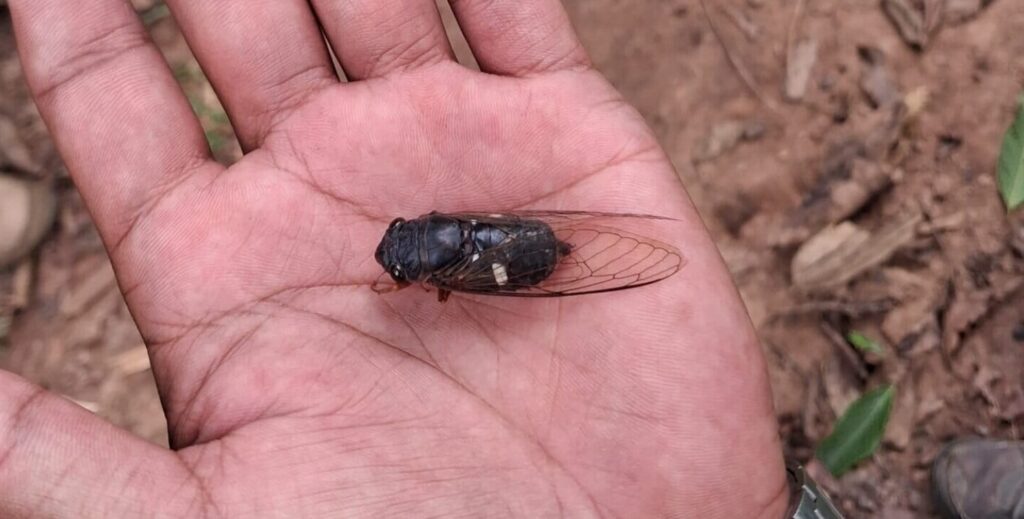
The World Cup cicada (Chremistica ribhoi). Image by Nabarun Guha
- A cicada that emerges every four years in Meghalaya was also recorded in Assam this year.
- Mass emergence of cicadas, however, does not bode well for the forest ecosystem and the animals that rely on it.
- These insects might soon emerge in other parts of Northeast India and more research and records are needed for this lesser-studied species.
As the football world cup began in the United States, Canada and Mexico this year, in one part of India, an insect emerged, as it does, every four years, in sync with the sporting event. However, this year, it was found beyond its typical home range.
Aptly named the World Cup cicada, the insect, Chremistica ribhoi, has been recorded in Meghalaya in Northeast India. This year though it was spotted in the neighbouring state of Assam during a field assessment around the Rani Reserve Forest conducted by wildlife biologist Pulakeswar Basumatary, with Langtuk Terang, Assistant Professor, Pragjyotish College, Mann Kumar Thapa, a research scholar at Royal Global University, M.Sc. student Lakhinandan Dutta and butterfly researcher Rajat Joshi.
Basumatary told Mongabay-India, “Until now, Chremistica ribhoi was known only from Saiden village and Lailad, near Nongkhyllem Wildlife Sanctuary in Meghalaya’s Ri-Bhoi district. The 2026 sighting across the Rani-Garbhanga-Basistha Reserve Forest is the first record of the species in Assam, and a real extension of its known range.”
However, while it has been scientifically recorded now, the local communities always knew of the cicada in Assam. “The Rabha community of Satargaon, in the Rani area (of Assam), say they had been seeing this cicada before the year 2000. That’s earlier than the first scientific record from Meghalaya. The species was almost certainly always here, just undocumented,” said Basumatary.
Periodical cicadas are among nature’s most precise timekeepers. Their mass emergence is triggered largely by soil temperature and humidity cues built up over years underground. So, the appearance of the World Cup cicada in Assam’s Rani-Garbhanga signals that the forest still holds the exact below-ground conditions the species needs, making it a living indicator of forest health. Data on C. ribhoi is limited, which is why every record counts, noted Basumatary. He added that the Assam record of the cicada now raises questions about the size of the population, its spread through the reserve, and whether it is genetically linked to the Meghalaya population.
The urinating insect
If one is standing under a big, leafy tree and gets drenched when it is not raining, there is a high chance that the reason is the World Cup cicada.
Mass urination is another reason this insect is widely known.
Satargaon, a small village comprising 59 households adjoining the Rani Reserve Forest is well acquainted with the World Cup cicada. The residents of this village, which has neither electricity nor mobile connectivity, are dependent on the forest for their living. They mainly collect firewood and catch fish.
Mangal Rabha, a resident of the village told Mongabay-India, “When we go inside the forest, we have been drenched by this insect on several occasions. This is why we call it mutrapuka (urinating insect).” Across the border in Ri-Bhoi, Meghalaya, the Khasis call it niangtaser.
Basumatary explains, “This insect feeds only on plant sap, piercing tissue with a straw-like mouthpart called a rostrum. Nymphs tap roots underground; adults drink from stems, branches and trunks.”
Sap is almost all water and carbohydrate, with very little nutrition packed in. To get enough, a cicada must process enormous volumes of fluid, up to 300 times its body weight, and continuously squirts out the excess, explains Basumataray. “During a mass emergence this becomes a fine mist falling from the canopy. Stand beneath a cicada-filled tree and you feel it as a light drizzle.”
Cicada mass emergence can harm forests
A mass emergence, tens of thousands to millions of insects, however, is not ideal for a forest. Basumatary says, “We saw feeding damage on Dillenia pentagyna (tree) and Heteropanax fragrans (plant): chlorosis, wilting and early leaf drop. The constant rain of excreted fluid also left the ground beneath aggregations persistently wet, affecting soil and undergrowth.
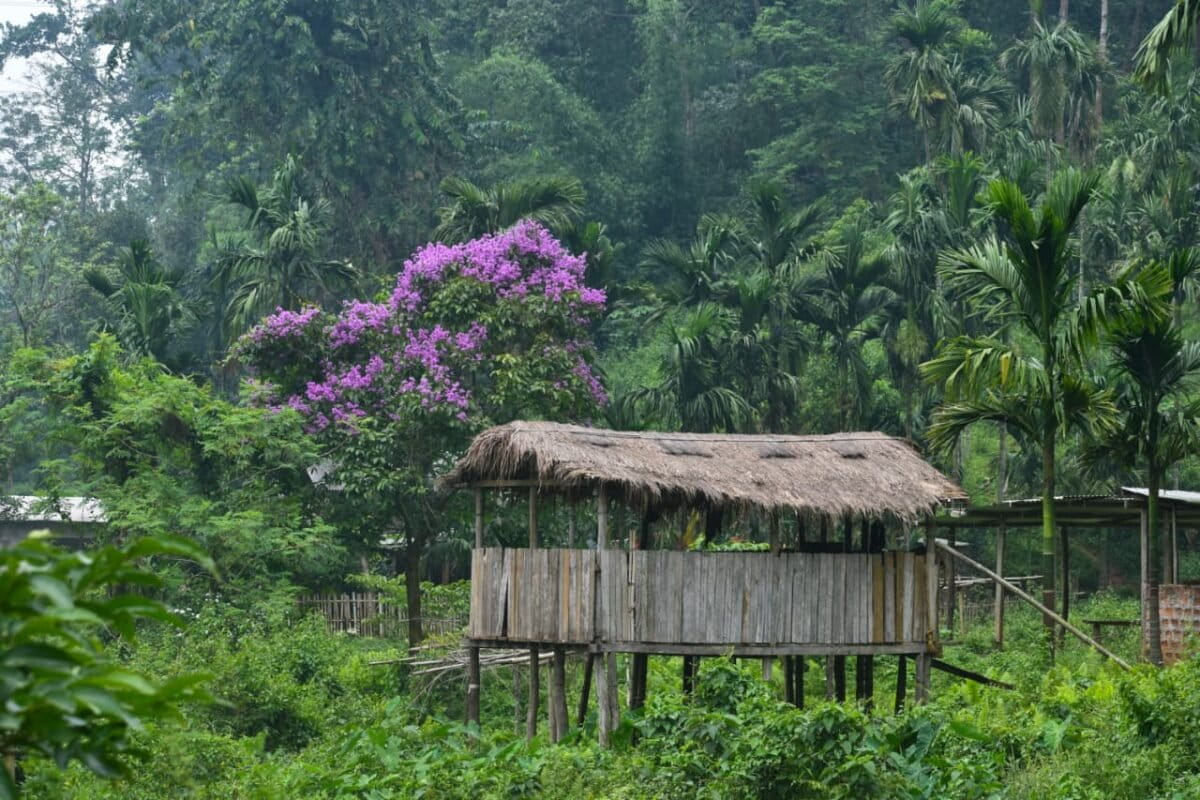
Additional damage is caused to the plants when the World Cup cicada females lay eggs. They slit young twigs to lay their eggs and that can can leave branch tips withering, a measurable setback in timber or fruit trees.
This time, according to people in the Rani area, the harm was limited. The cicadas mostly massed on larger trees deep in the forest and in backyards, near the farmland, and the intact forest cover seems to have absorbed the pressure.
Niranjan Rabha, the beat officer who oversees the Rani forest section told Mongabay-India, “We have noticed these insects inside the forest. However, we haven’t heard anything regarding these insects harming the vegetation in and around Rani Reserve Forest.”
Basumatary, however, recommended planning and monitoring to prevent damage by the mass emergence of cicadas. “Rani-Garbhanga borders active agro-forestry. If a future emergence coincides with thinner forest cover, the cicadas could shift into orchards, plantations or bamboo crops, where the damage could be serious. Communities and land managers should know the cycle and plan for it.”
Cicada feeding and sound can affect elephants
Rani-Garbhanga is a vital elephant corridor in Assam, rich in bamboo that elephants rely on for food and cover, and home to several birds, mammals, butterflies and plants.
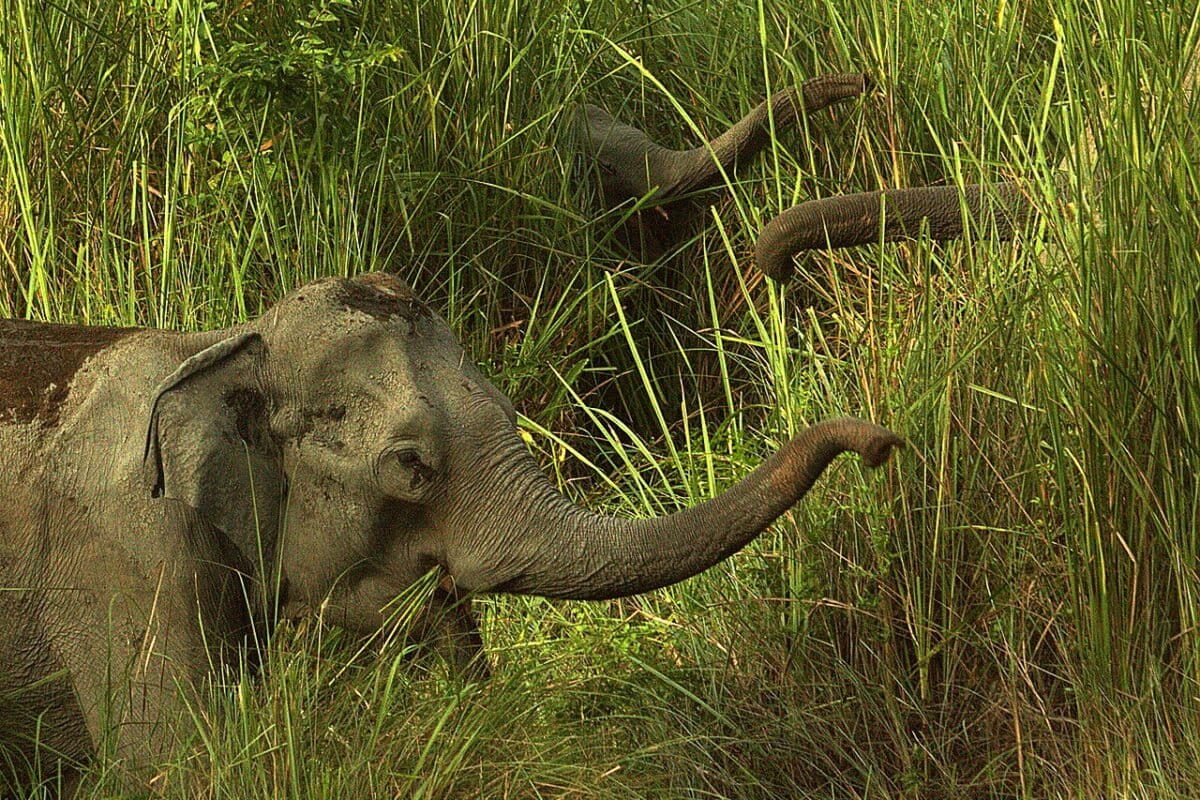
Beat officer Rabha says, “There is a large presence of elephants in this area apart from other animals like deer, leopards, bears etc. However it is the elephants which regularly enter villages and destroy farms, affecting local residents.”
Basumatary linked the emergence of cicadas with the elephant issue in Rani and said, “This year’s emergence likely disturbed the herds in several ways. The cicadas were draining sap from bamboo, the elephants’ main food here, and visibly stressing it. Their excreted fluid left the ground unusually wet where elephants normally feed and rest.”
He added, “The loudest factor, though, is sound. Male cicadas sing a continuous high-pitched mating call, and at this scale the chorus can reach 90 to 100 decibels, like standing beside a lawnmower or heavy traffic. Our own team struggled with it: at some sites it was so overwhelming we could not talk to one another or bear it for long. If trained researchers found a few hours hard, the effect on elephants, with far sharper hearing and weeks of exposure across their core habitat, is easy to imagine. Some residents noted they had not seen elephants in the area during the emergence, which may well be connected.”
The cicada feast
The World Cup cicada is a delicacy both in Assam and Meghalaya. Thejavikho Chase, a documentary filmmaker from Nagaland, observed these insects in Ri-Bhoi district in Meghalaya. He told Mongabay-India, “In the evening after sunset, the insects will come up and they will latch on to the plants. These are the nymphs of the cicadas and at a very particular time in the evening, the shell will break up and they will come out of the shell. After coming out of the shell, the shell will start hardening within four to five minutes,” said Chase. “The locals don’t eat the insect when they are in the nymph stage or are fully mature adults. They are eaten only when the shells are soft.”
The residents of Satargaon village in Assam also enjoy these insects as delicacies. Renu Rabha, a resident of the village told Mongabay-India, “In the evening, we try to catch these insects and fry them. They are nice to eat with rice.”
Basumatary said, “The emergence of these insects is a feast. Birds, mammals, reptiles, spiders and other invertebrates all cash in on the sudden flood of protein, and local people eat the cicadas too, especially the soft, freshly emerged pre-imagos, as a seasonal delicacy. What unsettles one part of the food web feeds another, which is exactly what makes these events so compelling.”
Cicadas in the Northeast
Basumatary feels that in the coming days, these insects might emerge from other parts of Northeast India.
“Most of Northeast India is still barely explored biologically, and documentation remains minimal. The odds of finding new species, from fungi to mammals, are high, and cicadas are no exception; the region already has a strong and growing record of them,” he said.
Rani-Garbhanga proves the point. The species sat in a single narrow Meghalaya locality for over a decade, and one focused field visit during the emergence window pushed its range into a whole new state. The humid, bamboo-rich forests of Arunachal Pradesh, Nagaland, Manipur, Mizoram and other parts of Meghalaya share similar conditions, and any of them could hold C. ribhoi or a related periodical cicada. The four-year window is narrow, and without someone in the right place at the right time, a whole cycle can pass unrecorded, as has happened with this species again and again, explains Basumatary.
“So, I would urge researchers, students and naturalists across the region to keep their eyes and ears open, and to document carefully what they find. Every record adds to a bigger picture, one that ultimately strengthens the case for protecting these remarkable forests.”
(Published under Creative Commons from Mongabay India)